Clear Sky Science · en
Role of fragility of the glass formers in the yielding transition under oscillatory shear
Why glass that does not shatter matters
From smartphone screens to metallic parts in aircraft, many everyday technologies rely on glassy materials that are strong yet vulnerable to sudden failure. This study looks inside these disordered solids to ask a simple but practical question: when we repeatedly bend or shake them, what decides whether they fail gently or snap without warning? The answer, the authors show, is tied to a key character trait of the liquid they came from, known as fragility, which links how a liquid flows to how its glassy solid eventually breaks.
How disordered solids give way
Unlike crystals, whose atoms line up in neat patterns, amorphous solids such as metallic glasses, silica glass, and many plastics have a jumbled internal structure. When gently deformed, they spring back like ordinary elastic solids. Under larger repeated deformations, however, they begin to rearrange through many tiny irreversible events, and at some point they yield and flow. The team focuses on oscillatory shear, a controlled back and forth shearing motion that lets them pinpoint the onset of yielding as a sharp jump in energy or stress. They ask how this yield point depends on how well relaxed, or annealed, the glass is before the test.
Fragile versus strong: two personalities of glass
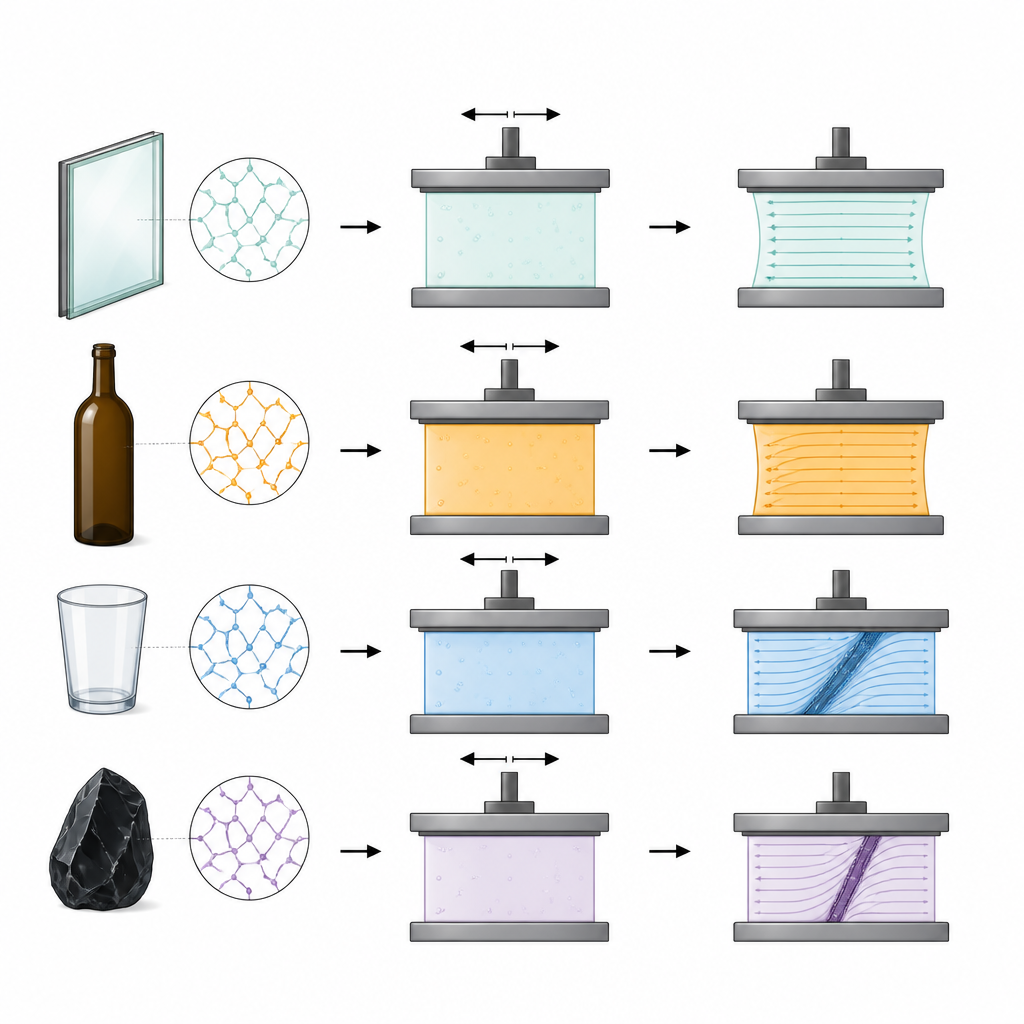
To explore this, the researchers simulate a wide variety of model glasses, including soft spheres, network-forming silica, molecular glass formers, granular-like packings, and metallic glasses. These cover a broad range of fragilities, a measure of how quickly a liquid’s flow slows on cooling. They find that in poorly annealed states all glasses behave alike: as the deformation amplitude grows, the steady energy first decreases then increases again at a critical strain, marking yielding. Below this critical preparation level, the yield strain is essentially fixed and does not depend on the sample’s history. Once samples are better annealed, however, a split appears. In fragile systems the yield strain increases strongly with further annealing, while in strong systems it barely changes, even though the microscopic interactions differ widely from model to model.
From gentle flow to sharp bands
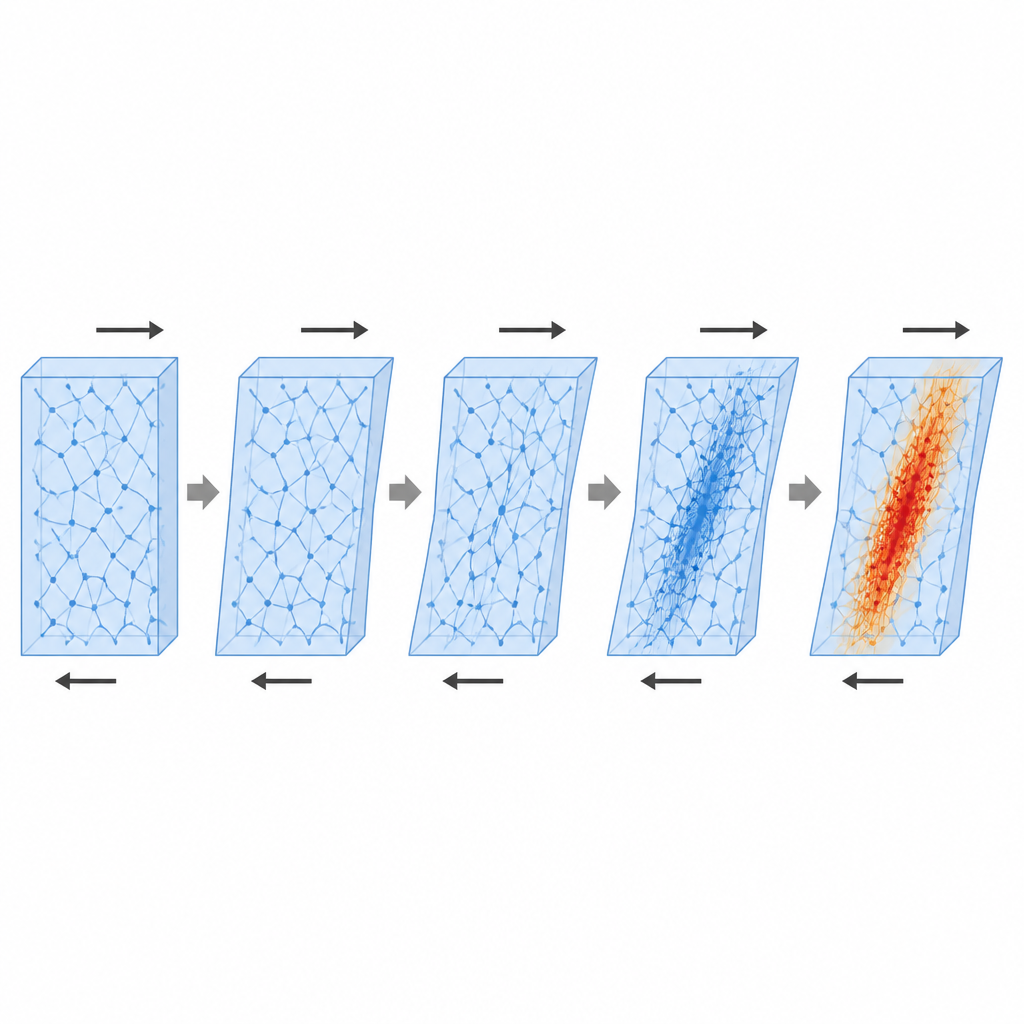
The way stress builds and then drops at yielding also reflects this divide. Strong glasses maintain a relatively smooth, ductile-like response, with modest stress drops and broad, diffuse zones of deformation. Fragile glasses, by contrast, display large, sudden stress drops that grow with annealing and are accompanied by narrow, sharply localized shear bands where most motion is concentrated. The authors track how many loading cycles a material needs to settle into a repeatable state and how many plastic rearrangements occur along the way. Strong glasses take more cycles and undergo more such rearrangements than fragile ones at comparable conditions, yet across all systems the time to reach steady behavior follows the same simple power-law relation with the number of plastic events, hinting at a shared underlying mechanism.
A simple model that captures the trends
To make sense of these diverse results, the authors build a mean-field elastoplastic model that treats the material as many independent mesoscopic blocks, each sitting in a local energy landscape. The crucial ingredient is how the average energy barrier for rearrangements grows as the glass is better annealed. In fragile systems, these barriers rise steeply with annealing; in strong systems, they increase only mildly and then saturate. With this single difference, the model reproduces the contrasting yielding diagrams, the changing yield strain, and the different time scales for strong and fragile glasses. By plugging in barrier values extracted from separate relaxation-time data, the model even predicts how the critical yield strain of a poorly annealed glass correlates with high-temperature barriers and the glass transition temperature.
What this means for tougher materials
For non-specialists, the central message is that how a glassy material breaks under repeated loading is already encoded in how its parent liquid flows. Liquids whose flow slows very sharply on cooling produce glasses whose yield strain and brittleness are highly sensitive to how carefully they were prepared, while more “strong” liquids lead to glasses whose yield behavior is robust. By tying these mechanical traits to energy barriers that can be inferred from liquid-state measurements, this work points toward a route for anticipating and tuning the failure properties of amorphous solids, from metallic glasses to molecular and granular materials.
Citation: Chatterjee, R., Adhikari, M. & Karmakar, S. Role of fragility of the glass formers in the yielding transition under oscillatory shear. Nat Commun 17, 4506 (2026). https://doi.org/10.1038/s41467-026-71157-w
Keywords: amorphous solids, metallic glass, yielding, oscillatory shear, glass fragility