Clear Sky Science · en
Energy, power, and infrastructure demands from electrifying airport ground support equipment at United States airports
Why airport service vehicles matter
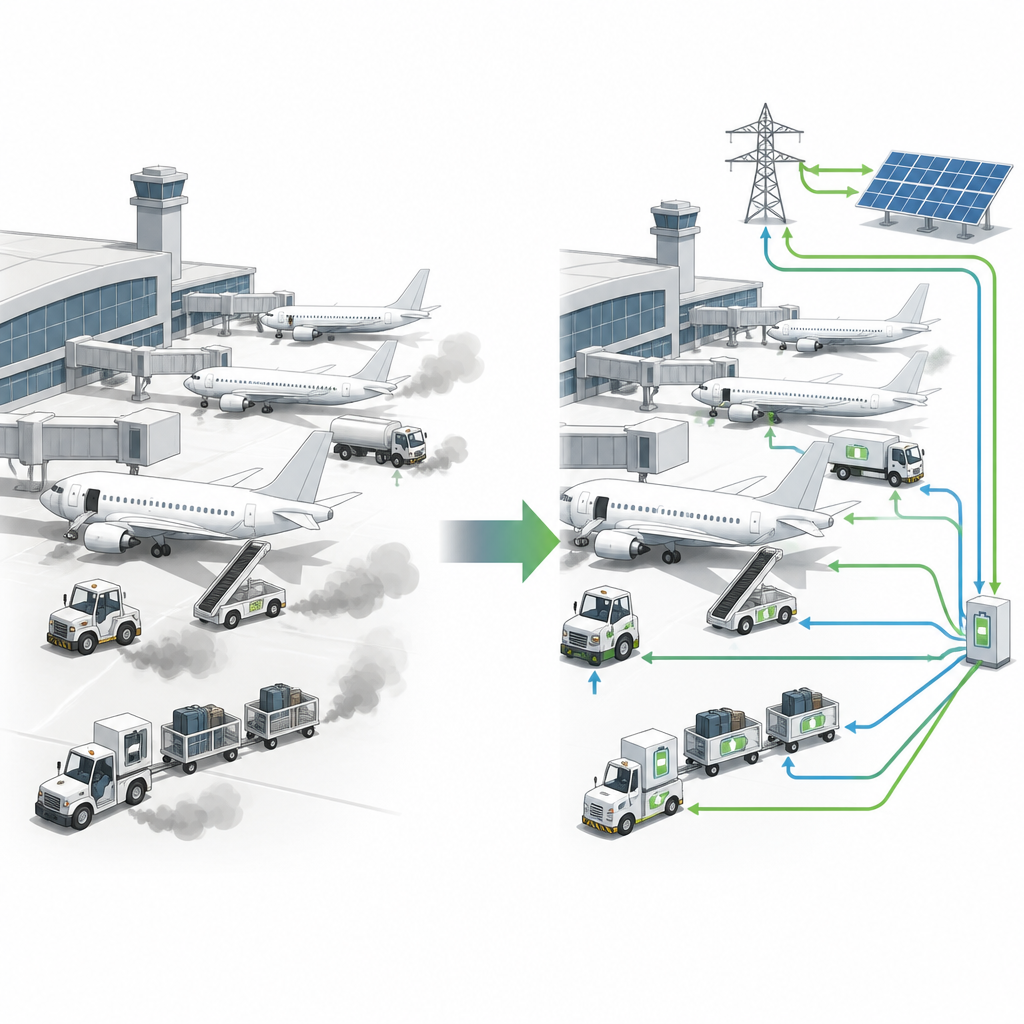
Most travelers think about jet engines when they picture airport pollution, but a hidden fleet of ground vehicles also burns large amounts of fuel. This study looks at what happens when those workhorses baggage tugs, belt loaders, power carts, catering and service trucks switch from diesel and gasoline to electricity at more than 300 airports across the United States. Understanding how much extra power these vehicles need, and how to supply it wisely, affects air quality, climate goals, and the cost of running airports.
The quiet machines under your window seat
Airports rely on ground support equipment to tow planes, move bags, load food, pump water, empty waste tanks, and power parked aircraft. Today many of these machines burn fossil fuels, contributing to local air pollution and greenhouse gas emissions in cities that already struggle with air quality. Electric versions of these vehicles are now available and are starting to appear at major airports. They are cheaper to run, quieter, and produce no exhaust at the tailpipe, making them attractive to both airlines and nearby communities.
Simulating a day in the life of an electric airport
The researchers built a detailed computer model that follows every arriving flight, assigns the needed mix of ground vehicles, and tracks when each electric vehicle works and when it plugs in to charge. They used government flight records for 317 U.S. airports, plus typical service times and battery sizes for eight types of ground equipment. This bottom up approach let them estimate, airport by airport, how many electric vehicles and chargers would be needed, how much electricity they would draw through the day, and how that demand would rise or fall under different charging habits.
How much power do electric fleets really need
The model shows that electrifying ground equipment can create very different electricity needs depending on airport size. At the biggest hubs, peak charging demand could reach up to about 20 megawatts roughly the output of a small power plant and yearly electricity use could approach 51,000 megawatt hours. Medium and small hubs need far less, and non hub airports stay under 1 megawatt. The timing of charging is just as important as the total energy. If vehicles charge opportunistically when they finish a job, power use tends to follow flight activity and spreads out over the day. If operators push most charging into night time off peak hours, demand bunches up into a short window that can create even higher peaks, though possibly at lower electricity prices.
Finding the right mix of vehicles, chargers, and timing
Different charging choices also change how many vehicles and chargers each airport needs to buy. Lower power chargers smooth out demand but keep vehicles plugged in longer, which means more chargers and sometimes more vehicles are required to keep flights on schedule. A strategy that charges immediately after every task tends to require more chargers but not more vehicles, while strict overnight charging demands both a larger fleet and many extra chargers to get everything ready before the morning rush. The study also looks at airports that power parked aircraft directly from the gate rather than using mobile power carts, which cuts both energy use and the number of electric carts needed.
Using solar panels and batteries to tame the peaks
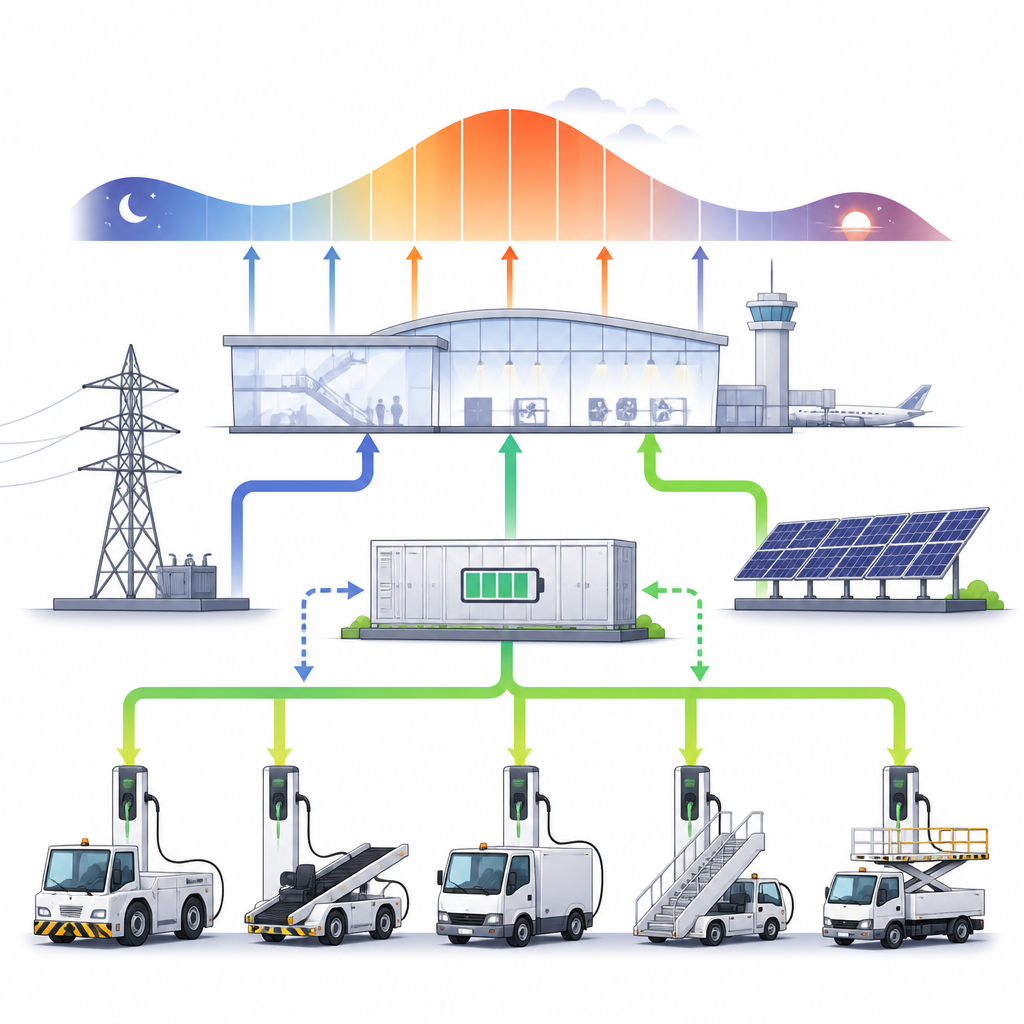
To see whether local clean energy could help, the team linked their airport load estimates to a separate tool that sizes rooftop solar and on site battery systems. For sample airports in each size group, they found that combining solar panels with stationary batteries can trim the sharpest power peaks by about 20 to 50 percent and lower long term costs by 5 to 20 percent, even after paying for the new equipment. The benefits are largest at smaller airports, where modest solar arrays and batteries can cover a big share of the charging demand.
What this means for future air travel
The study concludes that switching ground support equipment from fuel to electricity can greatly cut airport emissions, but it is not as simple as swapping engines. Airport operators, utilities, and planners need to coordinate on charging strategies, charger sizes, and possible use of solar and battery systems so that new electric loads do not overwhelm local grids or budgets. With careful planning, however, electric service vehicles can make airports cleaner and quieter while keeping planes, bags, and passengers moving smoothly.
Citation: He, Y., Kelly, K., Jeffers, M. et al. Energy, power, and infrastructure demands from electrifying airport ground support equipment at United States airports. Nat Commun 17, 4612 (2026). https://doi.org/10.1038/s41467-026-71125-4
Keywords: airport electrification, ground support equipment, electric vehicles, energy demand, solar and battery storage