Clear Sky Science · en
Small-molecule degraders for oncogenic KRASG12C and pan-KRAS mutations
Turning a Cancer Switch All the Way Off
Many tumors are driven by a faulty version of a protein called KRAS, a tiny molecular switch that tells cells when to grow. Doctors already have drugs that try to jam this switch, but cancers often adapt and become resistant. This study explores a different tactic: instead of just blocking KRAS, the researchers aim to get rid of the protein entirely, offering a fresh way to tackle stubborn cancers.
Why KRAS Matters in Cancer
KRAS sits at a key crossroads inside our cells, passing along growth signals that control when cells divide, specialize, or die. When KRAS carries certain mutations, it can become stuck in the “on” position, driving constant growth and contributing to many lung, colon, and pancreatic cancers. For decades, KRAS was viewed as nearly impossible to drug because it binds very tightly to its natural fuel and offers few good pockets for medicines to latch onto. Only recently have chemists learned to design small molecules that can bind to a specific mutant form called KRASG12C and hold it in an inactive state.
Limits of Current KRAS Blockers
Two KRASG12C-blocking pills are now approved, and several more are being tested in clinical trials. Yet their success is often short lived. Tumor cells can pick up new mutations in KRAS or reroute their signaling through other growth pathways, allowing them to escape. Another strategy, known as targeted protein degradation, tries to solve this by removing the problem protein altogether. Most such drugs, called PROTACs, are bulky molecules that link KRAS to a cellular “shredder” enzyme, but their large size can make it hard for them to slip into cells and work reliably across different tumor types. 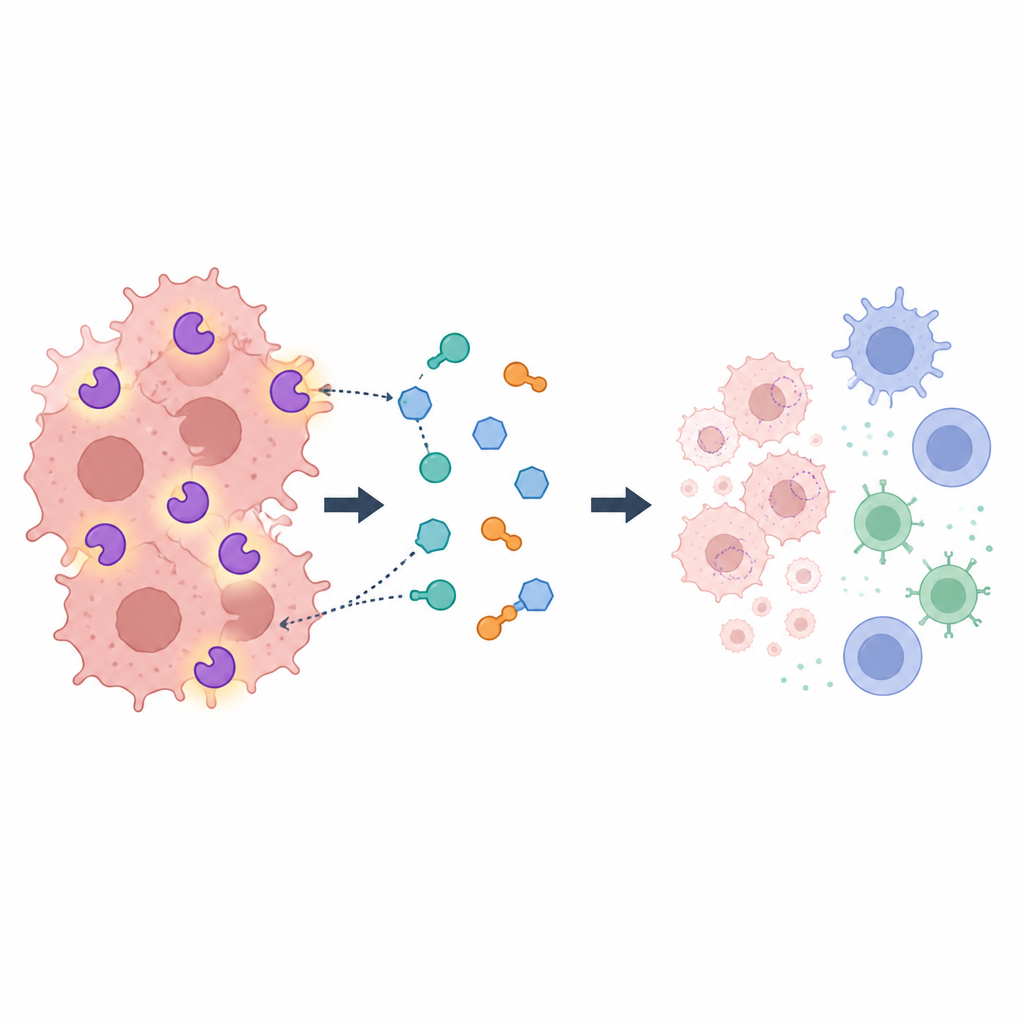
A Smaller Molecule That Erases KRASG12C
The researchers built on an existing KRASG12C blocker, adagrasib (MRTX849), and subtly altered it to create a series of new compounds. By attaching a small, reactive chemical group called an acrylamide in just the right position, they discovered DJX-A-KM, a compact molecule that not only binds KRASG12C but also calls in one of the cell’s natural disposal systems. In several cancer cell lines, DJX-A-KM caused rapid and almost complete loss of the mutant KRAS protein at very low doses, while leaving most other proteins untouched. This removal strongly dampened a major growth pathway linked to KRAS and slowed the proliferation of cancer cells more effectively than the original blocker.
How the Cellular Cleanup Crew Is Recruited
To understand how DJX-A-KM works, the team traced which proteins physically associate with KRAS after treatment. They found that the degrader helps form a three-part complex between KRASG12C and an enzyme called FBXO28, part of the cell’s tagging system for unwanted proteins. DJX-A-KM covalently attaches to both KRAS and a specific cysteine site on FBXO28, stabilizing their interaction. This brings KRAS close to the cell’s machinery that labels proteins for destruction and sends them to the proteasome, a molecular recycling barrel. Blocking this pathway with proteasome inhibitors stopped KRAS loss, confirming that the cell’s own waste-disposal system is doing the heavy lifting once DJX-A-KM has brought the pieces together. 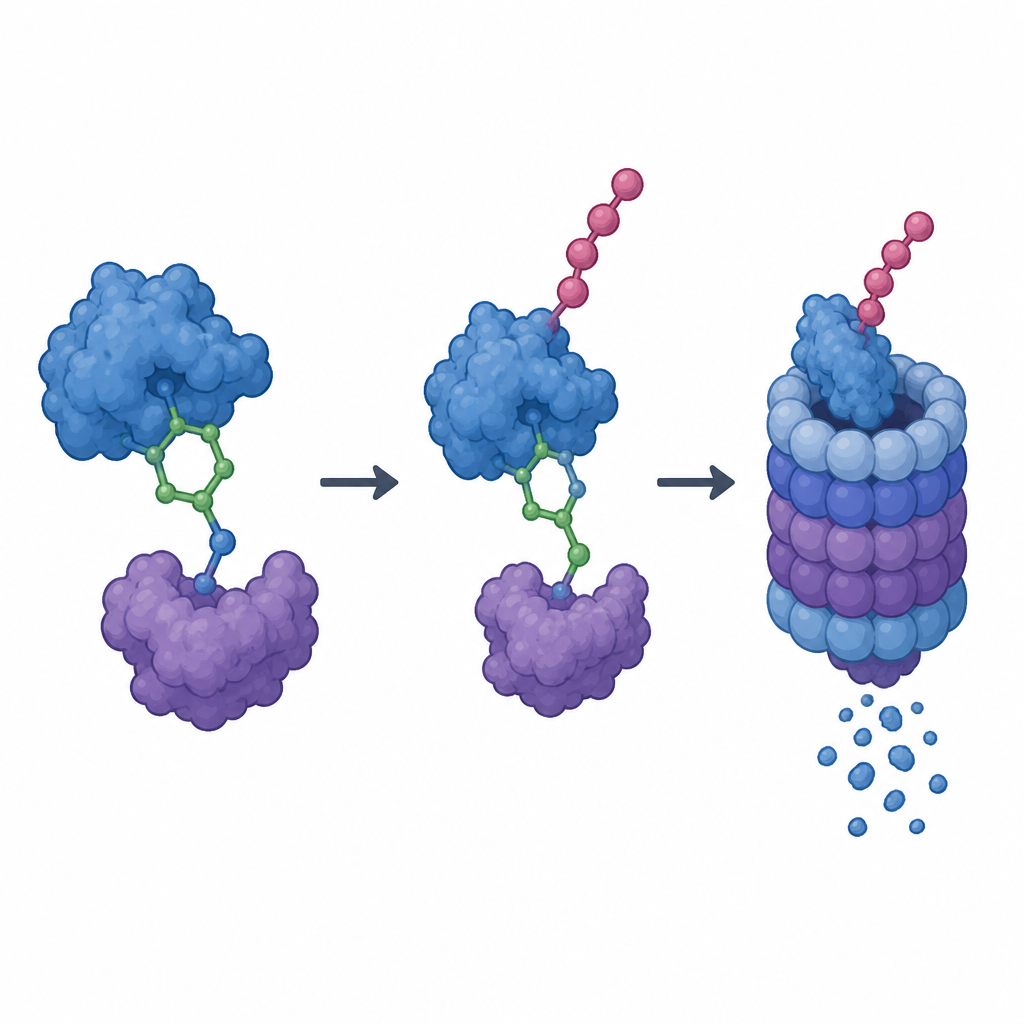
From One Mutant to Many
Encouraged by these results, the scientists asked whether the same design trick could be used more broadly. They transplanted the acrylamide “hook” into a different compound that can bind several KRAS mutants, creating a molecule named DS-01. In cancer cell lines carrying common KRAS changes such as G12D, G12V, and Q61H, DS-01 triggered strong reduction of the KRAS protein and lowered downstream growth signals. In mouse tumor models, both DJX-A-KM and DS-01 shrank tumors at tolerated doses and showed clear evidence of KRAS degradation in tumor tissue, suggesting that this approach can work in living animals, not just in dishes of cells.
What This Could Mean for Future Treatments
In simple terms, this study shows that it is possible to turn a KRAS blocker into a KRAS remover by adding a small chemical handle that enlists the cell’s own cleanup crew. DJX-A-KM provides a proof of concept that relatively small molecules can clear a hard-to-drug cancer driver and slow tumor growth in animals. The pan-KRAS degrader DS-01 hints that similar designs might be adapted to many KRAS mutations, not just one. While much work remains before such compounds could reach patients, the research outlines a blueprint for redesigning cancer drugs so they do not just silence dangerous proteins but make them disappear.
Citation: Deng, J., Shen, S., Huang, L. et al. Small-molecule degraders for oncogenic KRASG12C and pan-KRAS mutations. Nat Commun 17, 4425 (2026). https://doi.org/10.1038/s41467-026-71093-9
Keywords: KRAS, targeted protein degradation, small molecule degrader, cancer signaling, E3 ligase