Clear Sky Science · en
Achieving sub-pm wavelength regression via minimum-phase in a single-stream photonic IC
Why this tiny chip matters
Light underpins the internet, medical scanners, environmental monitors, and even atomic clocks. Many of these technologies need to know the color, or wavelength, of a laser with extreme accuracy. Today, that often means using bulky, delicate instruments that split light into many paths and take up a lot of space. This work shows how a millimeter-scale photonic chip can read out laser wavelength with accuracy finer than a trillionth of a meter, while using only a single path for light. That combination of precision and simplicity could help bring lab-grade optical tools into portable devices and future sensors on a chip. 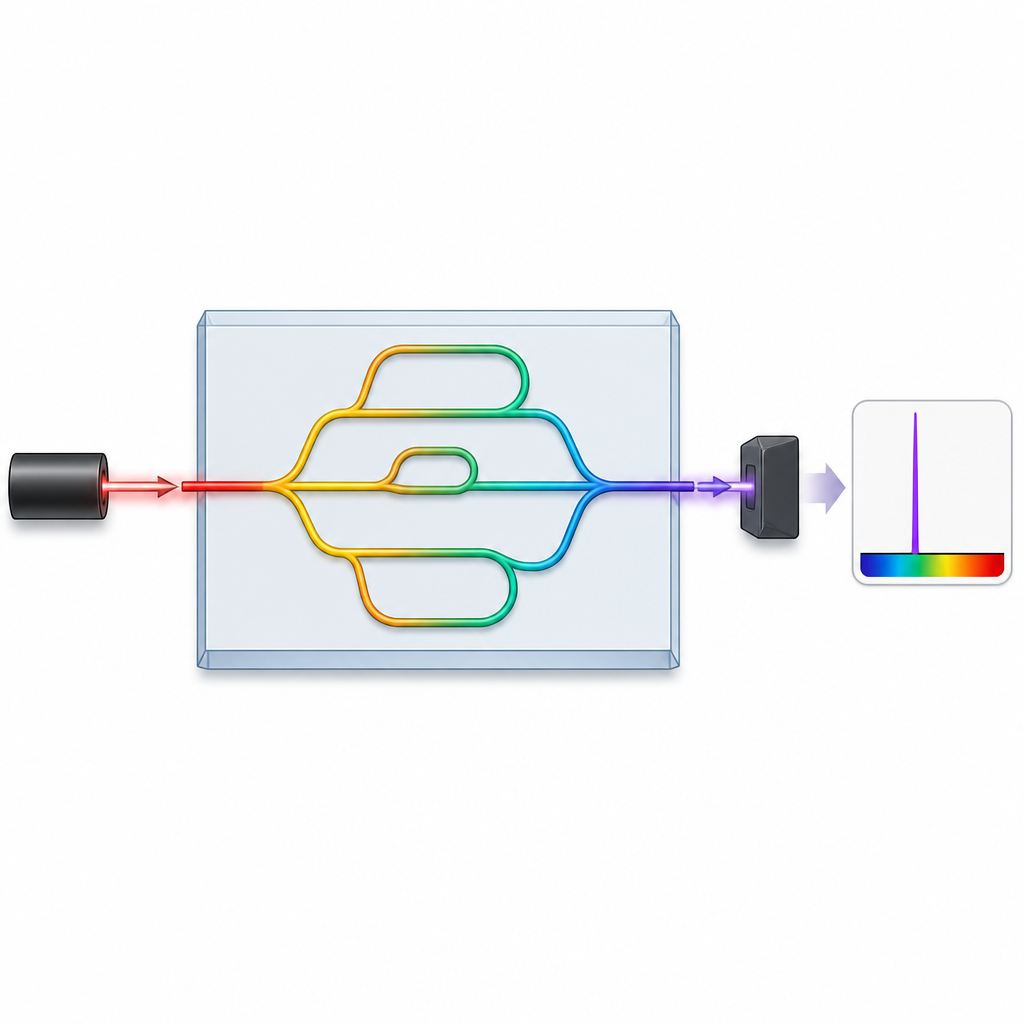
The challenge of reading light’s color
Conventional on-chip spectrometers juggle several trade-offs. Designs that spread light into many channels or use multiple optical cavities can reach high resolution, but they grow in size, lose signal strength, and become harder to manufacture. Approaches based on interferometers, which mix light traveling along slightly different paths, can be compact and cover a wide range of wavelengths. However, they usually look only at light intensity, not its phase, the hidden timing of the wave’s oscillations. Near interference nulls, where output intensity nearly vanishes, small errors become magnified, limiting how precisely wavelength can be read. Splitting light over many paths also lowers the signal-to-noise ratio, especially in tiny photonic circuits where every fraction of a decibel matters.
Listening to the hidden timing
The authors tackle this limitation by recovering phase information using only intensity measurements. They focus on a workhorse device called an asymmetric MachZehnder interferometer, in which light is split, sent along two paths of different lengths, and recombined. Under special “minimum phase” conditions, the shape of the intensity curve across wavelength is mathematically tied to the phase curve. By carefully choosing the splitting ratio and path length difference, the team derives a boundary condition that guarantees this minimum phase behavior. They then show, in simulations and in fabricated chips, that applying a Hilbert transform to the measured intensity allows them to reconstruct the phase with high fidelity over a practical wavelength range.
From raw signal to precise wavelength
Building on this, the researchers design algorithms that turn the recovered phase into an accurate wavelength reading. In a single-delay design, a known laser is first swept over a narrow range to calibrate the device. The intensity data are processed to extract a clean phase ramp, from which a simple linear model links phase slope to wavelength. When an unknown laser is later fed to the same circuit, the measured phase directly reveals its wavelength, achieving errors of only a few picometers. Tests with different chips and interferometer geometries show that matching the path length difference between calibration and measurement is key, because any change in that slope translates into a systematic shift in inferred wavelength. 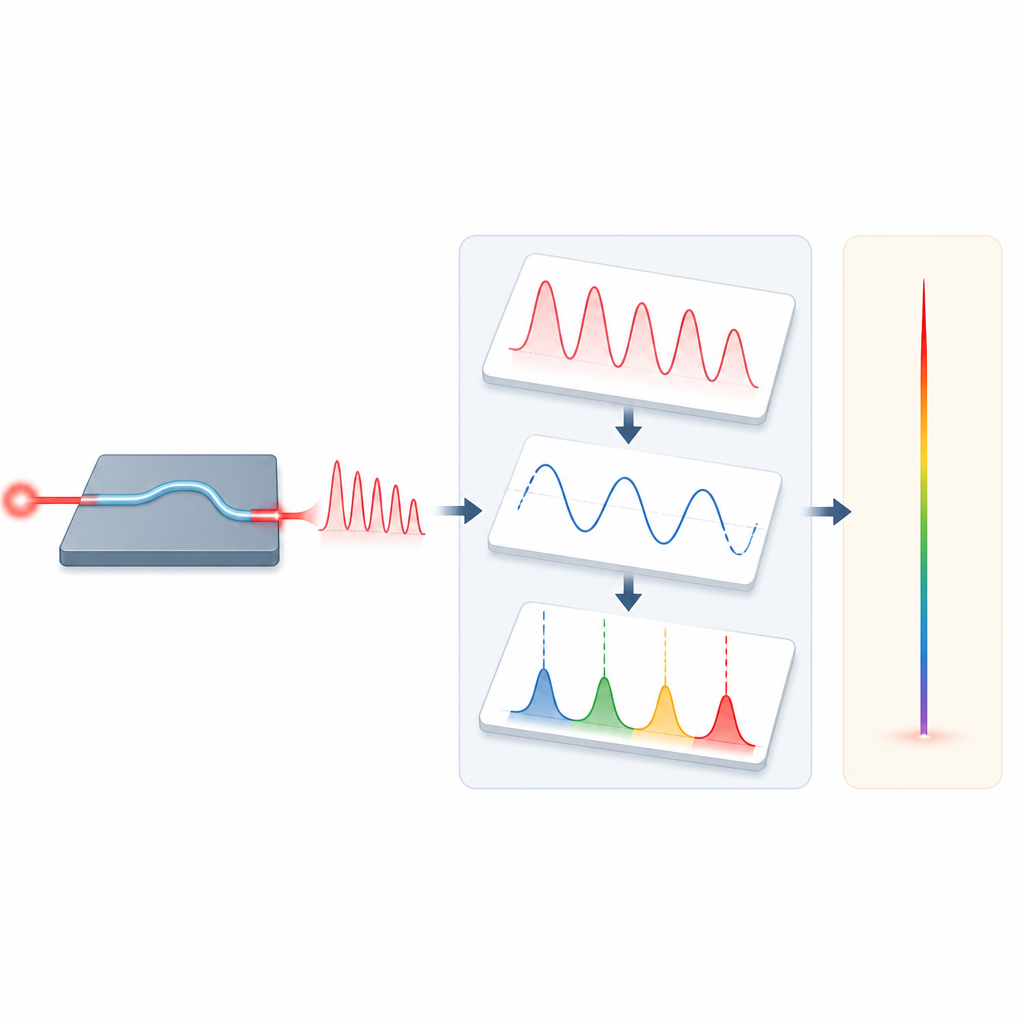
Stacking delays for a clearer picture
The authors then generalize the design to a more powerful structure that still uses just one input and one output. They build a sparse set of delay paths, each an integer multiple of a short reference path that sets the overall wavelength window. Longer paths respond more strongly to tiny wavelength changes, improving resolution. By analyzing the spectrum of the reconstructed signal, they isolate the contribution of each delay and model its phase with a second-order polynomial that includes dispersion, the slight wavelength dependence of light speed in the waveguide. A clever multi-stage algorithm first uses the shortest delay to fix the absolute wavelength region, then uses longer delays to refine the estimate. In experiments on a silicon nitride chip covering a 10 nanometer window, the final stage reaches sub-picometer root mean squared error.
What this means for future devices
In everyday terms, this work shows how to turn a single, compact light path into a highly accurate color meter by “listening” to the timing of light waves hidden inside intensity measurements. Instead of building ever more complicated multi-path spectrometers, the authors use mathematical structure and carefully engineered delays to pull phase information out of a simple signal. The result is a chip-scale wavemeter that can resolve shifts far smaller than the width of an atom, while remaining robust and relatively easy to fabricate. Such single-stream, minimum-phase designs could underpin future on-chip spectrometers, precision laser monitors, and optical sensors that bring high-end measurement capabilities out of specialized labs and into integrated systems.
Citation: Rubio Rivera, H.A., Neim, L., Deenadayalan, V. et al. Achieving sub-pm wavelength regression via minimum-phase in a single-stream photonic IC. Nat Commun 17, 4464 (2026). https://doi.org/10.1038/s41467-026-71087-7
Keywords: photonic chip, wavemeter, integrated spectrometer, minimum phase, laser wavelength sensing