Clear Sky Science · en
Domain gain or loss in a fungal chitinase enables specialization towards antagonism or immune suppression
How Friendly Fungi Help Plants Fight Germs and Stay Calm
Plants share their roots with entire underground communities of microbes, some helpful and some harmful. This study explores how a beneficial root-dwelling fungus fine‑tunes a single type of enzyme so that one version acts like a weapon against dangerous fungi, while a closely related version quietly disarms the plant’s own alarm system. Understanding this molecular balancing act could inspire better ways to protect crops without heavy chemical use.
Two Jobs for One Type of Enzyme
The researchers focused on a friendly root fungus called Serendipita indica, known to boost plant growth and protect roots from disease. Like many microbes, it produces chitinases—enzymes that cut chitin, a tough material that forms fungal cell walls and fragments that plants use as danger signals. The puzzle was why some of these chitinases seem to act in attack mode against rival fungi, while others appear to help the fungus slip past plant immunity. The team zoomed in on a conserved chitinase family and asked how small structural add‑ons, or domains, might steer each enzyme toward a different ecological role.
A Snap-On Grip Turns an Enzyme into a Fungal Shield
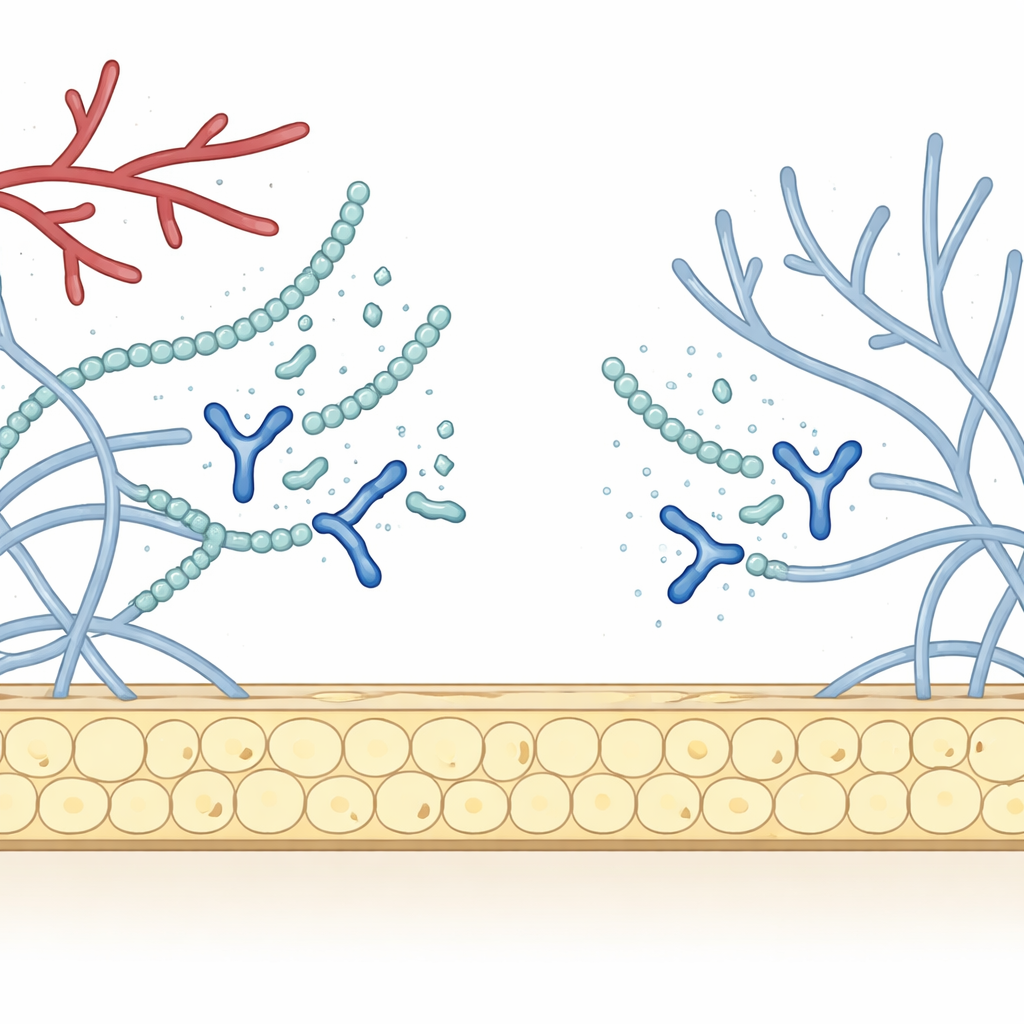
One enzyme, called SiCHIT, carries an extra attachment at its tail end known as a CBM5 domain. This add‑on acts like a gripping pad that helps the enzyme latch onto rigid, crystalline chitin in fungal cell walls. When the scientists trimmed off CBM5, the enzyme could still cut chitin in test tubes, but it lost its ability to bind tightly to solid chitin and to the cell walls of a pathogenic fungus, Bipolaris sorokiniana. Without this domain, SiCHIT no longer slowed the pathogen’s spore germination or protected barley and Arabidopsis roots from disease. Fusing the same CBM5 module onto a related chitinase restored strong antifungal activity and plant protection, showing that this small domain is a modular part that can turn a basic enzyme into a targeted defensive tool.
A Leaner Version Calms the Plant Alarm System
Right next to SiCHIT in the fungus’s genome sits its close relative SiCHIT2, which shares much of the same catalytic core but naturally lacks the CBM5 grip. Unlike SiCHIT, SiCHIT2 is not switched on during battles with other fungi. Instead, it is highly active when the fungus colonizes plant roots across several host species. Experiments with plant roots revealed that SiCHIT2 excels at cutting small, soluble chitin fragments that normally trigger a burst of reactive oxygen species—a rapid “flash” of plant defense. When chitin pieces were pre‑treated with CBM5‑free versions of the enzyme, the defense burst was strongly reduced, and Serendipita colonized roots more effectively. The presence of CBM5, in contrast, biased the enzyme toward attacking solid cell walls and away from rapidly clearing these immune‑activating fragments.

Evolution by Adding and Removing Parts
To place these findings in a broader evolutionary context, the team surveyed related chitinases across many fungi. They found that enzymes combining the catalytic core with CBM5 are common in certain fungal groups and often appear in clusters of duplicated genes. Some duplicates have kept the CBM5 domain, while others, like SiCHIT2, have lost it. At the same time, the regulatory “on–off” switches of these genes have diverged, so that one copy is induced during microbial confrontation in the soil, while another is activated inside plant roots. This pattern supports a scenario in which gene duplication, followed by gain or loss of domains and rewiring of expression, allowed an ancient, antimicrobial enzyme to be repurposed for immune suppression in a mutualistic lifestyle.
What This Means for Plant Health
In everyday terms, this work shows how a helpful fungus can carry two versions of essentially the same tool, each tuned for a different job. With its CBM5 add‑on, one chitinase becomes a precision chisel that attacks the walls of competing fungi and shields roots from infection. Stripped of that extra grip, the sister enzyme shifts roles, quickly shredding the chitin crumbs that would otherwise set off the plant’s alarm, allowing the fungus to settle in peacefully. By revealing how simple changes in protein “attachments” and timing of gene activity can redirect enzyme function, the study highlights an elegant strategy that root‑friendly fungi use to juggle both defense against enemies and harmony with their plant hosts.
Citation: Eichfeld, R., Endeshaw, A.B., Hellmann, M.J. et al. Domain gain or loss in a fungal chitinase enables specialization towards antagonism or immune suppression. Nat Commun 17, 3115 (2026). https://doi.org/10.1038/s41467-026-71064-0
Keywords: root microbiome, fungal endophyte, plant immunity, chitinase, crop protection