Clear Sky Science · en
Structural and evolutionary insights into the eukaryotic RNase MRP ribonucleoprotein complex
How a Tiny Cell Machine Shapes Growth and Health
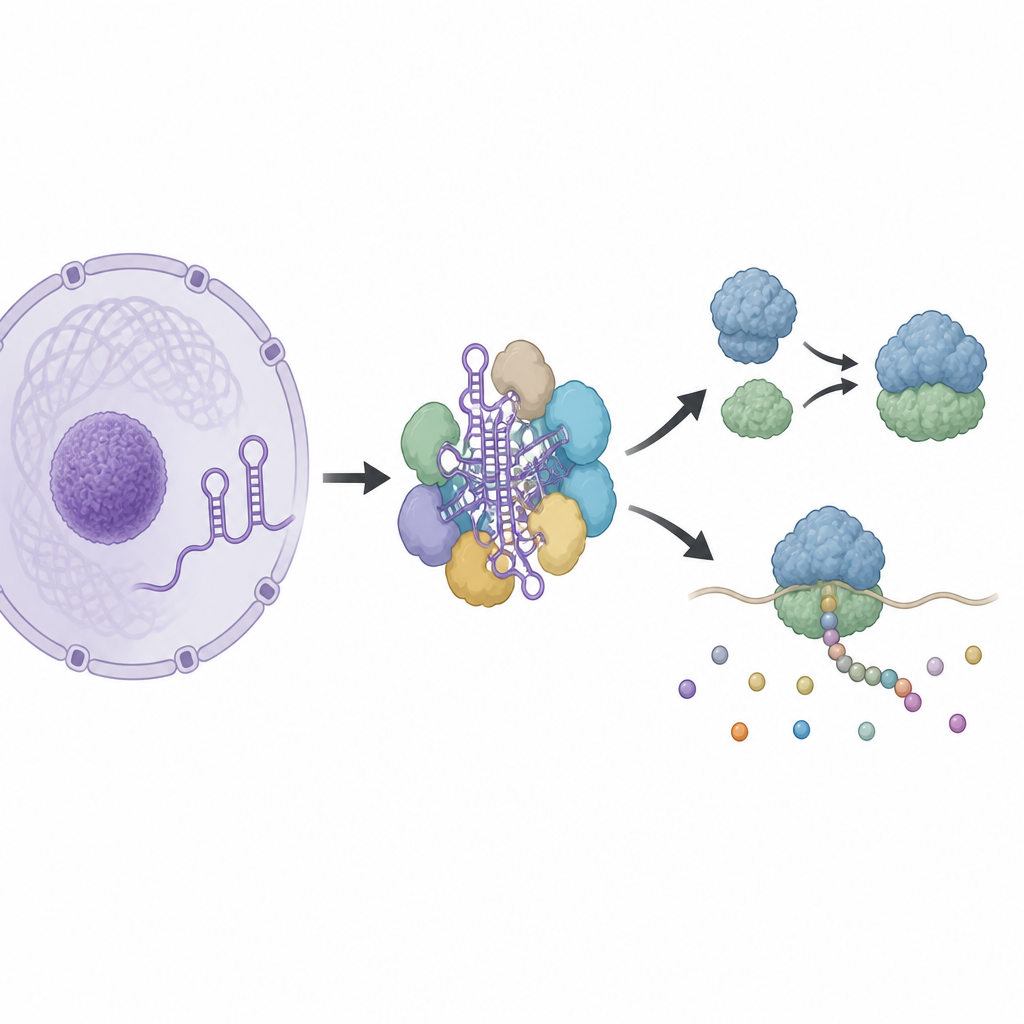
Every cell in our body must build ribosomes, the molecular factories that make proteins. When this construction process goes wrong, it can lead to problems in growth, bone formation, and immunity. This study uncovers how a little-known cell machine called RNase MRP is built, how it recognizes its RNA targets, and why faults in its parts are linked to rare skeletal disorders.
Finding Hidden Parts of a Cell’s Cutting Tool
RNase MRP is a molecular cutter that trims long precursor RNA strands into pieces that will become part of new ribosomes. For years, researchers knew its overall job but not its full make-up in human cells. Earlier work in yeast suggested that RNase MRP contains specialized proteins not shared with its relative RNase P, another cutter that works on transfer RNAs. However, those yeast-only proteins seemed to be missing in other species. In this study, the authors used three-dimensional structural searches, rather than simple sequence comparisons, to scan predicted protein databases across many organisms. They discovered that two human proteins, called NEPRO and C18orf21 (renamed RMP64 and RMP24), are structural twins of the yeast factors, even though their amino acid sequences look quite different.
Proving the New Pieces Are Essential
To test whether these newly identified proteins truly belong to human RNase MRP, the team purified protein complexes from cells and checked what traveled together. RMP64 and RMP24 consistently appeared only with the RNA subunit of RNase MRP and not with the RNA from RNase P. Activity tests showed that complexes containing RMP64 and RMP24 cut a ribosomal RNA segment but not transfer RNA, while RNase P complexes showed the opposite behavior. When the researchers reduced the levels of RMP64 or RMP24 in human cells, the cells accumulated uncut precursor ribosomal RNA, had trouble assembling ribosomes, made fewer new proteins, and grew more slowly. In mouse bone marrow stem cells, loss of Rmp64 also impaired cartilage formation, mirroring patient symptoms linked to mutations in this gene.
Seeing the Full Shape of the Machine
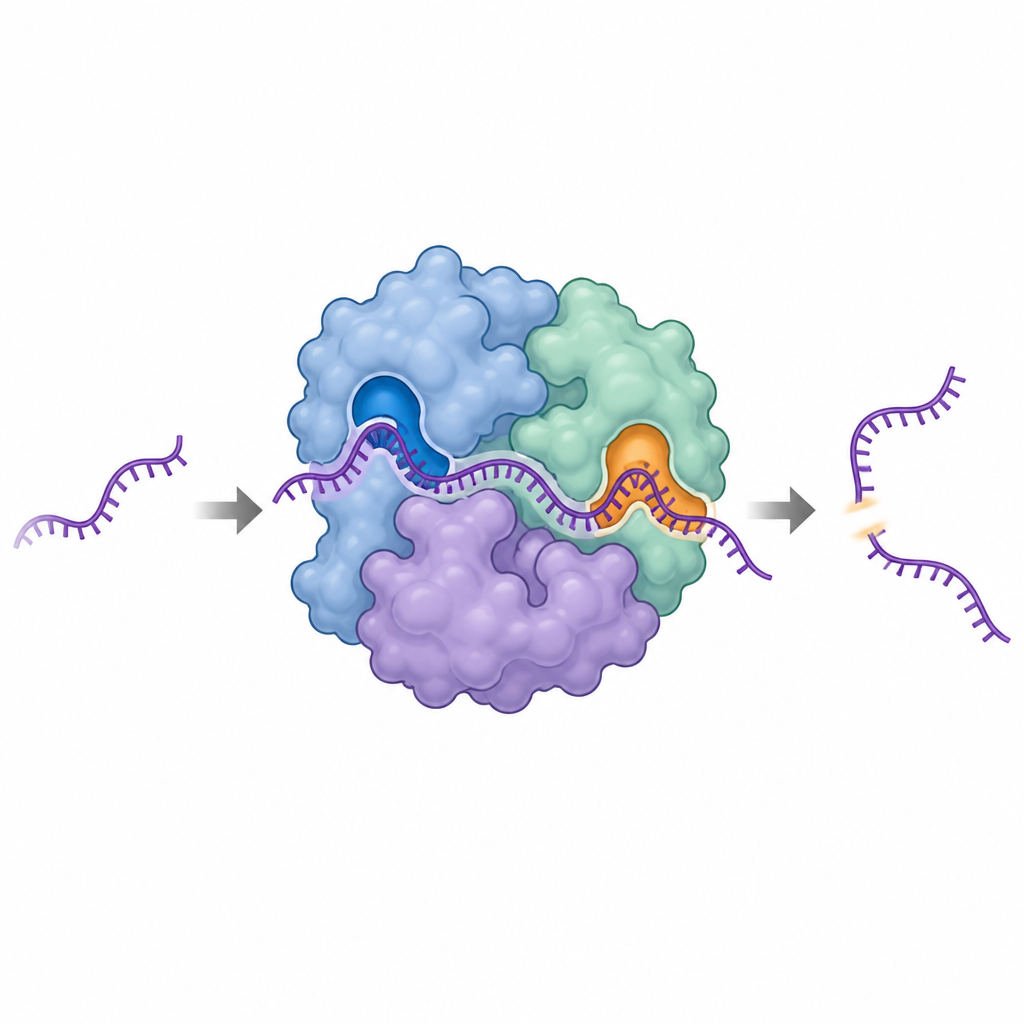
Using high-resolution cryo-electron microscopy, the authors visualized the three-dimensional structure of human RNase MRP. They found that an RNA scaffold called RMRP weaves through a hook-like ring of eleven proteins, including RMP64 and RMP24. The complex has a large lobe containing the catalytic heart and a smaller, more flexible lobe that helps position the RNA. Although RNase MRP and RNase P share a conserved catalytic core, RNase MRP has unique structural features in both its RNA and proteins. These include a short stem near the active center, a distinctive small RNA loop with a purine-rich sequence, and a special trio of proteins anchored on top. Together, these features reshape the surface near the active site so that it can grip single-stranded RNA, rather than the stiff double-helical regions favored by RNase P.
A Double Grip for Flexible RNA
The most striking insight from the structure is a “double-anchor” mode of binding. The team’s experiments with a human ribosomal RNA segment show that RNase MRP recognizes a short stretch of six nucleotides around the cut site. At one end of this stretch, a conserved RNA segment called CR-IV stacks against the substrate and acts as a first anchor. At the other end, a pocket made of both RNA and protein, including RMP64 and the large protein POP1, cradles a specific nucleotide in position. Between these two anchors, additional protein side chains mimic the role of a complementary RNA strand, shaping the flexible single strand into a configuration that closely resembles the strand cut by RNase P. Mutations in key anchor residues disrupt this handling step, leading to processing defects in cells and matching disease-causing variants seen in patients.
Tracing Evolution’s Reworking of an Ancient Enzyme
By comparing RNase MRP and RNase P across species, the authors propose that both complexes descended from an ancient ribozyme that mostly handled transfer RNAs. Over time, one branch, RNase P, kept a rigid recognition system tuned to a fixed transfer RNA shape. The other branch, RNase MRP, remodeled its RNA loops and added new proteins such as RMP64 and RMP24 to create a more adaptable binding groove for single-stranded RNA. This redesign lets RNase MRP recognize a wider variety of RNA pieces while keeping the same chemical cutting core. In simple terms, evolution took an old cutting tool and re-engineered its handle and jaws so that it could hold softer, more flexible materials without changing the blade itself.
Why This Matters for Human Disease
The study shows that growth and bone disorders linked to mutations in RMRP, RMP64, and POP1 often strike the very residues that form or stabilize the two anchors that hold RNA during cutting. This explains how small changes at the molecular level can ripple out to defects in ribosome production, reduced protein synthesis, and impaired cartilage development. By revealing the full structure and working logic of human RNase MRP, the work offers a clear framework for understanding existing disease mutations and for interpreting new variants as they are discovered.
Citation: Zhou, B., Wang, X., Wan, F. et al. Structural and evolutionary insights into the eukaryotic RNase MRP ribonucleoprotein complex. Nat Commun 17, 4451 (2026). https://doi.org/10.1038/s41467-026-71007-9
Keywords: RNase MRP, ribosome biogenesis, single-stranded RNA, structural biology, cartilage-hair hypoplasia