Clear Sky Science · en
Cross-order detection of bacteriophage transduction in microbial communities using RNA barcoding
Viruses that quietly rewrite microbial life
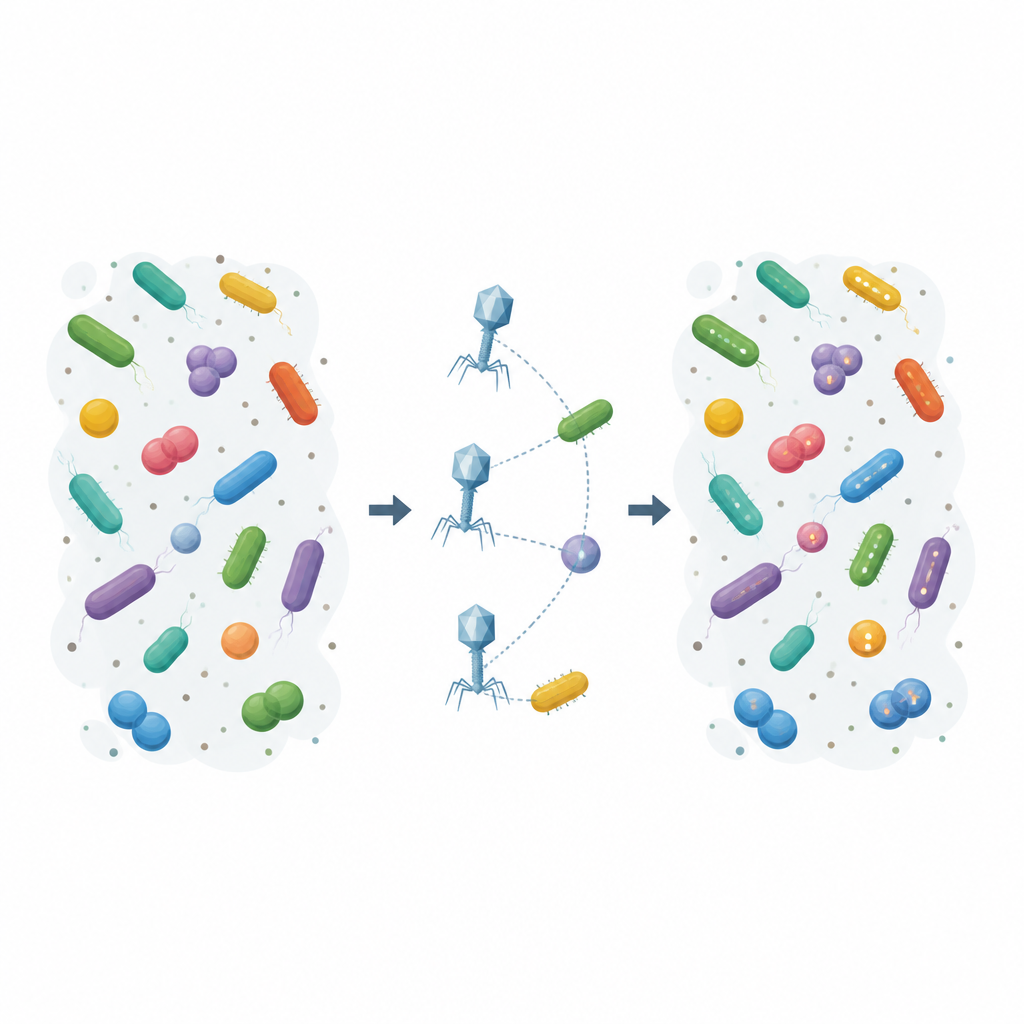
Invisible armies of viruses constantly swap genes among bacteria in our guts, waterways, and soils, reshaping ecosystems and influencing human health. Yet scientists have struggled to see which virus infects which microbe, especially in messy real-world communities like wastewater. This study introduces a clever molecular notepad built into a virus that lets researchers record who infected whom, revealing hidden connections that could guide safer antimicrobial therapies and microbiome engineering.
Why tracking tiny gene couriers matters
Bacteriophages, or phages, are viruses that infect bacteria. They can kill their hosts or quietly deliver new genes, including antibiotic resistance genes or useful metabolic traits. With an estimated 1031 virus particles on Earth, they are central players in the evolution and behavior of microbial communities. Phages are also being explored as targeted alternatives to antibiotics and as delivery vehicles for genetic tools. To use them wisely, however, scientists must know which bacteria each phage can infect inside complex communities, not just in pure lab cultures.
Limitations of older detective methods
Traditional approaches to mapping phage–host pairs rely heavily on plaque assays, which only work when both virus and host can be grown and tested one by one in the lab. Other methods can show which phages stick to bacterial surfaces, or link viral DNA to bacterial genomes, but they often require extensive sample handling, specialized instruments, or costly sequencing of entire communities. Many of these tools also have trouble distinguishing a virus that merely touches a cell from one that successfully delivers DNA inside it, which is the key step for gene transfer.
A molecular barcode written into bacterial RNA
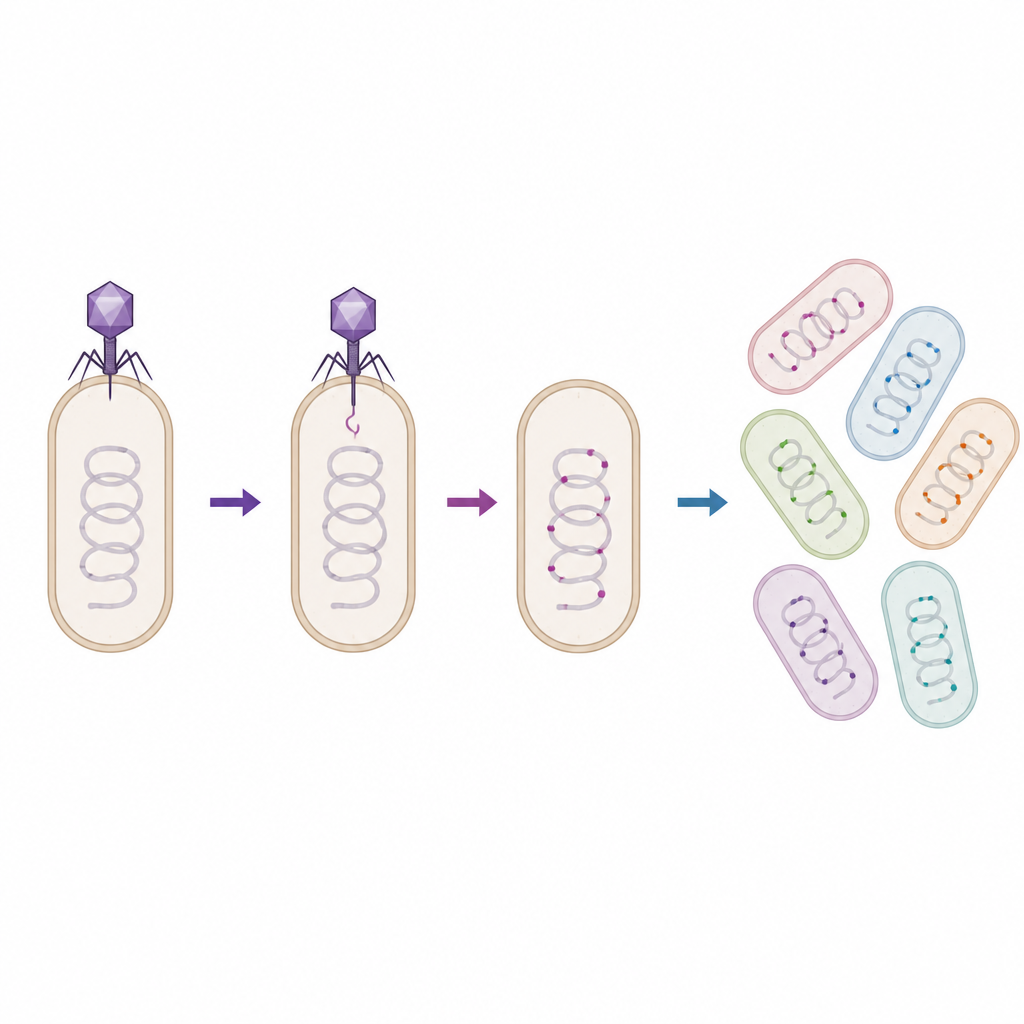
The team adapted a synthetic biology tool called RNA-addressable modification, or RAM, to solve this problem. They engineered a common phage named P1, and related phage-derived particles called phagemids, to carry a small RNA machine known as a ribozyme. When the engineered virus successfully enters a bacterial cell, this ribozyme attaches a short artificial “barcode” onto the cell’s 16S ribosomal RNA, a molecule found in all bacteria and widely used for species identification. Later, researchers can selectively sequence these barcoded RNA pieces to read out which community members were actually transduced, using standard laboratory workflows.
Revealing hidden hosts in lab and wastewater communities
First, the authors showed that P1 and RAM-carrying phagemids could reliably tag infected cells in several well-known gut bacteria, and that the strength of the barcode signal reflected differences in how well each construct spread. They then turned to an eight-species synthetic community containing important human-associated pathogens and relatives. In this setting, the RAM system recorded which bacteria received viral DNA, uncovering new transduction events, including stable delivery of a broad-host-range phagemid into Salmonella enterica. Because the barcode is written into RNA produced by the host, the method could detect infections even when the usual antibiotic selection tricks could not be used.
Discoveries from a real-world microbial soup
The researchers next applied their barcoded P1 particles to a wastewater influent community rich in diverse microbes. Sequencing of barcoded RNA revealed that roughly half of the detectable bacterial sequence variants in this environment had received viral DNA from at least one of the constructs. Strikingly, the method flagged Aeromonas, a common wastewater genus, as a previously unrecognized host for P1. Follow-up experiments with isolated Aeromonas strains confirmed that at least one species could indeed be transduced and produced barcoded RNA, demonstrating how this strategy can uncover new virus–host links that standard culturing would miss.
How viral tail design reshapes the infection map
Beyond cataloging hosts, the team used the RAM system to probe what controls which bacteria P1 can infect. They focused on two naturally switchable tail fibers on the virus, which recognize different sugar structures on bacterial surfaces. By constructing particles that carried one tail type or the other, and then tracking barcoded RNA in wastewater communities, they showed that these alternative tails produced distinct infection profiles. For example, particles with the S′ tail favored certain gut-related genera such as Enterobacter and Klebsiella, while mixtures containing both tails reached an even broader set of targets, including Aeromonas and Acinetobacter.
What this means for future phage tools
Together, these experiments establish RNA barcoding as a flexible, scalable way to read out who phages infect in complex, uncultivated communities. The method relies on short targeted sequencing rather than full metagenomes, lowering cost while retaining the ability to assign hosts at roughly the species or genus level. Although it does not yet distinguish among very closely related strains or guarantee that a virus completed its entire life cycle, it offers a practical blueprint for screening large panels of engineered phages or tail fiber designs. In the long run, such barcoded phages could help researchers match viral therapies to problem bacteria more precisely and understand how viral gene shuttling shapes the health and stability of microbiomes.
Citation: LaTurner, Z.W., Dysart, M.J., Schwartz, S.K. et al. Cross-order detection of bacteriophage transduction in microbial communities using RNA barcoding. Nat Commun 17, 4308 (2026). https://doi.org/10.1038/s41467-026-70995-y
Keywords: bacteriophage, microbiome, RNA barcoding, horizontal gene transfer, wastewater bacteria