Clear Sky Science · en
The role of the Helmholtz potential on electrocatalytic activity
Why this tiny boundary matters
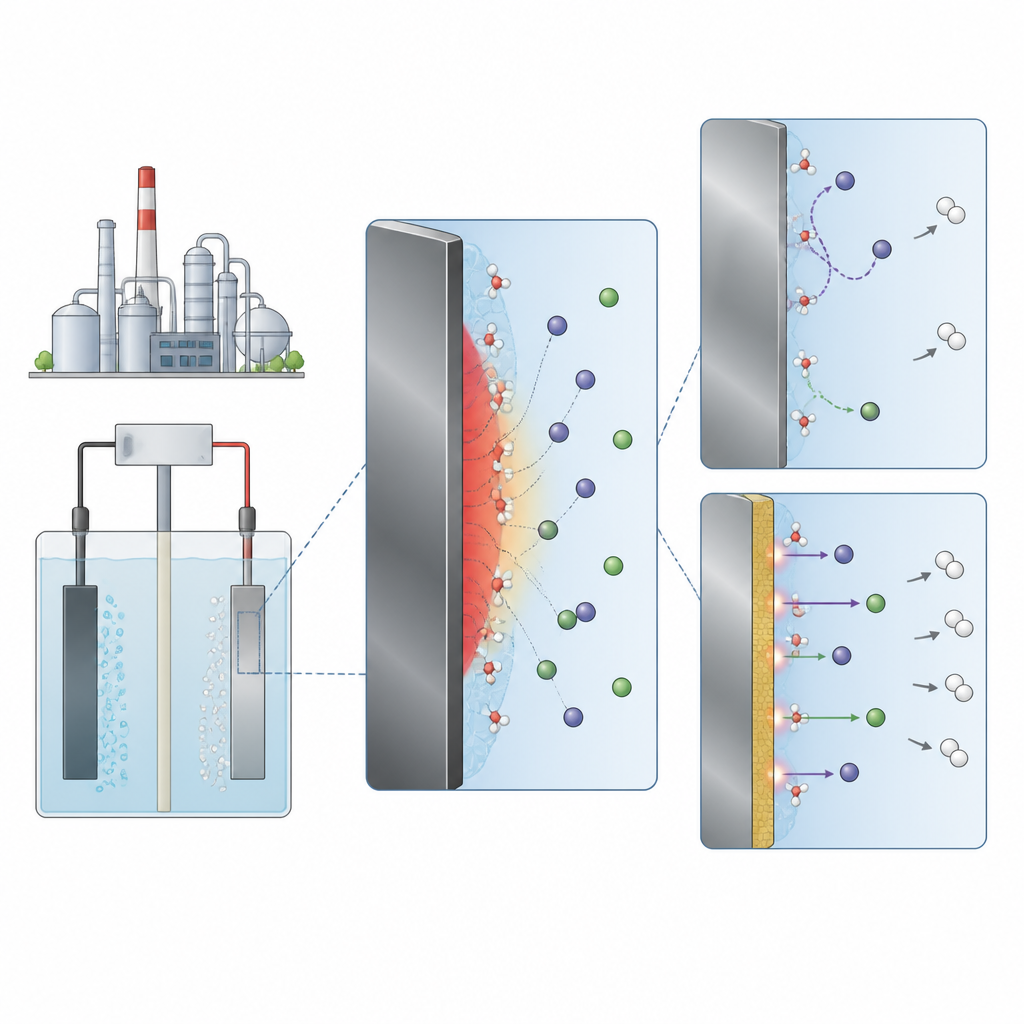
Turning water into hydrogen fuel may sound straightforward: add electricity and bubbles appear. Yet the real action happens in a nanometer thin region where the metal electrode meets the liquid. This paper shows that the electric landscape in that narrow zone, known as the Helmholtz layer, can either slow reactions down or let them run far more easily. By learning to tune this invisible barrier, we can design cheaper and more efficient catalysts for devices such as electrolyzers and fuel cells.
From precious metals to smarter surfaces
Industry wants to replace scarce metals like platinum and iridium with cheaper options while still making hydrogen quickly and efficiently. Earlier experiments revealed something puzzling: adding a sprinkling of nickel hydroxide clusters on top of metal electrodes made reactions such as hydrogen evolution much faster, even when the base metal itself was not very active. At first, scientists explained this as a local chemical teamwork between the metal and the nickel hydroxide. But later studies showed that the reaction rate did not simply track how much edge between the two materials was present, hinting that a more global surface effect was at play.
Seeing the hidden voltage wall
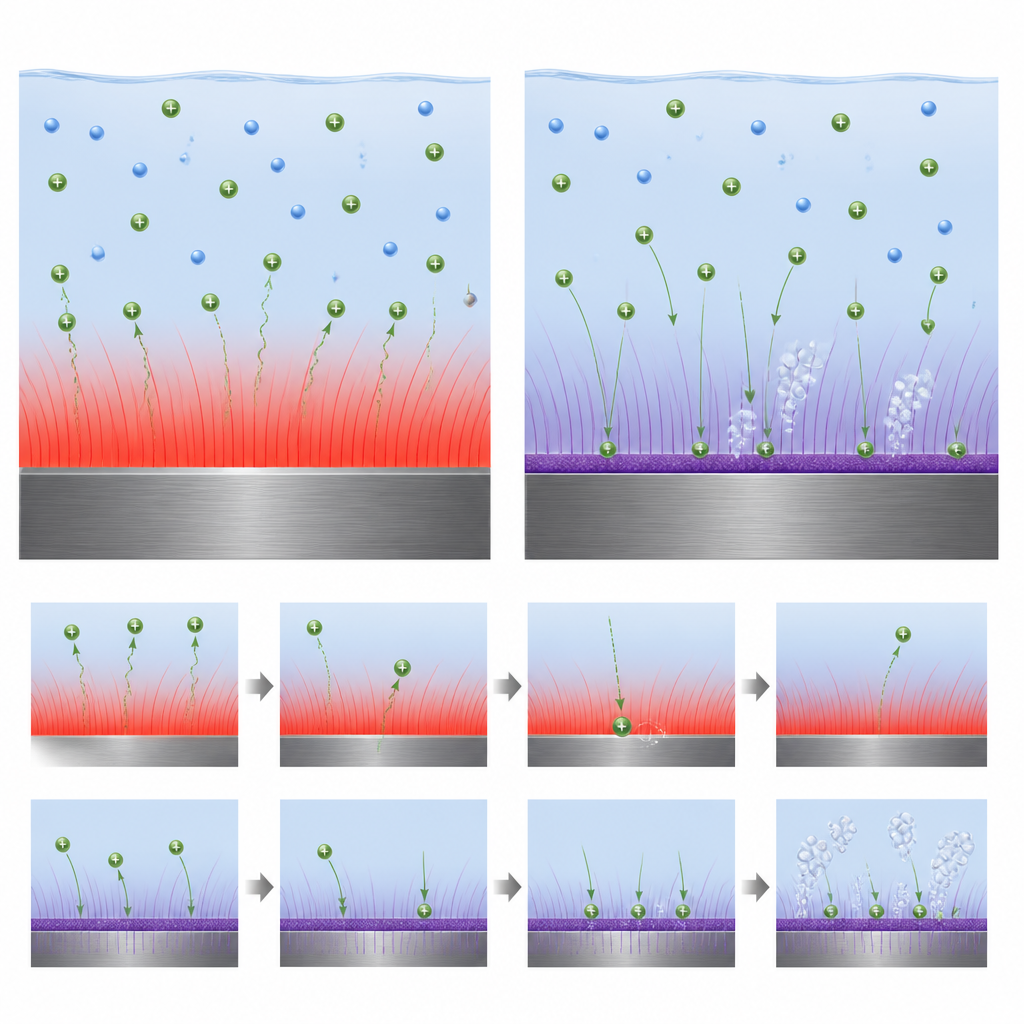
The authors focus on the electric potential drop that naturally forms when a metal touches an electrolyte. Electrons in the metal and charges in the liquid rearrange until they reach balance, leaving behind a compact layer of separated charge at the interface. This charged zone, described here as the Helmholtz potential, acts like an energy wall that ions must climb to reach the surface and react. When that wall is high, reactive ions such as protons are pushed away from the metal, and the surrounding water molecules become more ordered and rigid, making charge transfer harder. When it is low, ions crowd the surface and the water network is more flexible, helping the reaction along.
Linking surface voltage to reaction speed
To capture this behavior, the researchers extend the classic Butler–Volmer equation, a standard tool for describing how current depends on applied voltage in electrochemistry. They add an explicit term for the Helmholtz potential, which depends on how the metal’s work function compares to the chemical potential of the electrolyte. Working through this framework, they show that for the hydrogen evolution reaction the measurable “extra voltage” needed to drive a given current scales almost linearly with the Helmholtz potential. When they feed in experimental data for many different metals, the points fall on the predicted line whenever the interfacial barrier is the main limiting factor. From the fit, they deduce a physical upper limit for how fast an ideal metal surface could drive hydrogen evolution under typical conditions.
How a thin film softens the barrier
The study then turns to a particularly useful trick: placing an ultrathin semiconductor film, only one to ten nanometers thick, on top of a metal. Because semiconductors hold charge differently from metals, they can absorb a large portion of the potential drop inside the solid rather than in the liquid. The model shows that such a film can shrink the Helmholtz potential at the outer surface by more than half, depending on its thickness, charge carrier density, and dielectric constant. When the film is doped so that plenty of mobile charges are available, the interface starts to behave almost like a metal but with a much friendlier electric landscape for ions. This helps explain why nickel hydroxide and related coatings on metals like platinum or gold so often boost hydrogen evolution, hydrogen oxidation, and oxygen reduction rates.
Design rules for better catalysts
From this combined theory and data analysis, the authors propose simple guidelines for building improved electrochemical interfaces. First, choose or modify electrode materials so that their work function closely matches the electrolyte’s chemical potential, which naturally lowers the Helmholtz barrier. Second, use thin semiconductor or hydroxide layers with suitable band positions and high charge carrier densities to pull part of the potential drop into the solid and raise the local ion concentration. Third, fine tune the electrolyte composition itself to shift its chemical potential. Once the unwanted surface barrier is minimized, traditional surface chemistry rules, such as the Sabatier principle that balances how strongly intermediates bind, can be used to refine the catalyst. In plain terms, the paper argues that controlling the invisible voltage step at the solid–liquid boundary is just as important as picking the right atoms on the surface, offering a clear roadmap for designing the next generation of electrocatalysts.
Citation: Chemin, A., Godeffroy, L., Amans, D. et al. The role of the Helmholtz potential on electrocatalytic activity. Nat Commun 17, 4547 (2026). https://doi.org/10.1038/s41467-026-70980-5
Keywords: hydrogen evolution reaction, electrocatalysis, Helmholtz potential, thin film catalysts, electrochemical interface
See more on the researcher's website: https://www.arsenechemin.com/