Clear Sky Science · en
Biologically inspired microlens array camera for high-resolution wide field-of-view imaging
Seeing More in Tight Spaces
From smartphones to medical probes, cameras are often squeezed into ever smaller spaces while we still expect sharp, wide views of the world. This research describes a paper-thin camera that borrows tricks from an unusual insect’s eyes to capture detailed, panoramic images where bulky lenses cannot fit, opening paths for new tools in robotics, healthcare, and wearable devices. 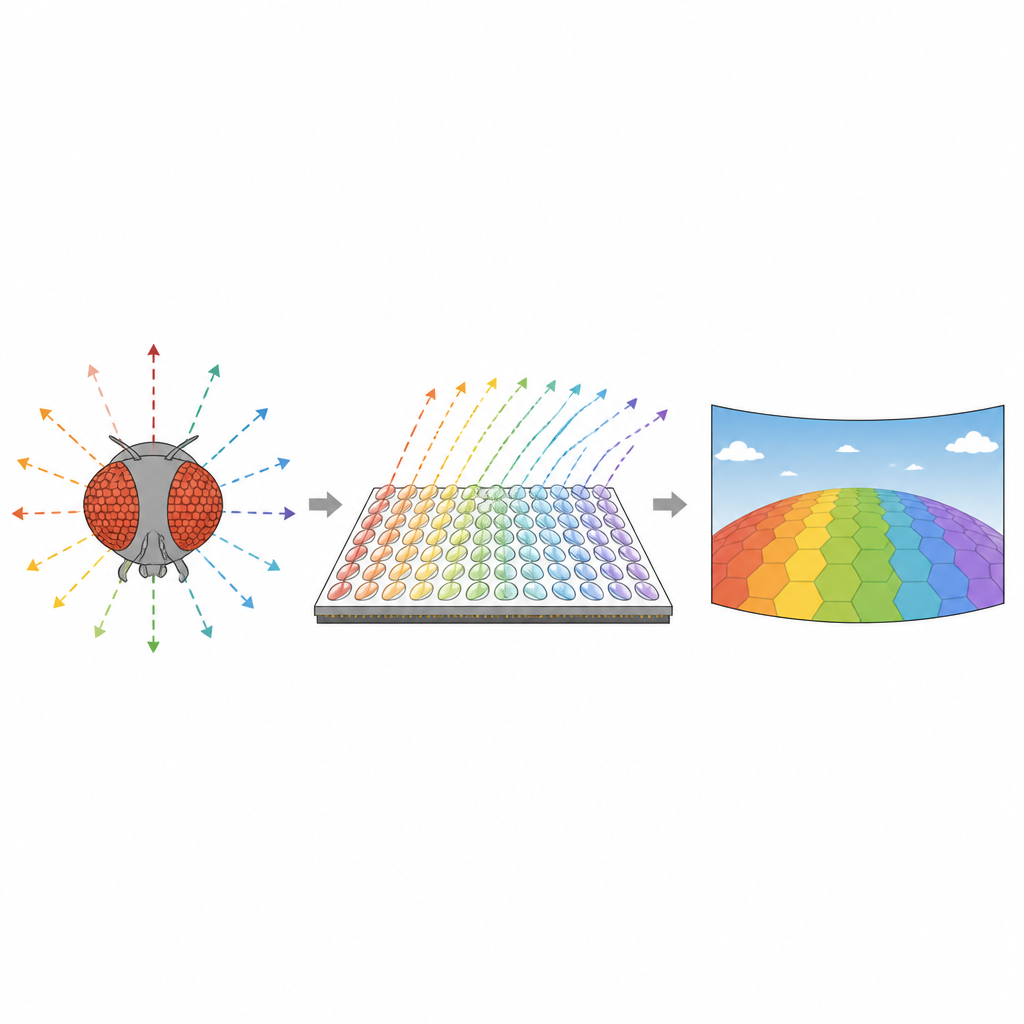
Lessons from Tiny Insect Eyes
In nature, animals have evolved many ways to see widely without carrying heavy optics. Insects with compound eyes use many tiny lenses to cover a broad field, but each lens acts like a single pixel, so the image is coarse. Other creatures, such as jumping spiders, chameleons, and birds of prey, arrange multiple eyes or eye regions to mix sharp central vision with wide peripheral coverage. One small parasitic insect, Xenos peckii, stands out: it packs dozens of miniature eyelets on a curved surface, each taking a small directional view. Together they form a wide, detailed picture of the surroundings while keeping the overall eye compact. This “chunk sampling” of different directions inspired the camera design in this study.
A Flat Camera that Acts like Many Tiny Eyes
The authors designed a spatially offset ellipsoidal microlens array camera, or SOEMLA, that mimics the insect’s eyelets using modern microfabrication. Instead of one large lens, the camera uses a grid of minute lenses and paired openings placed over a flat electronic sensor. Each optical unit consists of two laterally shifted apertures and one tiny ellipsoidal lens, all aimed in a slightly different direction and mapped to its own group of pixels. By carefully offsetting the apertures across the array, the system divides the full viewing dome into many overlapping directional slices, allowing it to cover a diagonal field of about 140 degrees while remaining under a millimeter thick. After capture, a computer corrects brightness falloff and distortion for each slice and stitches them into a single one-megapixel image.
Shaping Lenses to Tame Blurry Edges
Wide-angle lenses often suffer from blurring and shape distortion, especially near the edges of the frame, because light comes in at steep angles. In ordinary microlens arrays with spherical lenses, these off-axis rays focus differently in two directions, a problem called astigmatism, and the focus plane curves away from the flat sensor. The SOEMLA tackles both issues in hardware. The tiny lenses are ellipsoidal rather than spherical, with slightly different curvature along two axes. Their shapes are tuned so that light from oblique directions comes to a sharp, symmetric focus. At the same time, the focal length of each lens is adjusted from center to edge of the array to pull all viewing directions back to a common flat sensor plane. Experiments and simulations show that this design keeps the focused light spots nearly the same size across viewing angles, greatly improving sharpness compared with both conventional microlens cameras and a commercial wide-angle module.
From Microchips to Teeth and Faces
To prove practical value, the team imaged several real-world targets at close range. A large microfluidic chip filled with colored liquid channels was captured from only 20 millimeters away, yet the camera resolved fine channels down to about 70 micrometers while covering a much larger area than a standard microlens camera. Inside a dental phantom, the device was positioned where a real intraoral camera might sit, at about 30 millimeters from the teeth. In a single shot, it recorded all upper and lower teeth with enough detail to see small gaps and ridges, surpassing both a spherical microlens design and a compact wide-angle lens. Mounted on eyeglass frames, the same camera recorded both eyes at arm’s-length distances and full facial views while the wearer changed gaze and expressions, suggesting uses in gaze tracking and facial monitoring. 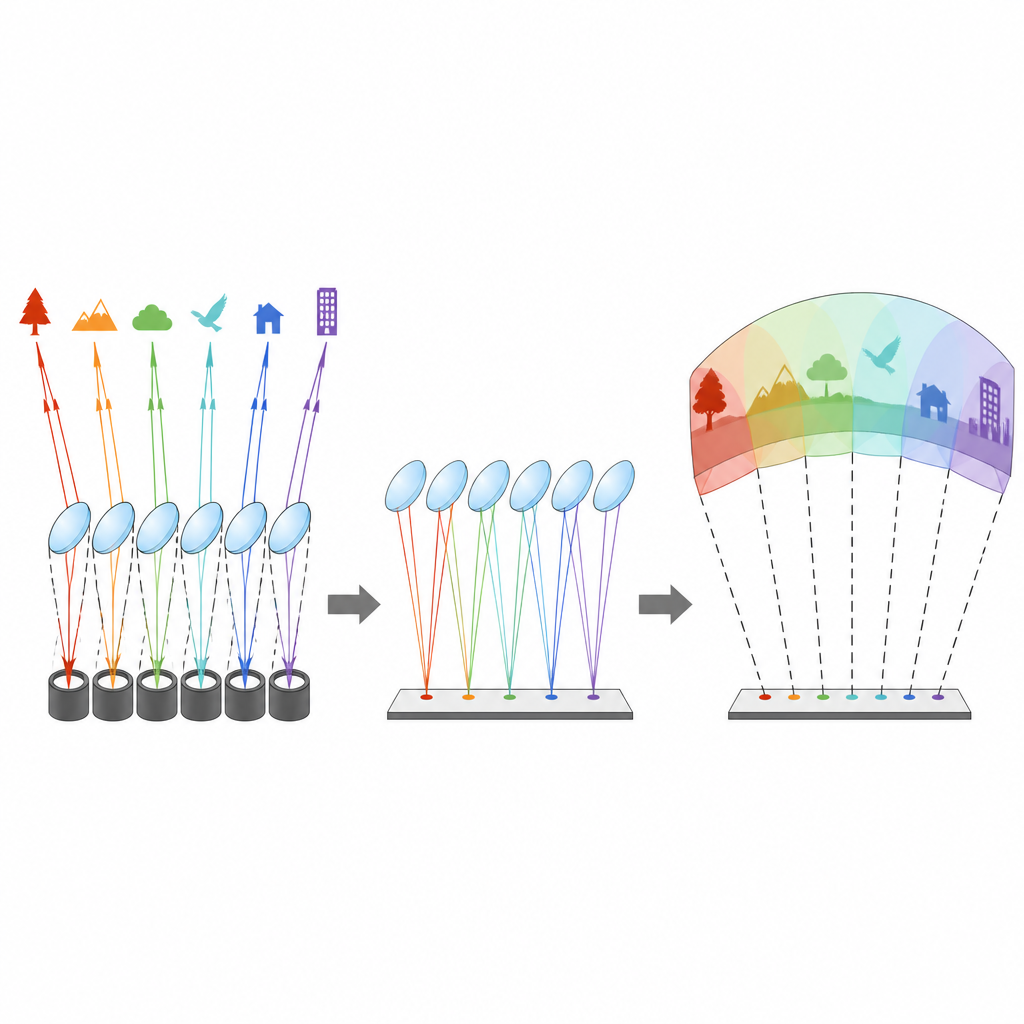
What This Means for Everyday Devices
In simple terms, the researchers have built a camera that sees a large area sharply while being thinner than a grain of rice. By carving many carefully shaped, tilted microlenses into a flat piece of glass and combining their small views digitally, the system sidesteps the usual trade-off between size and image quality in wide-angle optics. This biologically inspired approach could help future machines, medical tools, and wearables see more clearly in cramped spaces, much like tiny insects have done for millions of years.
Citation: Kwon, JM., Kwon, Y., Cha, YG. et al. Biologically inspired microlens array camera for high-resolution wide field-of-view imaging. Nat Commun 17, 4343 (2026). https://doi.org/10.1038/s41467-026-70967-2
Keywords: microlens array camera, wide field-of-view imaging, bioinspired optics, compact camera design, wearable imaging