Clear Sky Science · en
Deformation- and damage-free transfer of soft electronics onto highly curved and fragile biological surfaces
Electronics That Bend Where Bodies Do
Imagine a bandage-thin electronic patch that can wrap smoothly around a knuckle, a mushroom cap, or even a raw egg yolk without tearing or bruising what lies beneath. This study presents a new way to move such delicate soft electronics from flat factory wafers onto highly curved and fragile surfaces, opening paths toward more comfortable health monitors and sensors that can safely touch living tissues. 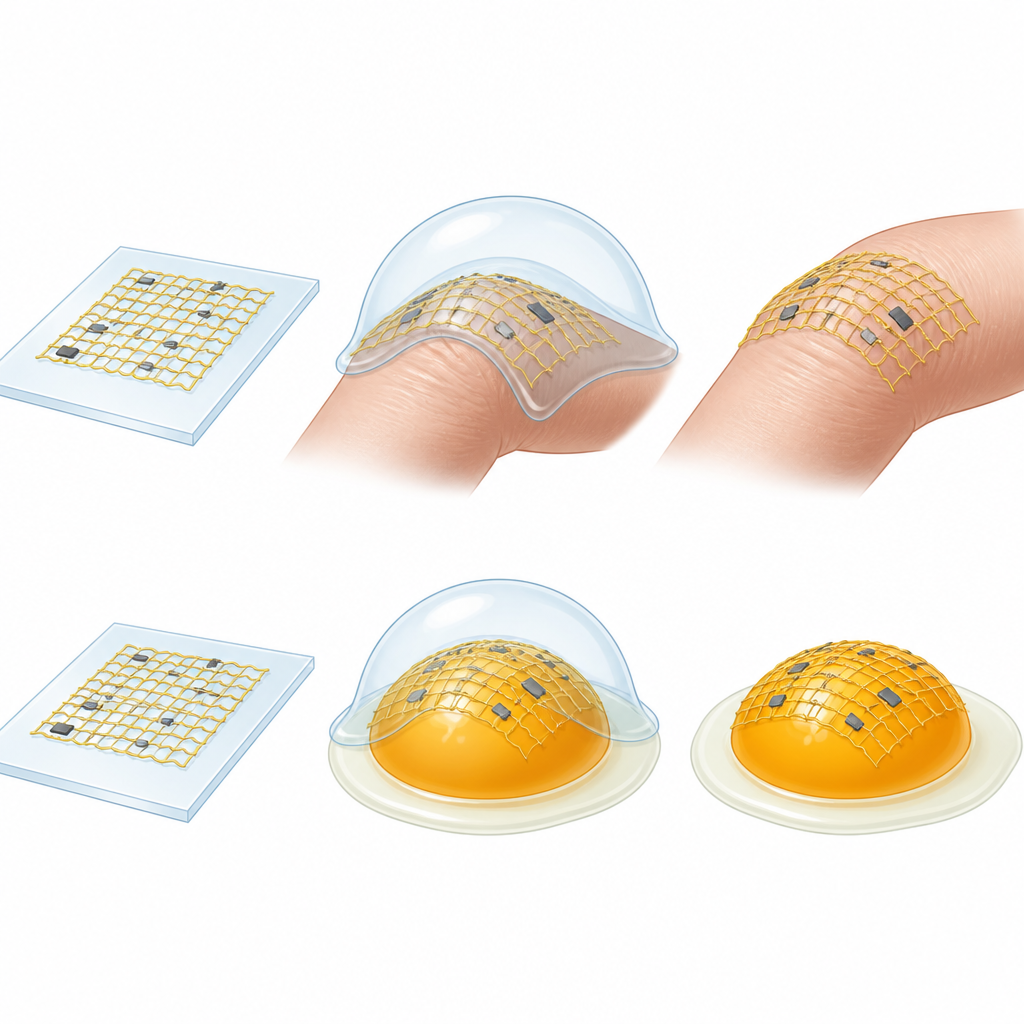
A Gentle Helper Between Chips and Skin
Soft health electronics work best when they hug the body closely, because good contact improves signal quality and comfort. Yet the chips and wiring are usually made on rigid, flat wafers, while real anatomy is bumpy, stretchy, and sometimes very fragile. Existing transfer methods often need heat, strong glue, or stiff supports, which can stretch the electronics, misalign them, or press too hard on tissues. The researchers set out to create a transfer medium that behaves like a careful middleman: firm enough to hold and position the device, but soft and adaptable enough to mold to complicated shapes without causing harm.
A Fluid That Acts Like Solid When You Need It
The team developed what they call DAYS fluid, made from water mixed with tiny, biocompatible silica particles. At rest, these particles link together so the fluid behaves like a soft solid that can support an ultrathin electronic mesh without it drifting or sagging. When a small mechanical stress is applied, the network loosens and the material flows like a liquid, letting it fill in the valleys and ridges of curved or wrinkled surfaces. The key is that this change happens at an extremely low stress level, far below the pressure that would crack a raw egg yolk or irritate human skin, so even very delicate substrates stay intact.
Letting the Fluid Move While the Device Stays Calm
A major challenge in moving electronics onto complex surfaces is that the carrier often drags on the device as it deforms, stretching or buckling the tiny wires. The DAYS fluid is tuned so its internal resistance to flow is very low. This means the fluid can slide and reshape itself while the electronic film on its surface feels very little force. Experiments on cones, lens-like shapes, joints, and highly irregular objects showed that when the fluid was adjusted to lower viscosity, strain in the electronics became negligible. Computer simulations backed this up, showing that a low-viscosity medium transmits far less stress to the device than thicker carriers such as molten sugar. With DAYS fluid, electronics could be laid smoothly over finger joints, rough rocks, wrinkled dried fruit, mushroom caps with undercuts, and soft egg yolks without visible distortion or damage. 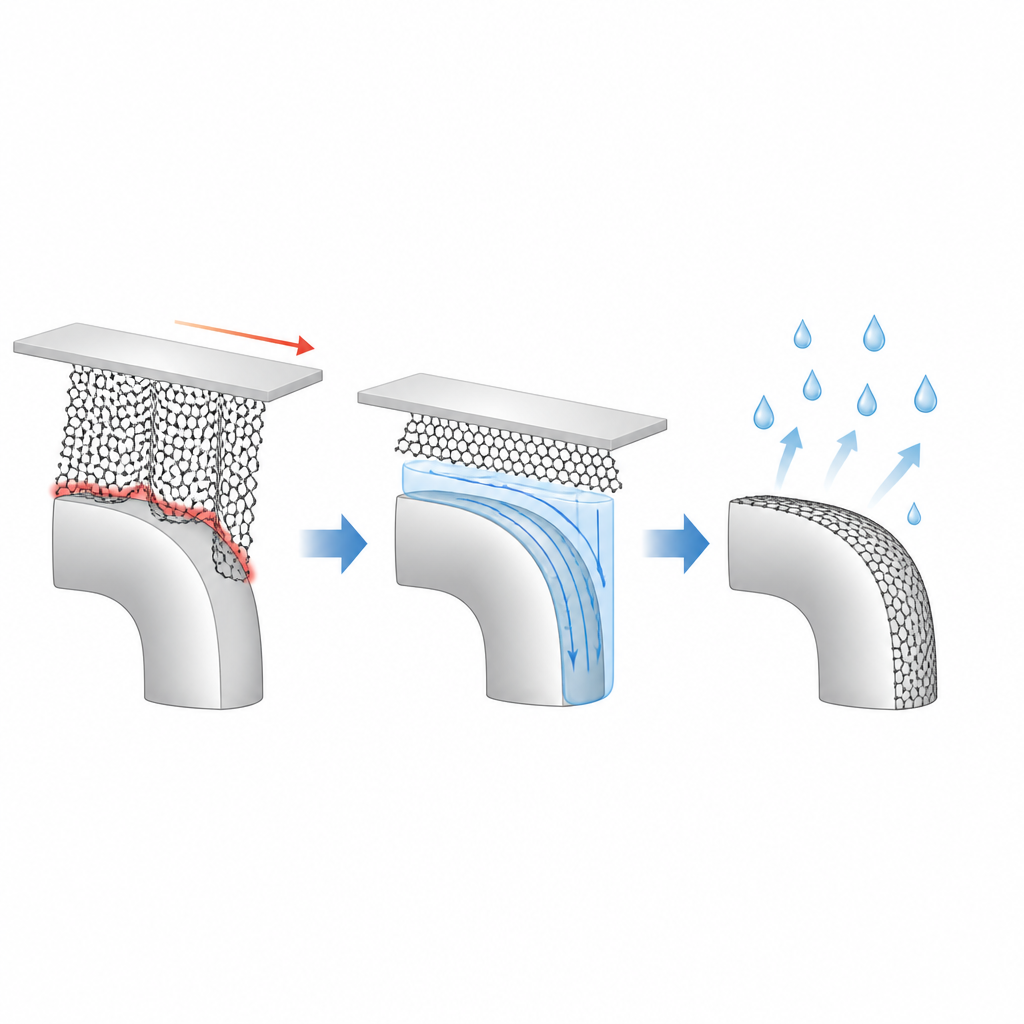
Using Water to Let Go Cleanly
Holding the electronics during placement is only half the story; the carrier must also let go without leaving sticky residue. DAYS fluid solves this with an adhesion-switching trick that uses plain water. When water reaches the boundary between the fluid and the device or substrate, it weakens the grip of the silica network and acts like a microscopic lubricant. The result is that the fluid’s hold drops to nearly zero, and it can slide off or roll away under gentle motion, leaving the electronics firmly attached while the surface underneath stays clean. This behavior was consistent across many common soft-electronics materials and worked only when the ingredients and solvent were chosen to avoid swelling or damaging the substrate.
From Lab Concept to Moving Fingers
To show that the method works in real-life situations, the researchers built a flexible wireless temperature sensor array that could be transferred onto the top of a finger joint. Using DAYS fluid, the sensor wrapped closely around the joint’s tight curve and stayed in place while the finger bent, typed on a keyboard, or gripped climbing holds. The readings remained stable and accurate, unlike camera-based infrared thermography, which suffered from motion, viewing angle, and distance. The conformal sensor picked up subtle temperature rises linked to overuse of specific fingers, while versions attached with thicker fluids gave noisy and unreliable signals. Similar transfers onto lettuce leaves and orange peels showed that the same approach works on both extremely soft and rough, rigid natural surfaces.
What This Means for Future Wearable Tech
In simple terms, the study shows that a carefully designed, water-based “smart fluid” can safely pick up soft electronics from flat wafers, carry them onto some of the most challenging shapes in biology, and then step aside without a trace. Because it avoids heat and high pressure, this approach could help engineers place sensors and circuits on regions of the body, plants, or soft robots that were previously too fragile or curved to handle. That paves the way for more comfortable medical wearables, better tools to monitor tissue health, and flexible devices that can live on or inside living systems with less risk of damage.
Citation: Song, K.M., Chung, MK., Jung, J. et al. Deformation- and damage-free transfer of soft electronics onto highly curved and fragile biological surfaces. Nat Commun 17, 4448 (2026). https://doi.org/10.1038/s41467-026-70948-5
Keywords: soft electronics, wearable sensors, yield-stress fluid, biological surfaces, transfer printing