Clear Sky Science · en
Photolytic oxidation of ammonium chloride as a source of Cl2 in the atmosphere
Sunlight, Smog, and a Hidden Chemical Player
City smog is more than a gray haze; it is a restless chemical soup that helps form ozone and fine particles that we breathe deep into our lungs. This study uncovers a surprising source of a powerful reactive ingredient in that soup: common ammonium chloride, a salt found in many urban air particles. When sunlight strikes these tiny particles, it can turn them into a daytime source of chlorine gas, reshaping how scientists think about urban air chemistry and pollution.
A Quiet Radical that Speeds Up Air Cleaning
Chlorine atoms in the lower atmosphere are short lived but highly reactive. They attack many airborne organic gases much faster than the better known hydroxyl radical, often called the air’s detergent. By doing so, chlorine atoms help create ozone and secondary organic aerosols, which are key components of smog and haze. To get these atoms, sunlight must first split molecules such as chlorine gas. Field measurements, however, have long shown daytime peaks of chlorine gas that existing sources cannot fully explain, especially in landlocked cities far from the sea. This mismatch hinted that an important chlorine source was still missing from scientific models.
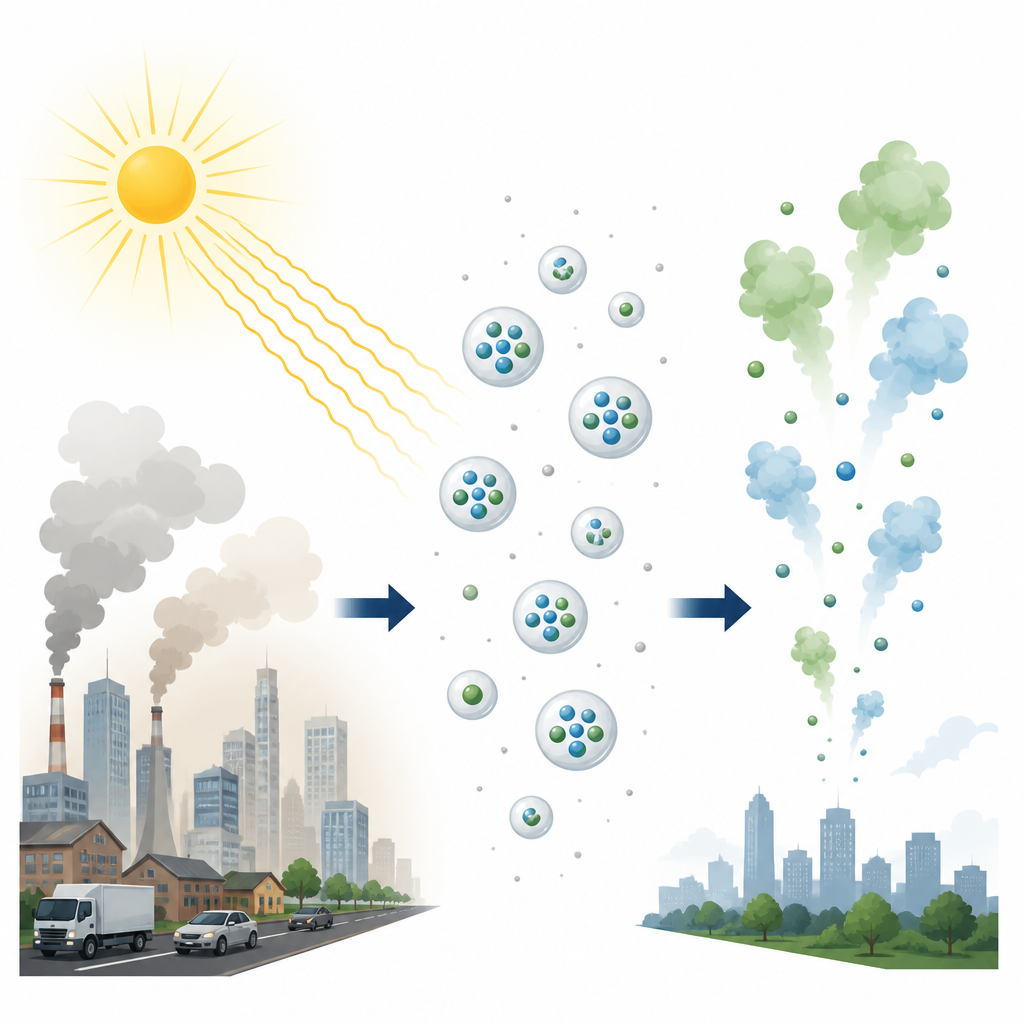
A Common Salt Turns into Chlorine in Sunlight
The authors focused on ammonium chloride, a widespread ingredient in inland atmospheric aerosols produced by human activities such as fuel burning. In carefully controlled lab experiments, they coated quartz plates with ammonium chloride and shone ultraviolet and solar like light on them under different levels of humidity and gas mixtures. Sensitive mass spectrometers detected a steady build up of chlorine gas in the outgoing air stream during illumination, reaching hundreds of parts per trillion by volume over a few hours. When oxygen in the carrier gas was removed, the chlorine gas signal vanished, and when oxygen was restored, the signal quickly returned. This showed that both light and oxygen are crucial drivers of chlorine release from the salt.
Water, Acidity, and Black Carbon Shape the Reaction
Further experiments revealed the conditions that favor this pathway. A little water vapor was necessary to get the reaction started, but once a thin moisture layer formed on the salt surface, adding more humidity did not greatly change the chlorine yield. The acidity of the particles, however, mattered a lot. In liquid ammonium chloride solutions, lowering the pH made chlorine production climb sharply. Comparable tests with other chloride salts showed that those that do not acidify themselves needed added acid before they could release much chlorine under light. This pointed to the ammonium part of the salt as a built in source of acidity that helps drive chloride toward oxidation and release as chlorine gas. When black carbon, a component of soot, was mixed with ammonium chloride, chlorine production rose even more, suggesting that these dark particles help shuttle electrons and speed up the process.
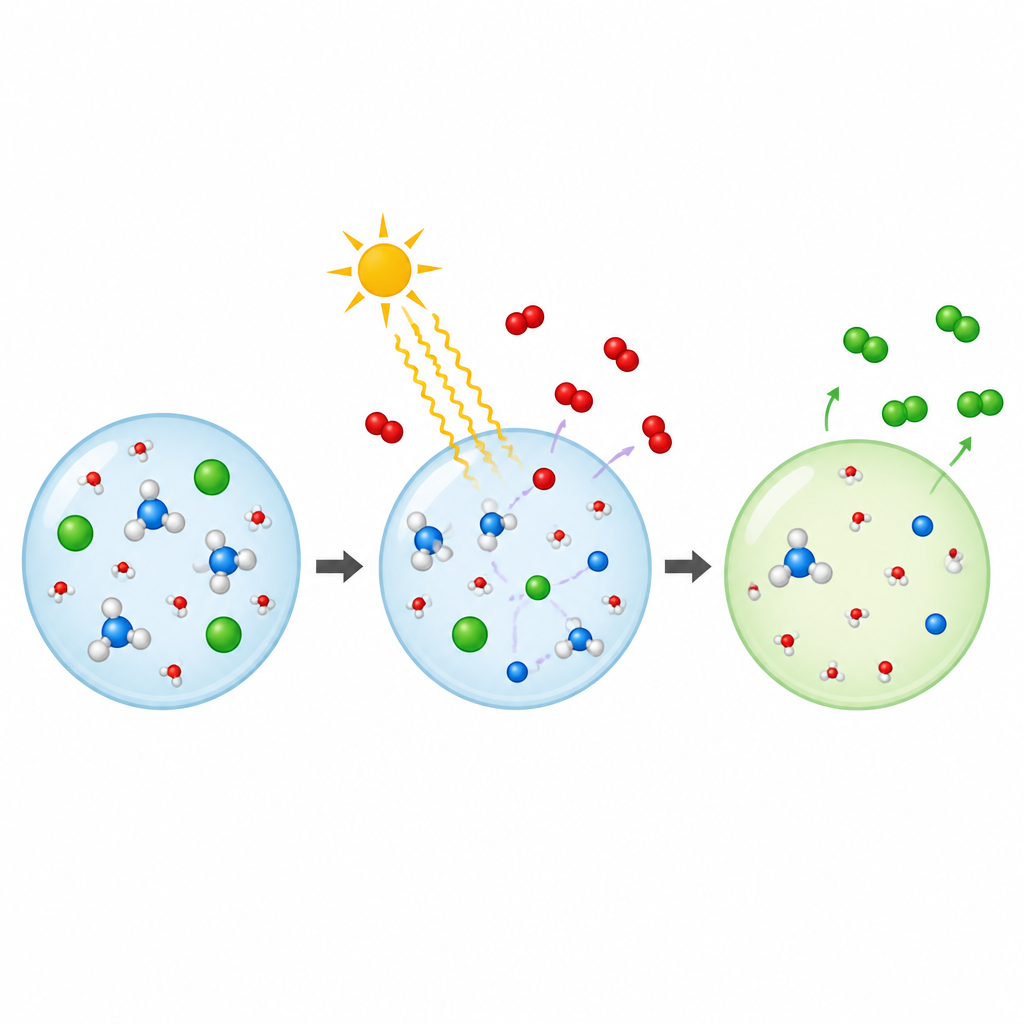
Peering Inside the Chemical Steps
To understand what happens at the microscopic level, the researchers used electron spin resonance, a technique that can spot fleeting radicals, along with laser based detection of hydroxyl radicals. They found signals consistent with the formation of short lived chlorine containing and oxygen containing radicals when the salt was illuminated in the presence of water and oxygen. Additional tests used a hydrocarbon called cyclohexane to soak up hydroxyl radicals. Even when these radicals were removed from the gas phase, chlorine gas still formed at similar levels, showing that hydroxyl radicals were a side product rather than the main cause. The picture that emerges is that light excites chloride at the particle surface, electrons jump to oxygen, and a cascade of radical reactions ultimately couples chloride ions into molecules of chlorine gas.
Real World Evidence from a Coastal City
Laboratory findings matter most when they help explain what happens outdoors. The team tested their mechanism using field data from Xiamen, a coastal city in southeast China, where they continuously measured chlorine gas, aerosol composition, and sunlight. Daytime chlorine levels showed a clear noontime peak that known mechanisms could not reproduce. The observed chlorine concentrations rose with both chloride and ammonium in particles, matching what the lab results would predict if ammonium chloride were being photoactivated. When the researchers added their new pathway, including its boost from black carbon, to a detailed atmospheric box model, the mechanism accounted for roughly 12 to 55 percent of the daytime chlorine gas observed, depending on conditions.
What This Means for Urban Air
For a lay reader, the key message is that a very common salt in city air, ammonium chloride, can quietly turn into chlorine gas when sunlight, oxygen, a bit of water, and particle acidity come together. This gas then feeds reactive chlorine atoms that speed up many chemical reactions in polluted air, influencing how fast smog forms and how long it lasts. Because this process does not require exotic minerals or extra chemicals, it may be widespread in regions with abundant chloride rich pollution, such as heavily industrialized or biomass burning areas. Incorporating this newly identified pathway into air quality and climate models should help scientists better estimate the atmosphere’s true oxidizing power and improve our understanding of urban haze.
Citation: Li, S., Wang, Y., Liu, Y. et al. Photolytic oxidation of ammonium chloride as a source of Cl2 in the atmosphere. Nat Commun 17, 4508 (2026). https://doi.org/10.1038/s41467-026-70941-y
Keywords: atmospheric chlorine, ammonium chloride, aerosol chemistry, urban air pollution, photochemical reactions