Clear Sky Science · en
Pentose phosphate pathway fuels cGAS-STING signalling to boost function of intratumoral conventional dendritic cells
Why this study matters for cancer treatment
Cancer immunotherapy has changed how we treat tumors, but many patients still do not respond. This study asks a simple question with big implications: are some key immune cells inside tumors running low on the fuel they need to work properly, and can restoring that fuel help the body fight cancer more effectively?
The immune scouts inside tumors
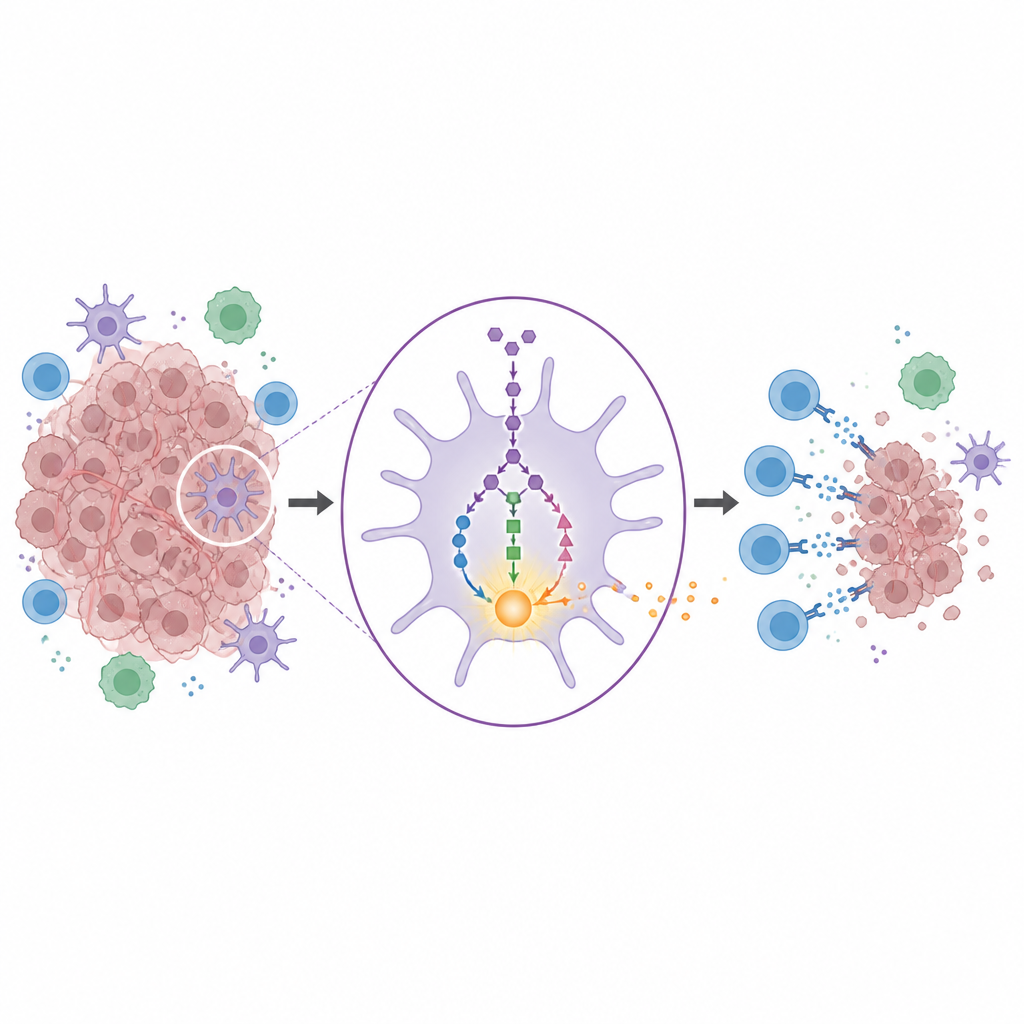
Among the many cells packed into a tumor, conventional dendritic cells act as scouts and messengers. They collect pieces of cancer cells and show them to T cells, which then learn to recognize and attack the tumor. The authors examined these dendritic cells in mice at early and late stages of tumor growth. Using single-cell genetic profiling and functional tests, they found that, as tumors progress, these cells become sluggish: they display fewer “ready” markers on their surface, move less efficiently to lymph nodes, and are worse at waking up T cells in lab dishes. This broad drop in performance affects multiple dendritic cell subtypes, suggesting a common underlying problem rather than a single damaged subgroup.
A hidden energy pathway runs low
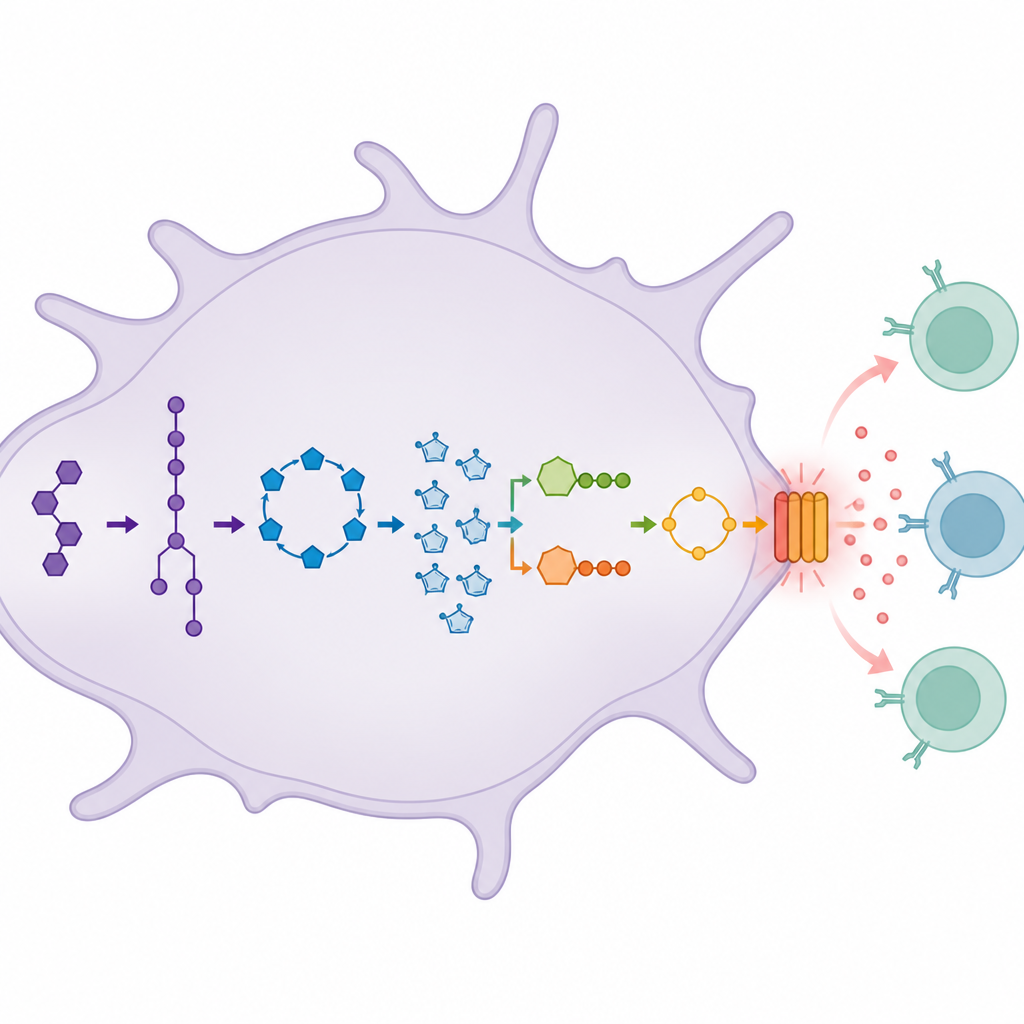
The team next looked under the hood at how these cells use nutrients, focusing on basic sugar metabolism. They discovered that a particular branch of glucose use, called the pentose phosphate pathway, is sharply reduced in dendritic cells from late-stage tumors. This pathway normally helps produce small building blocks for DNA and RNA, as well as molecules that keep the cell’s chemistry in balance. Measurements of many metabolites showed that products of this pathway and the nucleotides built from them were depleted, while other sugar routes were much less affected. When the scientists blocked this pathway with drugs or by genetically disabling a key enzyme in dendritic cells, the cells lost much of their ability to prime T cells and control tumors in mice. Restoring the pathway with a small-molecule activator had the opposite effect, reviving dendritic cell function and slowing tumor growth.
How fuel connects to danger sensing
Dendritic cells do more than just show cancer fragments to T cells; they also sense danger signals from tumor DNA using an internal alarm system known as the cGAS–STING pathway. When this alarm is triggered, dendritic cells release type I interferons and other factors that powerfully support antitumor immunity. The study shows that the pentose phosphate pathway and this alarm system are tightly linked. When the pathway is weakened, key steps in STING activation are muted, and interferon production drops. Detailed experiments revealed why: the pathway supplies ingredients for purine metabolism, which keeps the cell’s stores of ATP and GTP topped up. These two nucleotides are the raw materials for making a small ring-shaped messenger molecule that switches on STING. In late-stage tumors and in dendritic cells lacking the pathway, ATP, GTP and this messenger all fall, blunting the alarm signal. Supplying ATP and GTP, or the messenger itself, restores signaling even when the pathway is blocked.
Boosting therapy by recharging immune cells
Armed with this mechanistic insight, the researchers tested how manipulating this pathway might influence experimental cancer treatments. In mouse models where dendritic cells are used as a cell-based vaccine against tumors, blocking the pathway made the vaccines weaker, while activating it made them stronger and increased the number and vigor of tumor-fighting T cells. Importantly, stimulating the pathway in dendritic cells also worked hand in hand with a widely used form of immunotherapy that blocks the PD-L1 checkpoint, shrinking tumors more than either approach alone. In tumor samples from women with breast cancer, dendritic cells showed the same dependence on this pathway to maintain their STING alarm and nucleotide levels, and patients whose tumors had higher combined signatures of dendritic cells and pathway activity tended to fare better.
What this means for future cancer care
For a non-specialist, the take-home message is that some dendritic cells inside tumors are not just suppressed by external signals; they are also metabolically underpowered. A specific sugar-processing route acts as an internal checkpoint that decides whether these cells can fully sound the alarm and rally T cells. By restoring this pathway or its downstream products, it may be possible to “recharge” dendritic cells, sharpen the body’s natural attack on cancer and make existing immunotherapies work in more patients. While this work is still at the experimental stage, it points to new drug targets that focus not on the tumor cells themselves, but on the energy systems of the immune cells that patrol them.
Citation: Liu, B., Geng, Z., Huang, Y. et al. Pentose phosphate pathway fuels cGAS-STING signalling to boost function of intratumoral conventional dendritic cells. Nat Commun 17, 4342 (2026). https://doi.org/10.1038/s41467-026-70934-x
Keywords: cancer immunotherapy, dendritic cells, STING pathway, tumor metabolism, pentose phosphate pathway