Every healthy sperm cell must carry a flawless copy of DNA to the next generation. Yet during its formation, the male sex chromosomes X and Y face a special problem: they do not match up neatly like other chromosome pairs. This study reveals how a mobile structure inside the cell, the nucleolus, temporarily travels to the sex chromosomes and helps switch off their genes at a crucial stage, protecting fertility.
A quiet zone for sex chromosomes
In the testes, developing sperm cells pass through a long series of steps that reshape both their DNA and their overall structure. During a key phase called pachytene, most chromosomes pair tightly and swap DNA in preparation for being split into sperm. The X and Y chromosomes, however, only share a tiny region in common and remain largely unmatched. To avoid mistakes, the cell silences most genes on X and Y in a process known as meiotic sex chromosome inactivation. The silenced chromosomes form a distinct droplet-like area near the edge of the nucleus called the XY body.
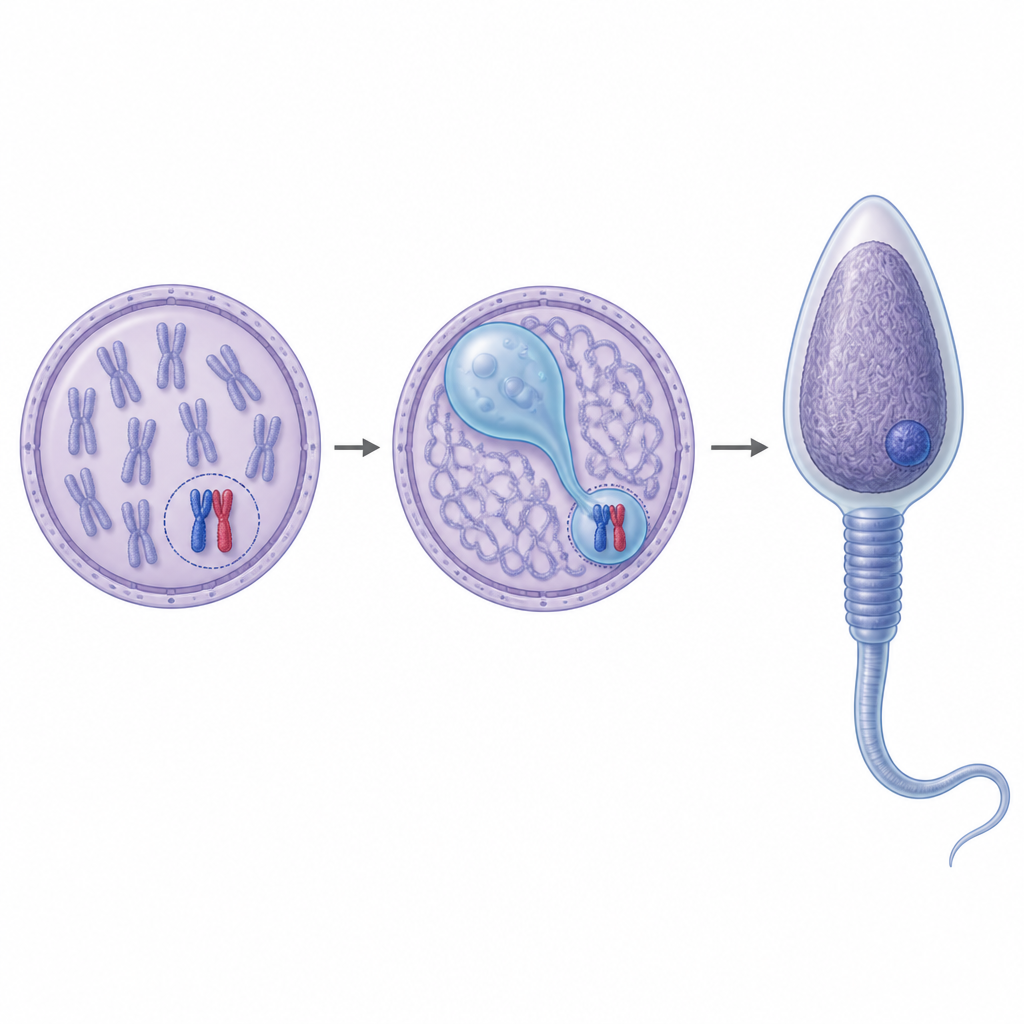
A surprising journey of the nucleolus Figure 1. Nucleolar droplets move onto the sex chromosomes to create a temporary quiet zone during sperm cell development.
The nucleolus is best known as the cell’s ribosome factory, where ribosomal RNA is made and assembled. Using advanced 3D microscopy in mouse testes, the researchers found that parts of the nucleolus progressively break apart and move toward the XY body during pachytene. Two nucleolar proteins, NPM1 and SENP3, together with ribosomal RNA, first form small specks and then spread to coat the XY body before later retreating to one side of it. Meanwhile, the usual nucleolus elsewhere in the nucleus is dismantled. This migration was seen in both mice and humans and happened only in male germ cells, not in female ones, suggesting a sex-specific strategy.
Key nucleolar players keep sperm development on track
To test how important these wandering nucleolar pieces are, the team engineered mice that lack NPM1 or SENP3 only in germ cells. These males looked normal but were completely infertile. Their testes were small, sperm cells stalled at the pachytene stage, and mature sperm were almost absent. Detailed chromosome imaging showed that while non-sex chromosomes paired correctly, X and Y were often misshapen or failed to fold into the usual compact form inside the XY body. In these mutant cells, the silenced XY body developed an abnormal hollow, ring-like shape, indicating that its internal structure depends on the proper actions of NPM1 and SENP3.
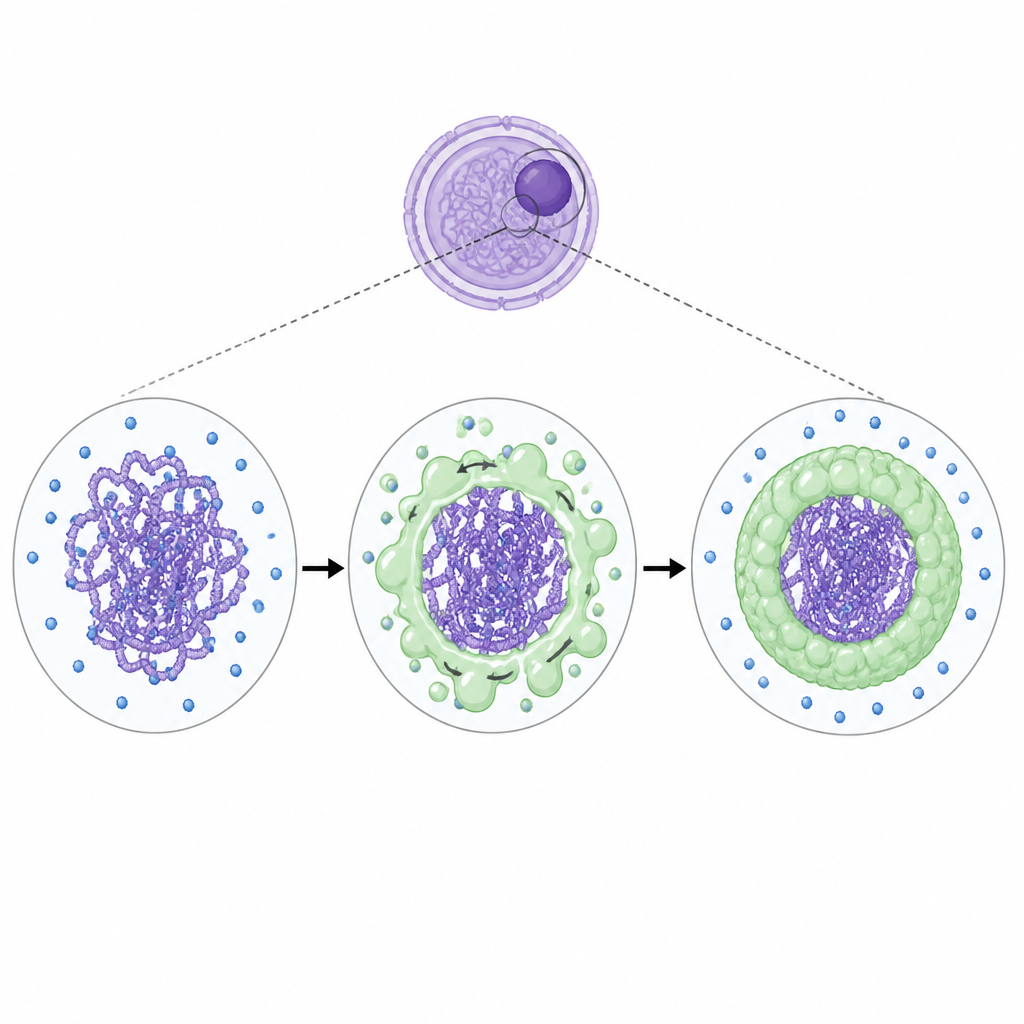
How nucleolar droplets shut down gene activity Figure 2. Liquid-like nucleolar shells form around the XY region and push transcription machinery away to silence its genes.
The researchers also examined gene activity directly. In normal cells, the main enzyme that copies DNA into RNA, RNA polymerase II, is largely absent from the XY body during pachytene. In cells missing NPM1 or SENP3, this enzyme invaded the XY body and many genes on X and Y became inappropriately active again. Blocking production of ribosomal RNA with drugs caused similar problems, showing that RNA itself is part of the silencing machinery. Biochemical tests revealed how this works: SENP3 modifies NPM1 so that NPM1 can tightly bind ribosomal RNA. Together they form liquid-like droplets that behave as a distinct phase inside the nucleus. In test-tube experiments, these droplets pushed components of the transcription machinery to their outer edges and reduced the rate of RNA production, suggesting a physical way to keep polymerase away from the XY chromosomes.
Phase separation as a molecular off switch
The team then altered NPM1 so it could still bind RNA but could no longer form droplets. Mice carrying only this phase-separation-defective version of NPM1 were again infertile, their sperm cells arrested, and XY-linked genes reactivated. When normal NPM1 was reintroduced into mutant cells, it gathered on the XY body and restored exclusion of polymerase, but the defective NPM1 could not. Together, the results support a model in which DNA damage sensors first mark the unsynapsed X and Y chromosomes, then recruit NPM1, SENP3, and ribosomal RNA. These components form a liquid shell around the XY body that physically expels the transcription machinery, turning genes off at the right time. Later, more permanent chemical marks on chromatin lock in this silent state as sperm mature. For a lay reader, the take-home message is that tiny, mobile droplets inside the nucleus help transform the sex chromosomes into a protected quiet zone, and when this process fails, male infertility can result.
Citation: Li, M., Du, Z., Li, H. et al. Nucleolar migration regulates meiotic sex chromosome inactivation via phase separation during mammalian spermatogenesis.
Nat Commun17, 4485 (2026). https://doi.org/10.1038/s41467-026-70932-z
Keywords: spermatogenesis, sex chromosomes, nucleolus, phase separation, male infertility