Clear Sky Science · en
Photoinduced Mn catalysis for efficient platform for C-heteroatom bond coupling of aryl halides
Lighting up greener chemical building blocks
Many medicines, plastics, and electronic materials rely on tiny carbon based frameworks decorated with nitrogen, oxygen, or sulfur atoms. Making these connections usually requires rare and costly metals and high heat. This study shows how an abundant metal, manganese, can be switched on by light to form these crucial links more gently and efficiently, offering a cleaner route to everyday molecules.
Why chemists care about these tiny bonds
Modern drug and materials design depends on joining flat ring shaped fragments, called aryl groups, to partners that contain nitrogen, oxygen, or sulfur. These carbon–heteroatom bonds control how a molecule behaves in the body or in a device. For decades, chemists have leaned heavily on palladium, a scarce and expensive metal, to build these bonds. Although other cheaper metals have begun to share the load, manganese, which is abundant in Earth’s crust and relatively non toxic, has played only a modest role because effective manganese based methods for this task were missing.
Using light instead of more metal
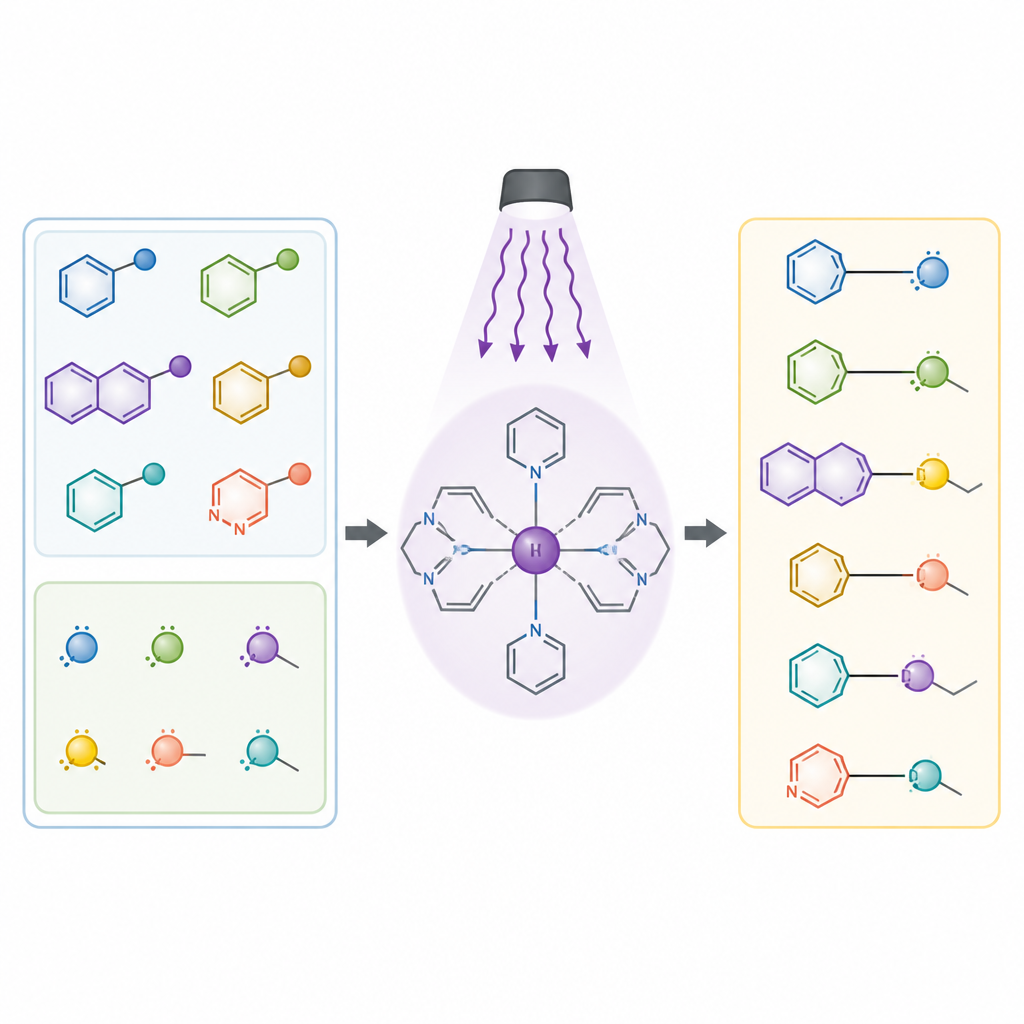
The researchers designed a simple catalyst built from manganese and a common organic ligand called bipyridine. When bathed in purple light, this single complex both absorbs the light and drives the bond forming reaction, eliminating the need for an extra light harvesting photocatalyst. In the reaction, aryl halides ring systems carrying chlorine, bromine, or iodine partners are linked to molecules that contain nitrogen, oxygen, or sulfur. Under carefully chosen conditions of solvent, base, and light wavelength, the team obtained the desired products in high yields, including challenging cases such as less reactive aryl chlorides.
One recipe, many ingredients
After fine tuning the conditions on a model reaction, the authors tested how broadly their manganese system could be used. They showed that a wide variety of aryl halides react smoothly, tolerating electron rich and electron poor groups, crowded ring systems, and fused or heteroaromatic rings that often appear in pharmaceuticals. On the partner side, many different nitrogen containing molecules work, from simple alkyl amines to aromatic amines, amides, sulfonamides, and nitrogen containing rings that usually interfere with metal catalysts. The same platform also forges carbon–oxygen bonds with alcohols and carbon–sulfur bonds with thiophenols. In total, more than 150 combinations were demonstrated, including modifications of complex drug like molecules, with yields up to 94 percent.
How light wakes up manganese
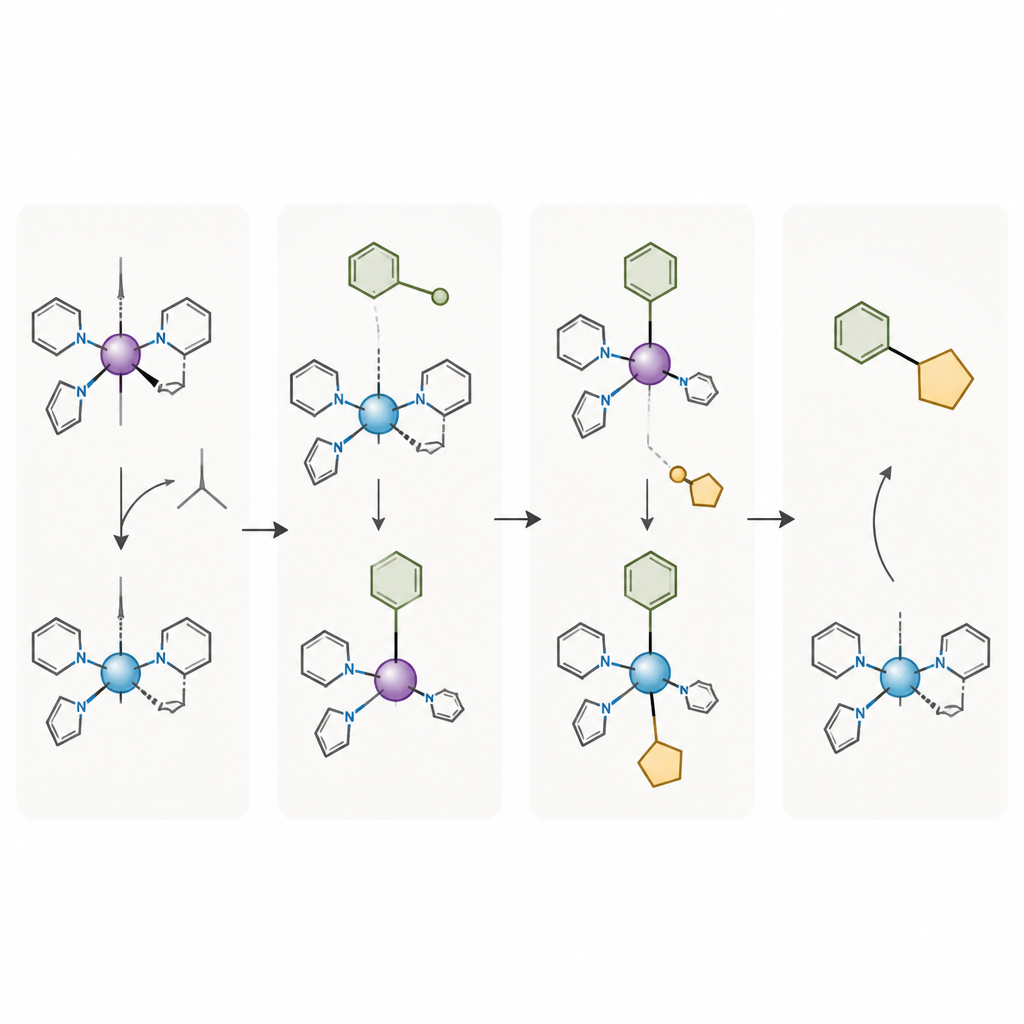
To understand how the catalyst operates, the team isolated a manganese complex that forms from manganese acetate and the bipyridine ligand. Spectroscopic studies showed that this complex strongly absorbs near the purple light used in the reaction. Under irradiation, the bond between manganese and an acetate group splits homolytically, indicating the formation of a lower valent manganese species. Additional experiments, including trapping of radicals, tests with related manganese complexes, and model reactions that mimic individual steps, suggest that the catalyst cycles between two oxidation states as it first engages the aryl halide and then releases the coupled product.
A new path toward cleaner synthesis
Putting these pieces together, the authors propose that light transforms the resting manganese complex into an active form that adds to the aryl halide, binds the nitrogen, oxygen, or sulfur partner, and then closes the new bond while regenerating the catalyst. Because a single, earth abundant metal complex both harvests light and carries out the bond construction, the method simplifies reaction design and reduces reliance on precious metals. For non specialists, the key message is that carefully tuned light driven manganese chemistry can provide a versatile, more sustainable toolkit for building the small molecular connections that underpin medicines and advanced materials.
Citation: Song, G., Song, J., Li, Q. et al. Photoinduced Mn catalysis for efficient platform for C-heteroatom bond coupling of aryl halides. Nat Commun 17, 4509 (2026). https://doi.org/10.1038/s41467-026-70925-y
Keywords: manganese catalysis, photocatalysis, C–N coupling, aryl halides, green chemistry