Clear Sky Science · en
An ultrafast plenoptic-camera system for high-resolution 3D particle tracking in unsegmented scintillators
Seeing Invisible Particles in Three Dimensions
Many of the universe’s most elusive particles, such as neutrinos and possible dark matter candidates, leave only the faintest traces of light when they pass through matter. Detecting and precisely tracking these ghostly visitors usually demands huge, intricate detectors with thousands or millions of readout channels. This article presents a new way to capture their paths in three dimensions, using camera technology similar in spirit to high-end photography, potentially cutting complexity and cost while sharpening our view of particle interactions.
Why Traditional Detectors Hit a Wall
Modern particle detectors often rely on blocks of scintillator—materials that flash with light when charged particles pass through. To pinpoint where particles go, these blocks are usually chopped into many tiny pieces or crisscrossed with optical fibers, each segment or fiber connected to its own electronics channel. This fine-grained approach can reach sub-millimetre precision, but scaling it up to ton-size detectors requires an enormous number of channels and expensive readout hardware. Some newer designs try to avoid physical segmentation by using highly scattering materials to trap light in tiny regions, but they still face trade-offs between resolution, complexity and cost.
A Camera That Captures Light in 3D
The authors propose a different strategy: instead of cutting the scintillator into many pieces, they keep it as a solid block and use “plenoptic” cameras to reconstruct where each photon of scintillation light came from. A plenoptic, or light-field, camera sits outside the block and combines a standard main lens with a dense array of tiny lenses mounted just in front of a special imaging sensor. Each microlens views the scintillator from a slightly different angle, so a single flash inside the block produces a cluster of small images across the sensor. By combining this angular information with the position of each detected photon and using a detailed optical model, the system can trace the photon paths back into the scintillator and rebuild the original 3D particle tracks. 
Single-Photon Cameras at Extreme Speed
To make this work for rare and faint particle events, the plenoptic system is paired with advanced imaging chips called single-photon avalanche diode (SPAD) arrays. Unlike conventional camera sensors, each tiny pixel in a SPAD array can detect individual photons and measure their arrival time with sub-nanosecond precision. Because the readout electronics are built directly into the chip, millions of pixels can share only a few data lines, eliminating the need for a separate analog readout chain per channel. In the prototype described here, a custom plenoptic lens system feeds light onto a SPAD array, forming a device the authors call the PLATON prototype. Careful calibration with a movable point light source shows that this setup can localize a single point in space to about a few millimetres in depth and below a millimetre sideways, even when only a modest number of photons are available.
From Laboratory Electrons to Simulated Neutrinos
As a proof of principle, the team placed a small plastic scintillator block in front of the PLATON prototype and exposed it to electrons from a radioactive source. By cooling the sensor to suppress noise and selecting frames with just a handful of detected photons, they were able to reconstruct the positions of individual electron events within roughly a couple of centimetres along the viewing direction—performance consistent with expectations from earlier calibration tests. Building on this, they designed a more advanced virtual detector, consisting of arrays of improved plenoptic cameras viewing a 10-centimetre scintillator cube from two sides, and simulated how it would respond to muon neutrinos from an accelerator beam. Here, a deep neural network based on transformer models was trained to interpret the sparse patterns of detected photons and cluster them into particle tracks.
Sharp Tracks Without Cutting the Detector
The simulations show that this upgraded PLATON module could reconstruct particle paths with typical three-dimensional precision of about 200 micrometres—thinner than a sheet of paper—even when several particles emerge from a single neutrino interaction. The method can recover where the interaction started, how many protons were ejected, and how much energy they lost along their tracks, with proton energy estimates accurate to better than 10% over much of the relevant range. When the same exercise is repeated with conventional cameras instead of plenoptic ones, the 3D resolution degrades by roughly a factor of four, especially as the detector volume grows. Scaling the design up in simulation to a one-cubic-metre scintillator, the authors find that millimetre-level resolution for point-like energy deposits is already achievable, with a clear path toward sub-millimetre performance through better optics, smaller pixels and more powerful reconstruction algorithms. 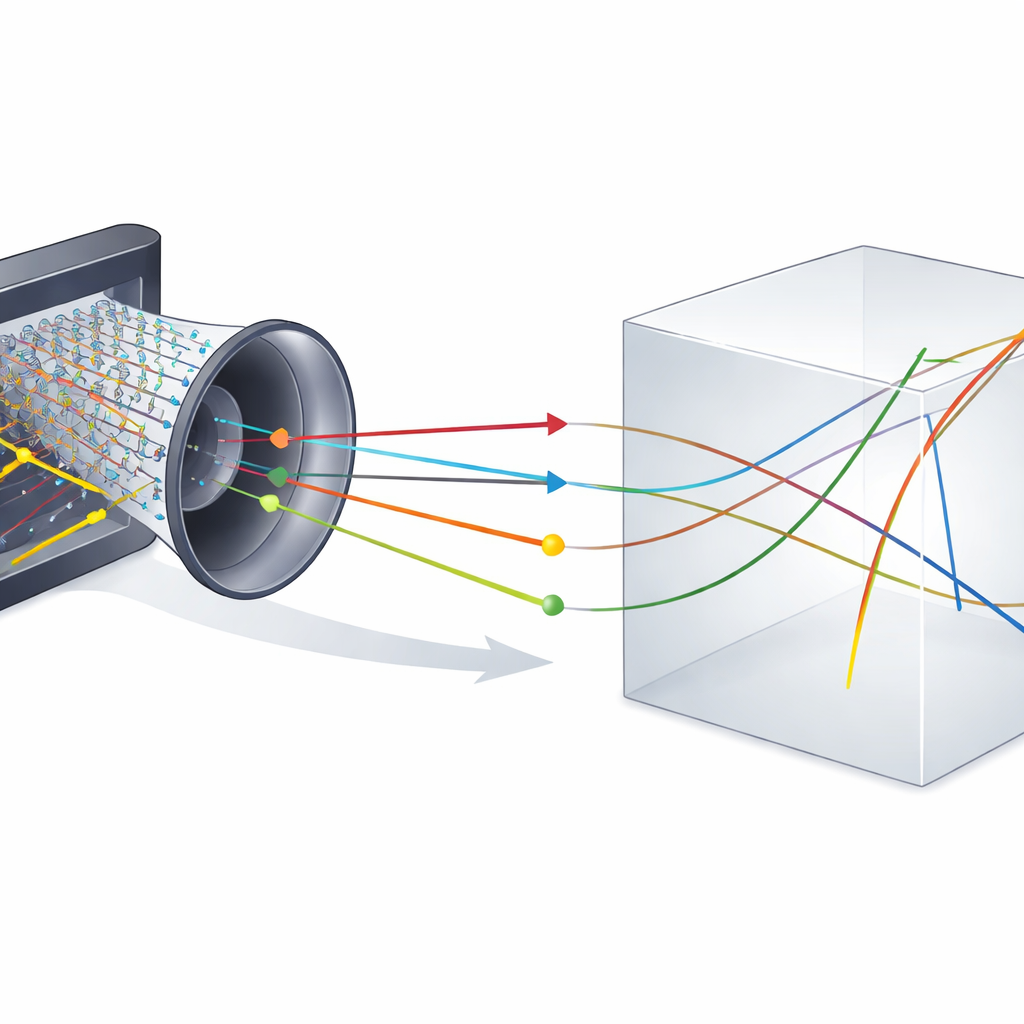
Opening New Windows on Elusive Physics
In essence, this work replaces physical segmentation inside a detector with optical and computational “segmentation” outside it. By combining plenoptic imaging, single-photon timing and modern machine learning, the PLATON concept offers high spatial and temporal resolution in large, dense scintillators without proliferating readout channels. The authors argue that such detectors could sharpen future measurements of neutrino interactions, aid in dark matter searches, and improve medical and industrial imaging techniques that rely on scintillation or Cherenkov light. If the necessary sensor and optics improvements can be realized, large unsegmented scintillator blocks may one day provide detailed 3D movies of invisible particles passing through matter.
Citation: Dieminger, T., Alonso-Monsalve, S., Alt, C. et al. An ultrafast plenoptic-camera system for high-resolution 3D particle tracking in unsegmented scintillators. Nat Commun 17, 4204 (2026). https://doi.org/10.1038/s41467-026-70918-x
Keywords: neutrino detectors, light-field imaging, single-photon cameras, 3D particle tracking, scintillator technology