Clear Sky Science · en
Mechanical hysterons with tunable interactions of general sign
Smart Materials That Remember Pushes and Pulls
Most of the objects around us simply spring back when we push or bend them, but some materials "remember" how they were handled. This paper shows how to build such mechanical memory from the ground up using simple parts—little rotating bars and springs—that can be wired together to sense, store, and process information carried by pushes and pulls. The work turns an abstract idea used to understand glasses and magnets into a hands-on design recipe for future smart materials and mechanical computers.
Tiny Mechanical Bits of Memory
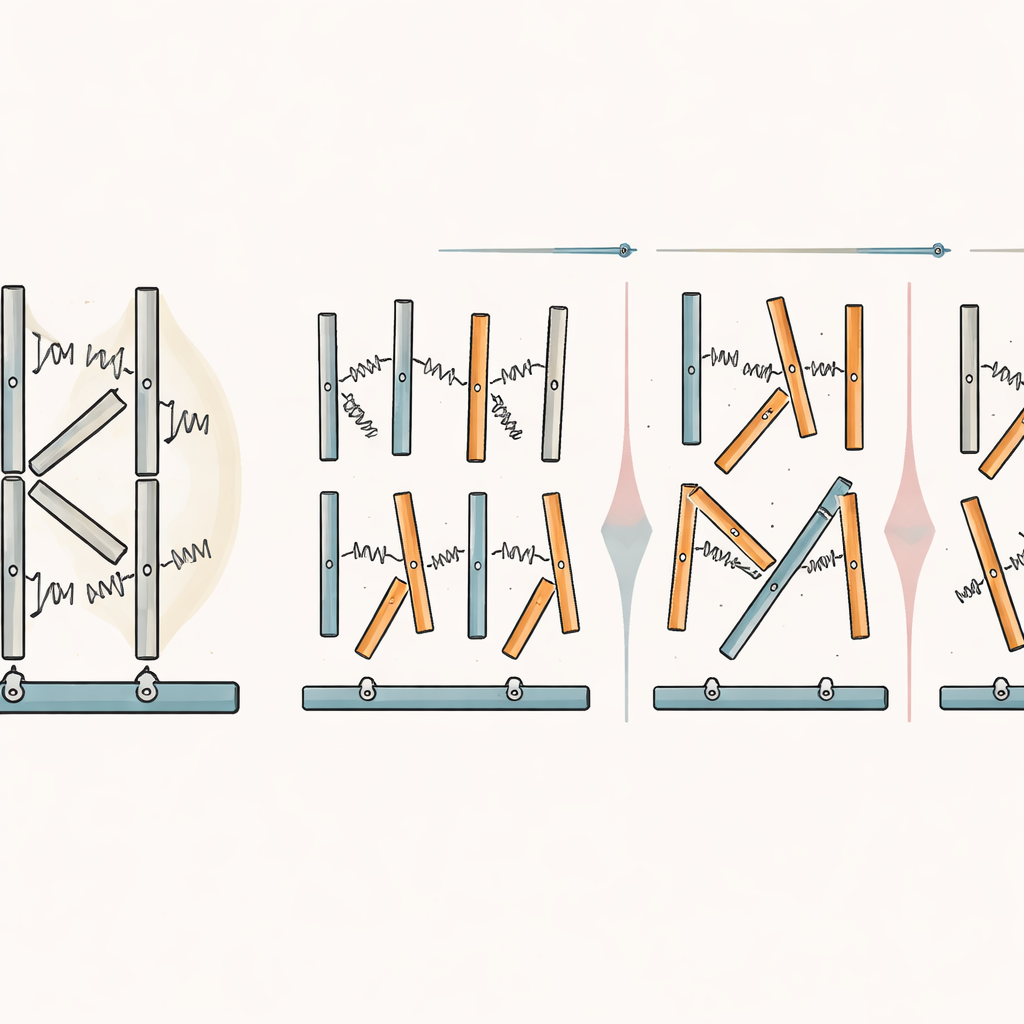
At the heart of the study is the idea of a hysteron, a basic unit that can sit in one of two stable states and that switches between them only when a driving signal crosses certain thresholds. In magnets, these units are tiny regions whose north and south directions flip; here, the author builds a large-scale mechanical version from a rigid bar that rotates around a central pivot and is trapped between two physical stops. A spring connects each bar to a sliding rod that moves back and forth to provide a global mechanical drive. As the rod moves, the bar suddenly jumps from one allowed angle to the other, and it only jumps back when the rod is moved far enough in the opposite direction. This jumpy, history-dependent response is exactly the hallmark of hysteresis and turns each bar into a mechanical bit of memory.
Making the Bits Talk to Each Other
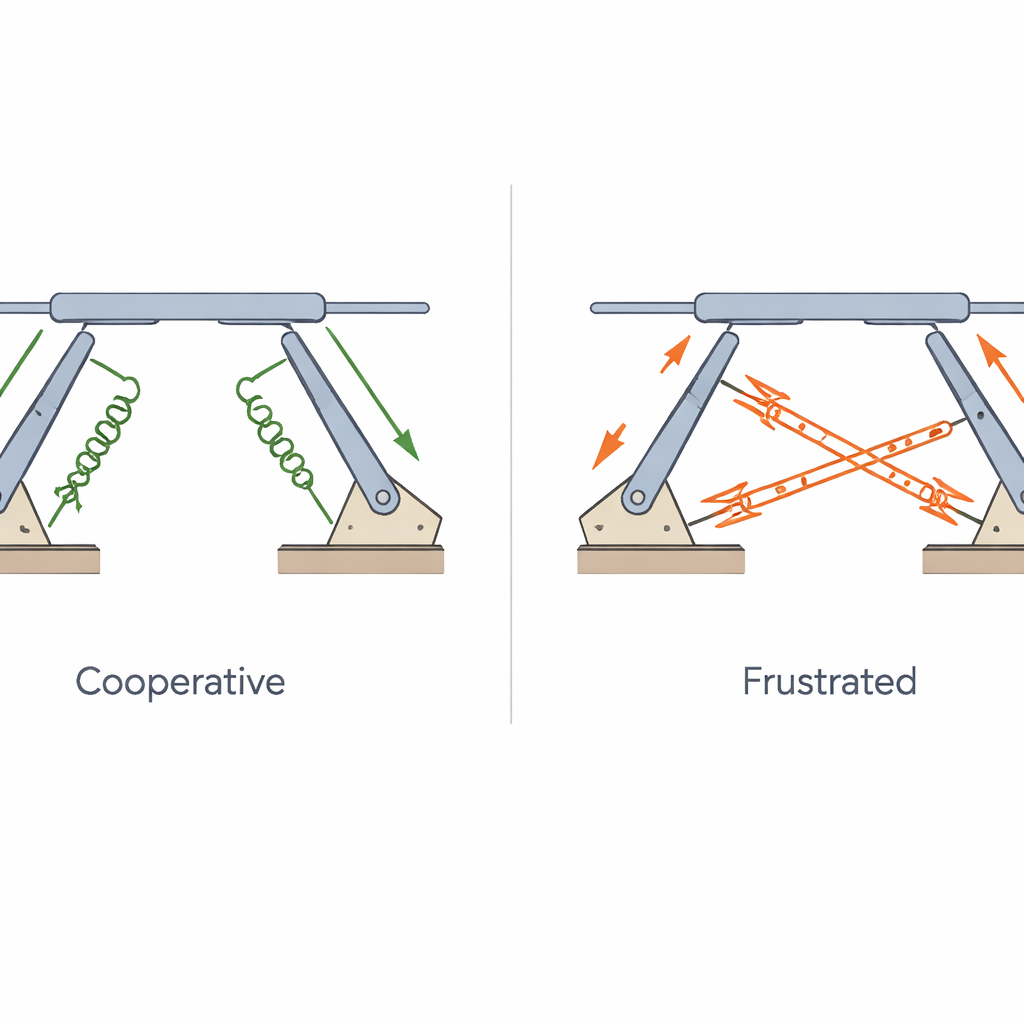
One hysteron on its own is a simple memory cell; the real power comes when many of them interact. To achieve this, the author links pairs of rotating bars with extra springs mounted at carefully chosen positions along each bar. When the connecting springs run straight between the two bars, both units prefer to point the same way, mimicking the behavior of neighboring spins in a ferromagnet. When the springs are crossed, the bars prefer to point in opposite directions, like an antiferromagnet. By changing where along each bar the coupling springs attach, the strength of this preference can be tuned continuously, and even subtle effects—such as one bar influencing its partner more strongly than it is influenced in return—can be engineered.
A Design Map from Geometry to Behavior
To turn this into a true design platform, the paper develops a mathematical description that links simple geometric choices—bar lengths, angles to the stops, spring positions, and rest lengths—to the switching thresholds and mutual influences of the hysterons. By balancing torques from the driving and coupling springs, the author derives formulas that predict when each bar will flip, depending on the states of all the others. In certain limits, these relationships simplify to a clean, almost textbook form where interactions are pairwise, linear, and controllable in sign and strength. This bridge between geometry and logic allows the experimenter to dial in desired behaviors by adjusting screws and mounts on a tabletop apparatus rather than guessing by trial and error alone.
Mechanical Circuits That Latch and Count
Armed with this design map, the author demonstrates several small "mechanical circuits" that carry out recognizable information-processing tasks. With two strongly frustrated, unequal interactions, the system realizes a latch: a modest push sequence flips one bar into a new state that stays put even after the drive returns to zero, and only a larger sequence resets it—an essential ingredient of memory that intentionally violates the usual rule that systems retrace their steps. Chains of many hysterons with alternating preferences act as mechanical counters, where a moving boundary between ordered regions marches down the chain, advancing one step per driving cycle and recording how many times the system has been shaken. A carefully tuned arrangement of four interacting units even distinguishes between odd and even numbers of cycles, performing a simple modulo-two computation purely through mechanical motion.
Why This Matters for Future Smart Materials
Altogether, the work shows that a wide variety of complex, history-dependent behaviors seen in disordered materials can be reproduced and purposefully engineered using a single, reconfigurable mechanical building block. Instead of designing a new structure from scratch for each task, one platform can be retuned to latch, count, convert analog inputs into digital patterns, or follow intricate state sequences. This points toward materials and mechanisms that blur the line between structure and computation: objects that not only bear loads, but also record how they were used and respond in programmable ways, offering new possibilities for soft robotics, adaptive devices, and physical systems that learn without electronics.
Citation: Paulsen, J.D. Mechanical hysterons with tunable interactions of general sign. Nat Commun 17, 2799 (2026). https://doi.org/10.1038/s41467-026-70913-2
Keywords: mechanical memory, hysteresis, mechanical metamaterials, programmable matter, mechanical computing