Clear Sky Science · en
Volumetric 3D printing of a fluoropolymer and closed-loop chemical recycling of its fluorinated content
Why smart plastics need a better ending
Fluorinated plastics are the quiet workhorses inside nonstick pans, medical tubing, aircraft wiring, and microchips. They shrug off heat, harsh chemicals, and flames, which makes them invaluable in modern technology. But that same stubbornness means they hardly break down once discarded, raising concerns about long term build up in the environment. This study presents a way to both shape a fluorinated plastic into intricate 3D objects within seconds and chemically take it apart again so its fluorinated building blocks can be reused.
New way to shape stubborn plastics
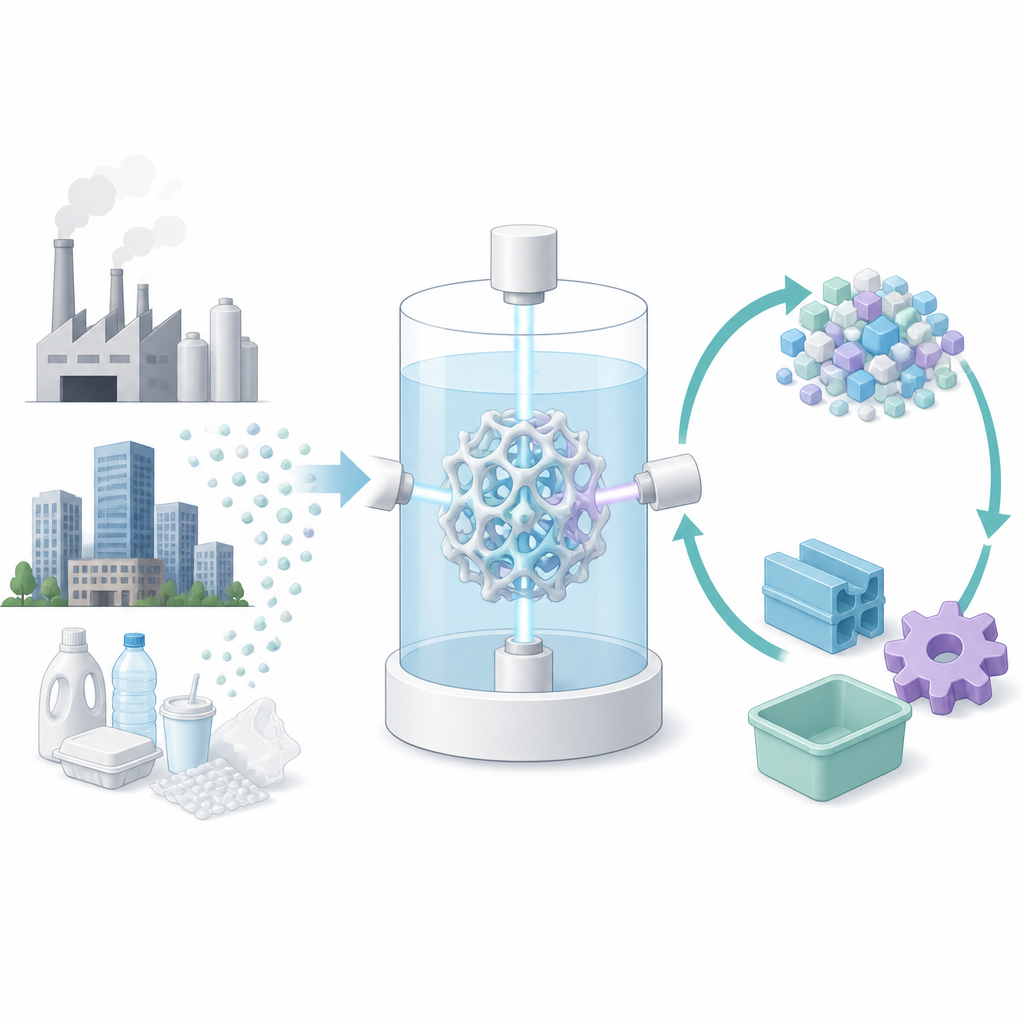
Conventional fluorinated plastics are notoriously hard to process. They do not melt cleanly and are often insoluble, so engineers must carve or sinter blocks rather than print fine features on demand. The researchers tackled this by designing a special liquid mixture, called a photoresist, that turns solid under light. Using a method known as tomographic volumetric 3D printing, they spin this liquid in a transparent container while shining carefully computed light patterns through it. Within tens of seconds, a complete three dimensional object appears inside the liquid, without stacking layers. The new fluorinated photoresist supports centimeter scale parts with features as small as about fifty micrometers, on par with some of the sharpest polymer prints reported for this printing style.
A recipe engineered for speed and precision
To make the liquid resin behave well under this unusual printing method, the team carefully tuned its chemistry and flow. They started from a fluorinated molecule that carries two alcohol groups and attached small carbon carbon double bonds to each end. These double bonds allow the molecules to link up when exposed to light in the presence of a sulfur rich partner molecule. A tiny amount of light sensitive ingredient launches the reaction when illuminated with violet light. A thickening additive keeps the mixture viscous enough so that printed regions do not sag or sink while the part is forming. Measurements of how the resin stiffens under light revealed a short delay before it turns into a solid network. That built in waiting period lets the printer deliver enough dose to the right regions while keeping the surrounding liquid unreacted, which is essential for crisp details in volumetric printing.
Designing a plastic that can be taken apart
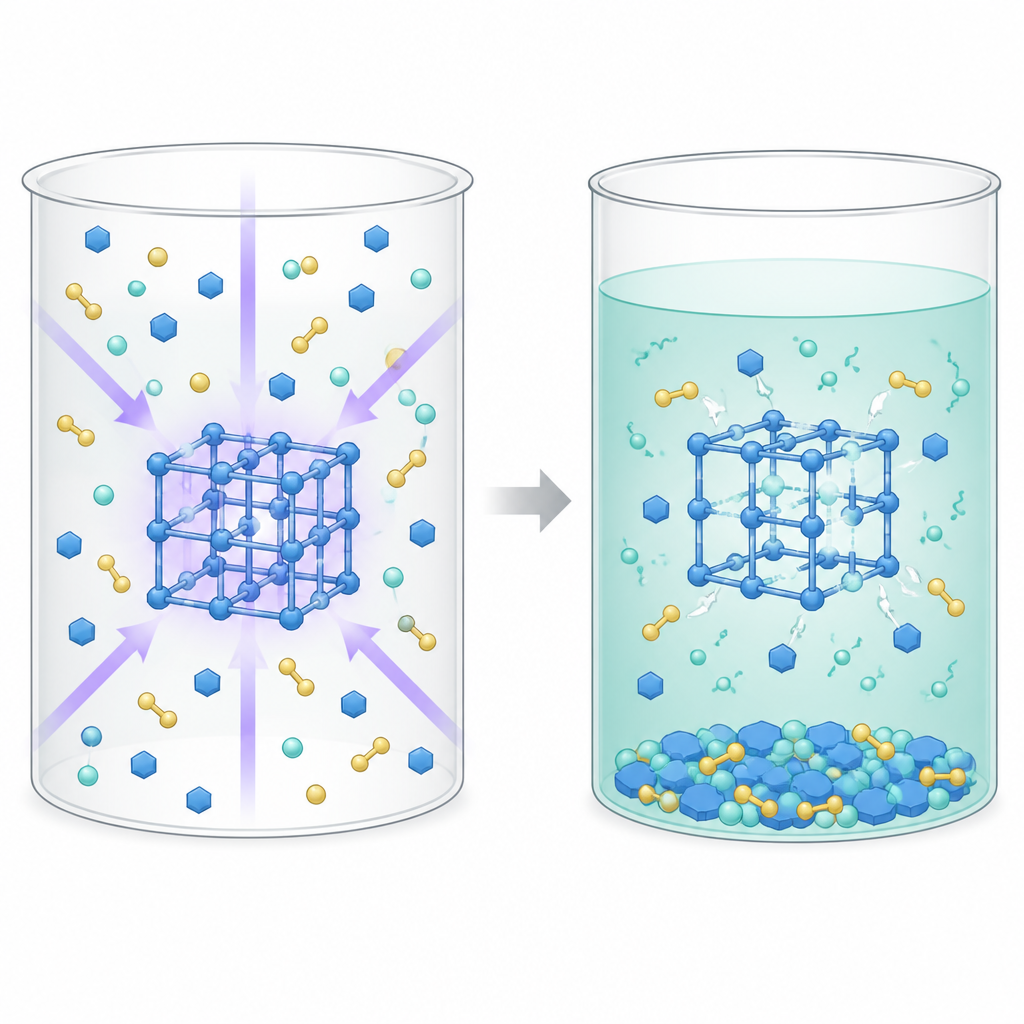
While ease of printing solves the front half of the problem, the authors also built an exit strategy into the material itself. The linkers they added between the fluorinated core and the reactive ends were chosen so that they can be cut under strong alkaline conditions. After use, printed parts are ground and boiled in a concentrated base solution. This treatment selectively snips the designed linkages, releasing the original fluorinated building block into the liquid while leaving non fluorinated fragments behind. By optimizing the strength of the base and the reaction time, the team recovered about ninety seven percent of the fluorinated content. Tests using chemical fingerprinting tools showed that the recovered material was essentially indistinguishable from the starting compound.
Reprint without loss of quality
The recovered fluorinated building blocks can be “re armed” with the same reactive ends and mixed back into the printing liquid. When the researchers repeated the printing process with this recycled material, the resulting plastics matched the originals in important ways. They withstood heat up to nearly three hundred degrees Celsius before noticeable weight loss, showed the same transitions from glassy to soft and partially crystalline states, and displayed similar strength and stretch before breaking. In mechanical tests they could elongate to several times their original length, giving them toughness comparable to commercial nonstick fluoroplastic sheets, even though the new material is a crosslinked network rather than a meltable thermoplastic. Cell culture experiments suggested that the printed parts do not harm human fibroblast cells in the lab, hinting at possible biomedical uses.
Toward cleaner cycles for high tech plastics
By combining rapid volumetric 3D printing with a built in route to recover and reuse the fluorinated core, this work outlines a new life cycle for a class of plastics long viewed as durable but disposable. The study shows that it is possible to keep the advantages of fluorinated materials, such as chemical resistance and stability, while opening a chemical “escape hatch” at end of life that preserves performance over multiple reuse cycles. Although demonstrated here with a single fluorinated system, the same design principles could be adapted to other fluorinated building blocks, helping move high value components in electronics, microfluidics, and medicine toward a more circular and less wasteful future.
Citation: Thijssen, Q., Jaen-Ortega, A., Pien, N. et al. Volumetric 3D printing of a fluoropolymer and closed-loop chemical recycling of its fluorinated content. Nat Commun 17, 4153 (2026). https://doi.org/10.1038/s41467-026-70897-z
Keywords: fluoropolymer, volumetric 3D printing, chemical recycling, circular materials, photoresist