Clear Sky Science · en
Extending the mean-field microkinetics for an accurate and efficient modeling of complex heterogeneous catalyst surfaces
Why tiny catalyst surfaces matter
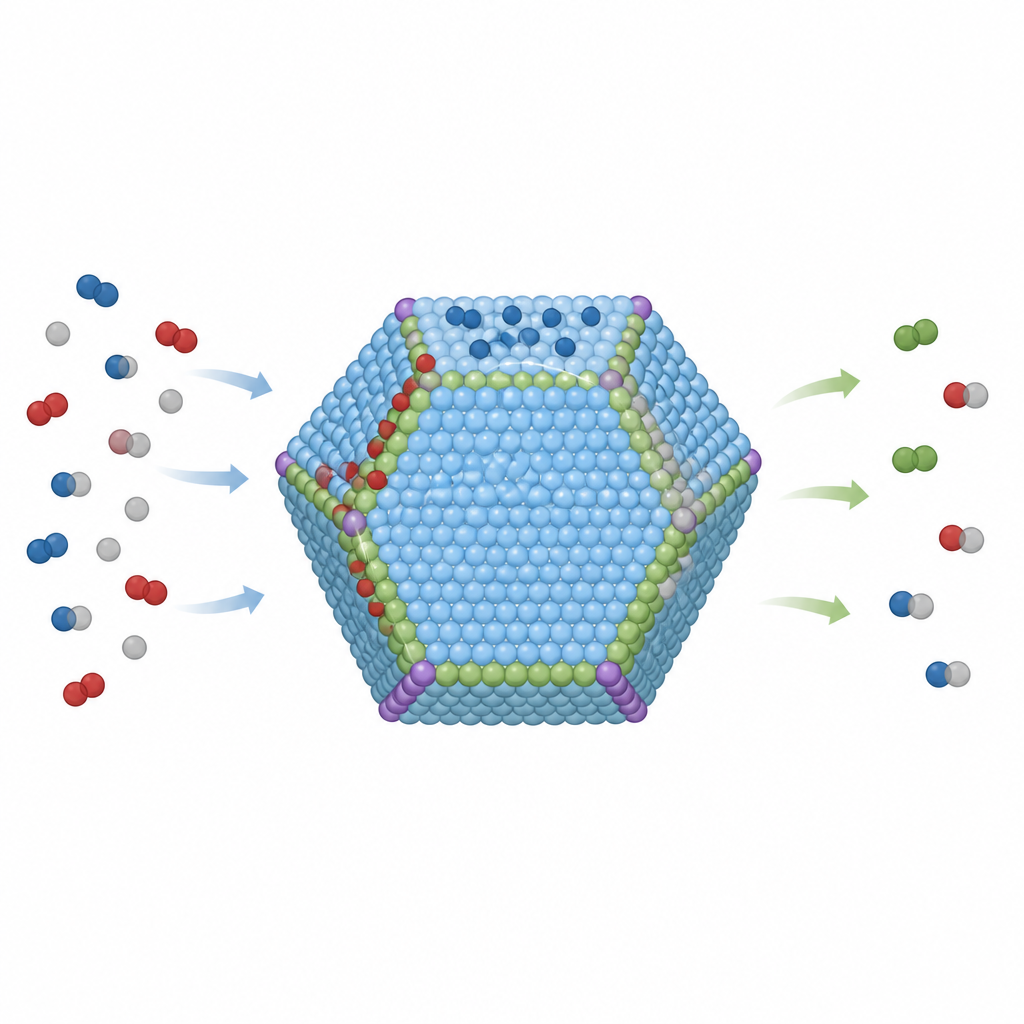
Catalysts quietly drive most industrial chemical reactions, from making fuels to cleaning exhaust. Many modern catalysts are tiny metal particles whose surfaces are patchworks of different atomic neighborhoods. To design better catalysts on a computer, scientists rely on mathematical models that predict how fast reactions will run. This study introduces a new way to model these complex surfaces more accurately, without paying the huge computing cost of fully detailed simulations.
Limits of current shortcut models
Common modeling approaches treat each flat face of a metal particle as if it worked alone. They also often ignore how crowded the surface becomes when many reacting molecules jostle for space or slide from one kind of site to another. These shortcuts make the math simple and fast, but can give misleading answers about which surface features are truly active and how quickly products form. More detailed methods exist that track every event on a grid of atoms, but they are so computationally heavy that they cannot be used to explore many catalyst shapes, sizes, or compositions.
A new way to see the whole particle
The authors present an extended mean field framework, called XMF, that treats an entire metal nanoparticle as a single interacting system. Instead of isolating each surface facet, the method links different types of sites through a description of how easily molecules diffuse between them and how they repel each other when the surface gets crowded. A key idea is to focus on the most abundant surface species, often carbon monoxide in this work, and use its average coverage to adjust the reaction energies everywhere on the particle. By building a compact network of equations based on this information, XMF keeps track of how coverages and reaction rates on different sites influence each other while remaining as cheap to run as older simplified models.
Testing the method on known reactions
To see whether the new approach works, the team studied the water gas shift reaction on platinum, a well known process that helps generate and purify hydrogen. They compared three levels of the XMF method against detailed kinetic Monte Carlo simulations, which served as a numerical gold standard. On simple flat platinum surfaces, XMF closely reproduced reaction rates, apparent activation energies, and which elementary step limits the overall speed, while standard mean field models failed badly when the surface became crowded with carbon monoxide. XMF also matched how the preferred active sites changed with temperature, capturing shifts in which reaction step controls the rate as the system warms.
When surface patches cooperate
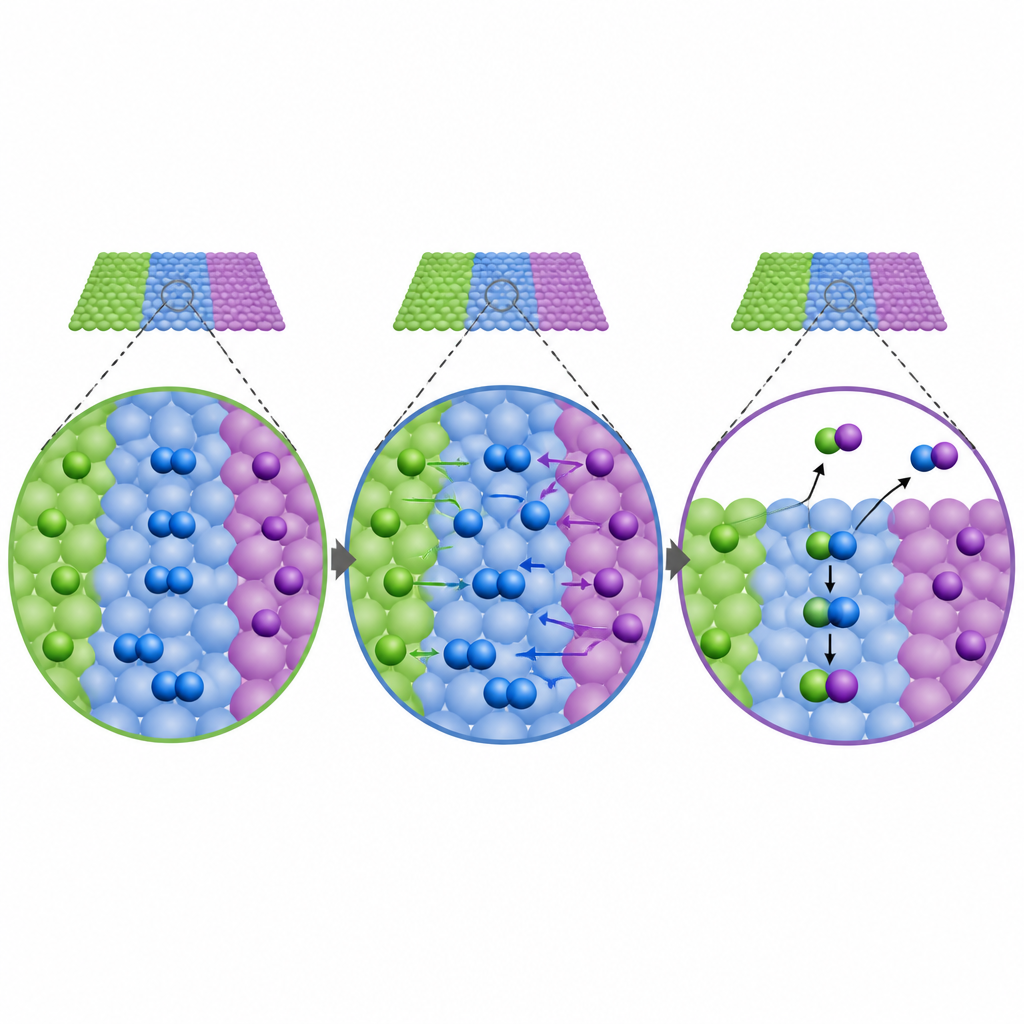
The real strength of XMF appears when different surface patches can work together. The authors built a simple model combining two platinum faces with distinct reactivity and allowed molecules to diffuse between them. In this coupled system, the reaction pathway rearranged itself: water broke apart mainly on edge-like sites, while key intermediates migrated to flatter regions to finish the reaction. XMF captured the higher overall activity and the new rate limiting step that emerged from this cooperation, while conventional models that simply added the separate contributions of each face could not. Applying the method to realistic platinum nanoparticles of many sizes, the study showed that edge and terrace sites remain kinetically linked even on particles approaching one hundred micrometers, challenging the idea that large particles behave like independent slabs.
Reaching toward real-world catalysts
The researchers finally applied XMF to more intricate systems, including platinum nanoparticles of different shapes and platinum ruthenium alloys proposed for low temperature hydrogen production. XMF reproduced the trends from detailed simulations in reaction rates and apparent activation energies and correctly picked out alloy compositions predicted to be most active, though it overestimated activity when poison molecules clustered tightly on multiple adjacent ruthenium atoms. Even with such limitations, the framework enables rapid screening of thousands of candidate structures while still accounting for surface crowding and communication between sites.
What this means for catalyst discovery
For non specialists, the main message is that the fine structure of a catalyst particle matters, and the different corners, edges, and flat regions do not work in isolation. By offering a computational tool that can see the whole particle at once yet still run quickly, this work helps bridge the gap between complex atomic reality and practical design calculations. The XMF framework provides more reliable guidance on which surface motifs and alloy patterns truly boost performance, supporting faster and more informed searches for better catalysts across many industrial reactions.
Citation: Wang, Y., Shen, T., Yang, Y. et al. Extending the mean-field microkinetics for an accurate and efficient modeling of complex heterogeneous catalyst surfaces. Nat Commun 17, 4426 (2026). https://doi.org/10.1038/s41467-026-70896-0
Keywords: heterogeneous catalysis, microkinetic modeling, nanoparticle catalysts, water gas shift reaction, platinum ruthenium alloys