Clear Sky Science · en
Aptamers with magnetically tunable affinity for divalent cobalt ions
Using magnets to control tiny helpers
Imagine being able to turn molecular recognition on or off with a knob, the same way you flip a light switch. This study shows how very strong magnets can tune the way short pieces of DNA grab onto metal ions, hinting at future tools that could release drugs, sharpen medical scans, or sense chemicals only when a magnetic field is present.
Why magnets matter in biology
Scientists have long wondered whether magnetic fields can reliably control biological activity. Some ambitious ideas, such as steering brain cells with "magnetogenetic" proteins, have met with skepticism because the forces from Earth strength fields are usually too weak to overcome thermal noise. Instead of focusing on whole cells or proteins in weak fields, the authors turned to a simpler and more controllable system: how certain metal ions, which are naturally sensitive to magnetism, interact with DNA. This shift in focus allowed them to ask a clear question: can one deliberately select DNA strands whose grip on metal ions becomes stronger only in a strong magnetic field?
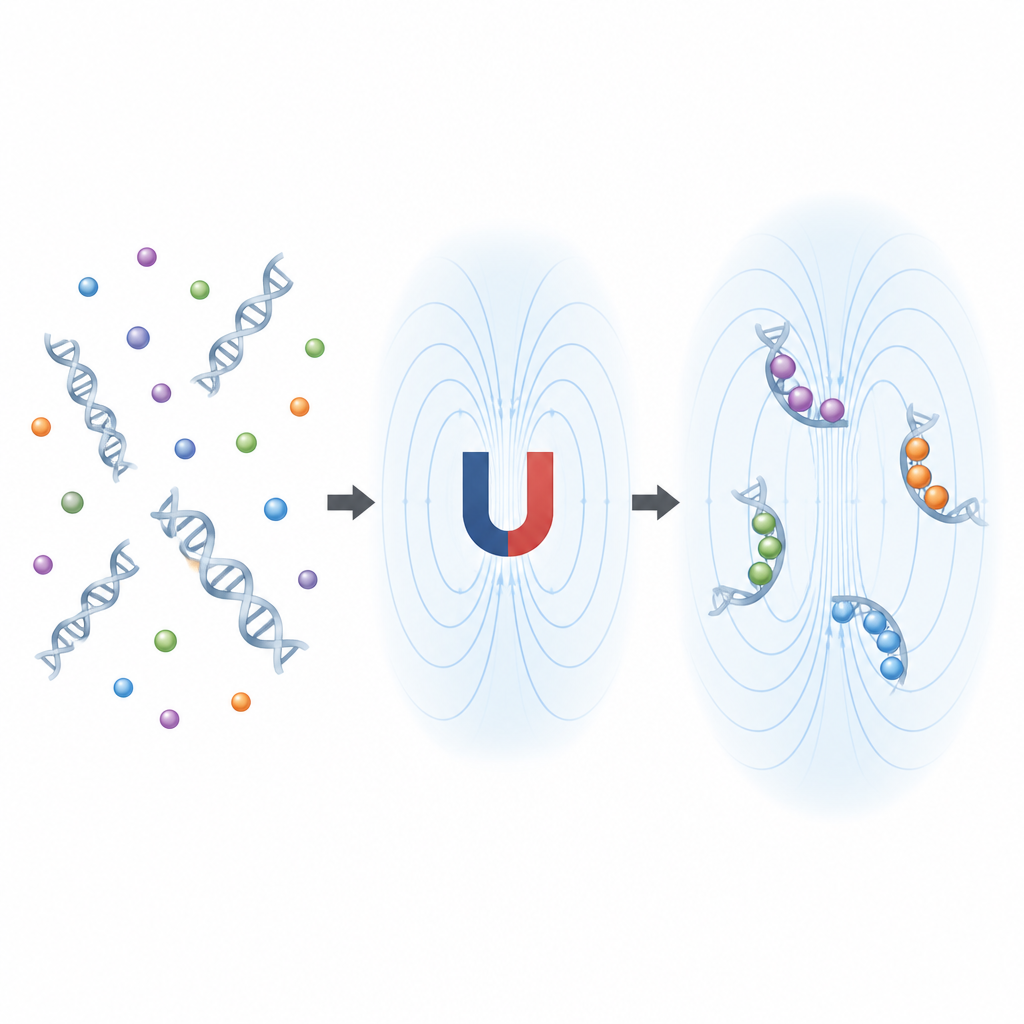
Designer DNA that grabs cobalt harder in a magnet
The team worked with aptamers, which are short DNA strands that fold into shapes able to latch onto specific targets. They built a large pool of random DNA sequences and exposed it to divalent cobalt ions inside an intense 9 tesla magnetic field, far stronger than any hospital scanner. Using a method called HM SELEX, they repeatedly kept the DNA that bound cobalt in the magnet while discarding sequences that either stuck to other metals or already bound cobalt in Earth’s normal field. Over seven rounds of this selection, the pool evolved into a much smaller set of aptamers enriched for magnetic field dependent binding.
Two kinds of magnetic response
Tests on the ten most common aptamers revealed two distinct behaviors. One group, exemplified by a sequence called Co M3, already bound cobalt at normal field strength but became 2–3 times tighter as the field was raised stepwise from ambient to 3, 6, and 9 tesla. Another group, typified by Co M8, behaved more like a true switch: in normal conditions it barely bound cobalt at all, but above about 6 tesla it suddenly showed clear binding. Independent measurements using fluorescence, calorimetry, circular dichroism, and gel assays all agreed that these changes were real and reversible, and that the sequences were fairly selective for cobalt over many other metal ions.
How shape change and charge drive the effect
To understand what the magnetic field was actually doing, the researchers combined computer simulations with chemical probing. The calculations modeled how cobalt ions and the negatively charged DNA backbone attract each other in the presence of a field that acts on cobalt’s three unpaired electrons. They found that increasing the field strengthened the electrostatic interaction between ions and aptamer, and encouraged more ions and more DNA bases to join the binding pocket. In Co M8, for example, specific regions of the strand reconfigured to open up a multi ion cluster only in strong fields. Chemical footprinting and point mutations at key bases disrupted this cluster and erased the switching behavior, tying the magnetic effect directly to a particular folding pattern and coordination geometry.
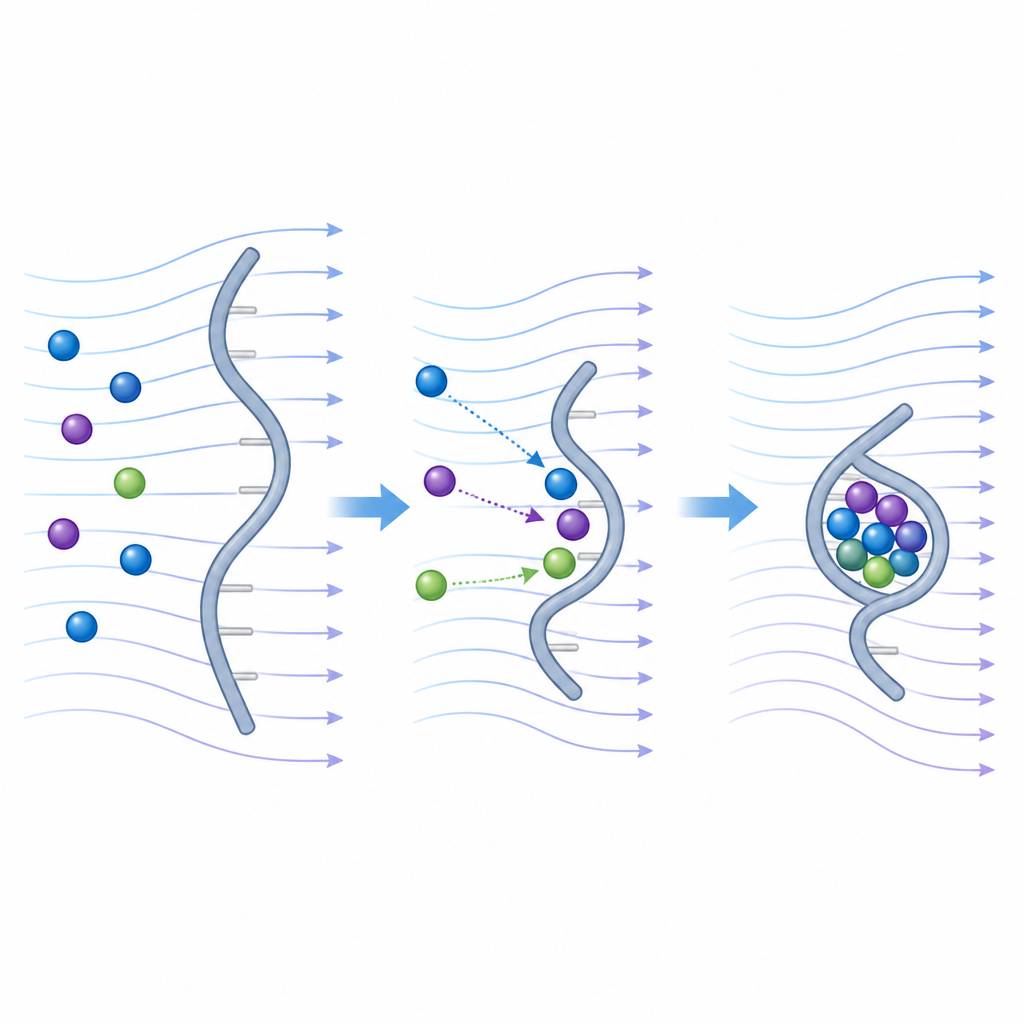
From proof of concept to future tools
The study concludes that these aptamers act as magnetically tunable molecular switches: their grip on cobalt can be dialed up, or in some cases turned on entirely, by applying a strong magnetic field. The energy contributed by the field is small but enough to tip the balance for multi ion binding sites that are already poised near a threshold. Although today’s effect appears only at very high fields and only for paramagnetic ions like cobalt, the work offers a clear blueprint for designing DNA based components that respond directly to magnets. With further refinement and lower switching thresholds, similar systems could underpin smart MRI contrast agents, magnetically triggered drug carriers, or sensors that recognize their targets only when a field is applied.
Citation: Gao, S., Wang, L., Yao, L. et al. Aptamers with magnetically tunable affinity for divalent cobalt ions. Nat Commun 17, 4150 (2026). https://doi.org/10.1038/s41467-026-70871-9
Keywords: aptamers, cobalt ions, magnetic field, DNA switches, biorecognition