Clear Sky Science · en
AP-1 mediates cellular adaptation and memory formation
How Cells Learn From Stress
When we think of learning and memory, we picture brains, not single cells. Yet this study shows that individual cancer cells can form memories of past drug treatments and use those memories to survive. By uncovering how this cellular memory works, the researchers reveal why some tumors become resistant to therapy and hint at new ways to prevent that escape.
Cells That Do More Than Follow Instructions
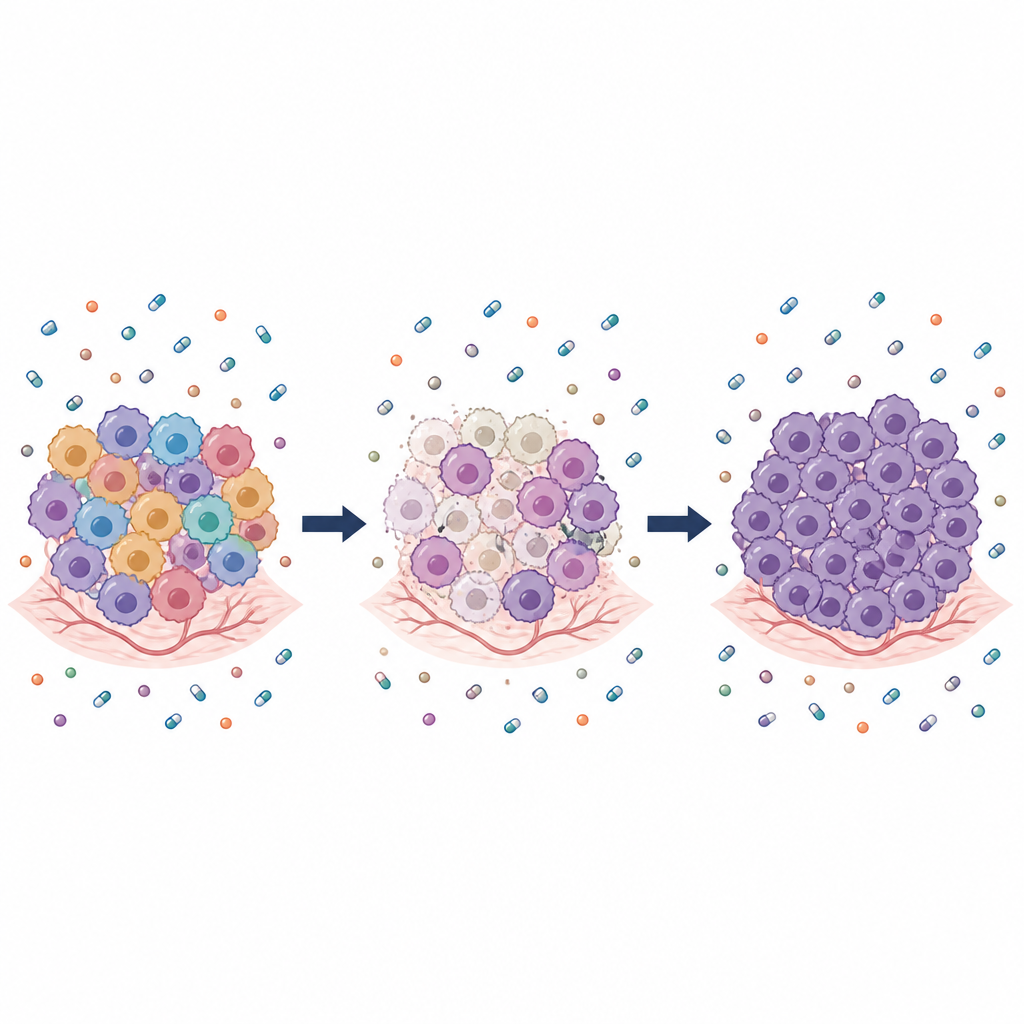
Biologists often describe cells as running fixed genetic programs, like factory machines following a blueprint. In that view, a cell’s response to a drug is predetermined by its DNA. The authors challenge this idea using melanoma cells treated with targeted cancer drugs. Most cells die, but a tiny minority are in a special "primed" state that lets them survive and eventually regrow. Earlier work showed these survivors were not genetic mutants. Here, by tracking gene activity and behavior over time, the team finds that primed cells do not simply expand unchanged. Instead, as drug exposure continues, they adapt, altering their molecular state to become fully and stably resistant.
Evidence That Cells Adapt Over Time
To separate simple selection from true adaptation, the researchers used a clever dose-escalation strategy. They first treated cells with a low dose of a drug, then after two weeks switched to a higher dose. If resistance were fixed from the start, only the rare cells already tough enough for the high dose would survive the switch. Instead, many more colonies lived through the step up in dose than this model predicts. Lineage barcodes, which track the fate of sister cells, showed that some clones could survive the low dose only after time had passed, and these same clones then withstood the higher dose. Live imaging confirmed that when the dose increased, most cells in an already established colony paused briefly, then resumed growth, rather than dying off and being replaced. Together, these results point to active adaptation during treatment.
Writing Memories Into Cellular Material
The team then asked what exactly the cells were remembering. They reasoned that if a cell can learn, it should be able to preserve the activity of any gene that happens to be switched on when therapy begins, even if that gene is not normally part of a resistance pathway. To test this, they used a common steroid drug to briefly turn on certain genes, then removed the steroid and added the cancer therapy. In ordinary conditions these genes switch off once the steroid is gone. Under therapy, however, their elevated activity persisted for weeks, as if the cells had recorded a snapshot of which genes were active at the moment treatment started. Measurements of chromatin accessibility, a readout of how open or closed DNA is, showed that regions associated with those genes also stayed open, supporting the idea of a lasting molecular memory.
The Role of AP-1 and Local Memory Encoding
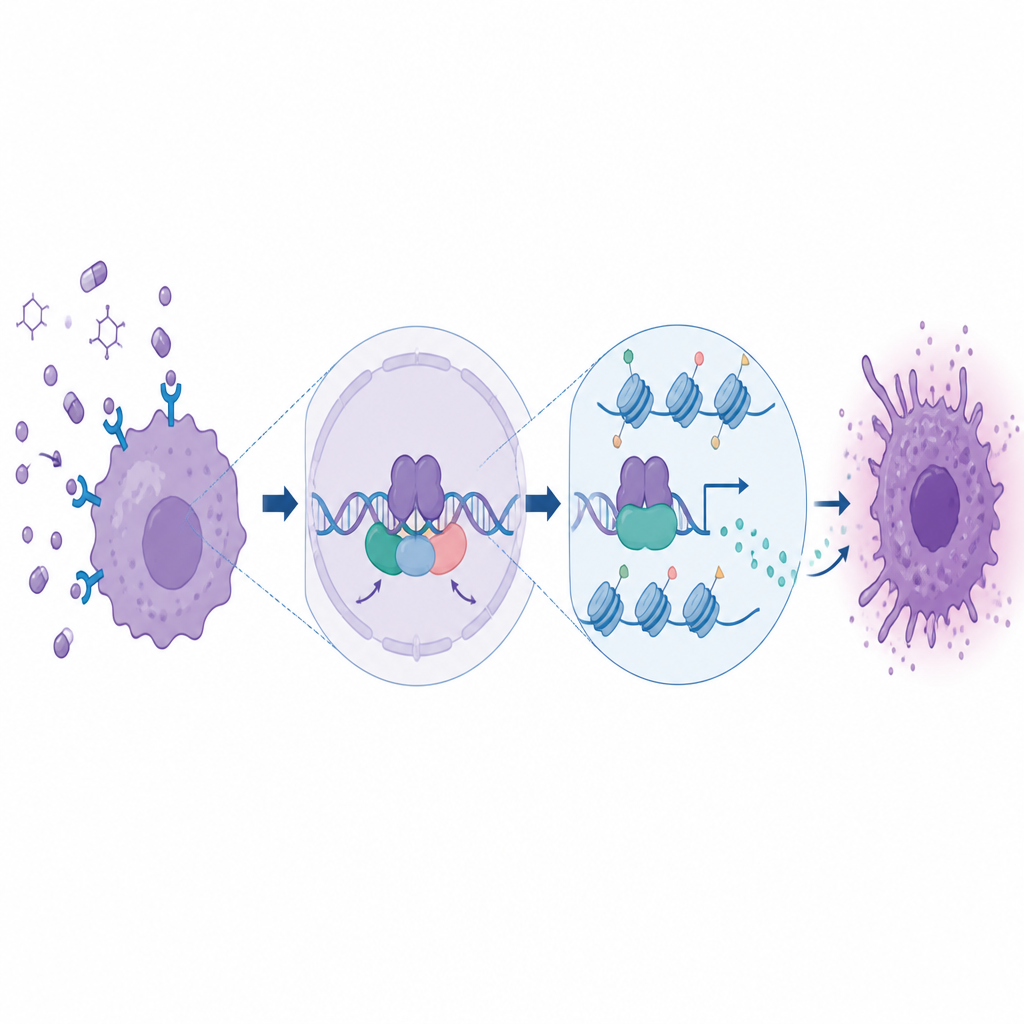
A central player in this process is AP-1, a common transcription factor that responds to cellular stress. When the researchers blocked AP-1 activity using chemical inhibitors, cells lost much of their ability to adapt during dose escalation, and the memory of steroid-induced genes was largely erased. To see where this memory is stored, they built a dual-color reporter system with two identical AP-1–responsive switches driving different fluorescent proteins. Before treatment, random molecular noise made one color or the other brighter in individual cells. After prolonged drug exposure, entire resistant colonies tended to preserve whichever color was higher at the start, even though the underlying DNA control sequences were the same. This shows the memory is encoded locally at each gene copy, not just in a global cell state, a form of "cis" memory.
How Memory-Storing Enzymes Help Resistance Last
To dig deeper into the machinery of memory, the authors examined CBP and p300, enzymes that add chemical tags to histone proteins and can both read and write these marks. Inhibiting their activity during or after treatment weakened or erased the enhanced reporter activity in resistant colonies and could even prevent colonies from forming in the first place. This suggests that CBP/p300 help stabilize the open, active chromatin states that store the memory of past gene activity and pass it through cell divisions.
Why Cellular Memory Matters for Cancer Treatment
In simple terms, this work shows that cancer cells can "remember" stressful drug exposure and adjust their behavior accordingly. Instead of relying only on fixed genetic programs, they use AP-1 and chromatin-modifying enzymes to lock in whatever gene patterns were active when therapy started, turning temporary responses into long-lasting traits. For patients, this means that resistance can arise not just from mutations but from flexible, learned changes in cell state. Targeting the memory-forming machinery, or timing treatments to avoid helping cells encode these memories, may offer new strategies to keep cancers from learning how to survive therapy.
Citation: Li, J., Ravindran, P.T., O’Farrell, A. et al. AP-1 mediates cellular adaptation and memory formation. Nat Commun 17, 4265 (2026). https://doi.org/10.1038/s41467-026-70862-w
Keywords: cellular memory, therapy resistance, AP-1, epigenetics, melanoma