Clear Sky Science · en
Increasing fatigue resistance in ordered intermetallic alloys with multi-element symbiosis
Why tougher metals matter
From jet engines to nuclear reactors, many of our most demanding machines rely on metallic parts that must endure billions of tiny push–pull cycles without breaking. A major class of promising materials, called intermetallic alloys, are very strong but tend to crack early under this kind of repeated loading, a failure known as fatigue. This study reports a new way to build intermetallic alloys that resist fatigue so well that they can withstand stresses even above the level where they first start to deform, opening a path to safer and lighter components in extreme environments.
Building a new kind of metal
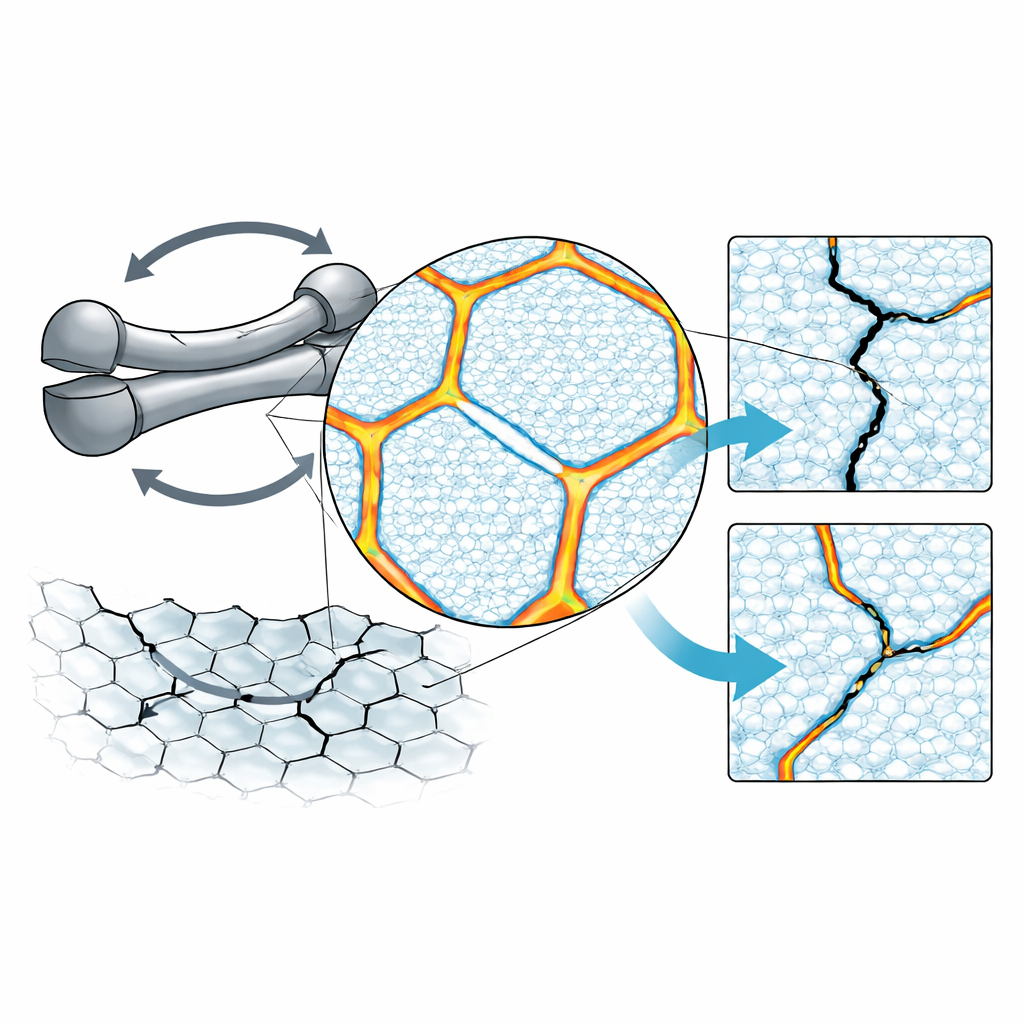
The researchers engineered a carefully tailored alloy made mostly of cobalt and nickel, with smaller amounts of titanium, aluminum, tantalum, vanadium, and a trace of boron. Inside this metal, atoms arrange in a highly ordered pattern that normally gives intermetallics their strength but also makes them brittle. The team deliberately pushed the composition away from the usual recipe so that certain elements would migrate to the borders between tiny crystalline grains. This produced an internal “core–shell” architecture: each grain retains an ordered core, while its boundary is wrapped by an ultrathin, more disordered layer only about two billionths of a meter thick.
A hidden soft layer at grain borders
Using advanced electron microscopy and atom probe techniques, the authors mapped where each type of atom prefers to sit. They found that cobalt and boron crowd into the grain edges, while several other elements are pushed out. This segregation turns the orderly structure at the grain boundary into a more flexible, face-centered cubic layer, while the grain interiors stay strongly ordered. In effect, every grain is glued to its neighbors by a nanoscopic, slightly softer skin. At the same time, the complex arrangement of elements inside the ordered cores raises the energy cost of certain atomic shifts, which strengthens the lattice against the defects that usually form under cyclic loading.
Strength and endurance beyond expectations
Mechanical tests on samples with both fine and coarse grains showed a rare combination of very high strength and large stretch before failure. Most striking, under repeated tension at room temperature, the new alloy sustained stress levels of 800 to 1,100 megapascals for at least ten million cycles without breaking. These fatigue limits are not only far above those of earlier intermetallics—typically below 400 megapascals—but also exceed the alloy’s own yield strength, which is where permanent deformation begins. In most metals, the safe fatigue stress lies well below this yield point; having it sit above marks an unusually efficient use of the material’s strength compared with many state-of-the-art steels and superalloys.
How the alloy stops cracks from spreading
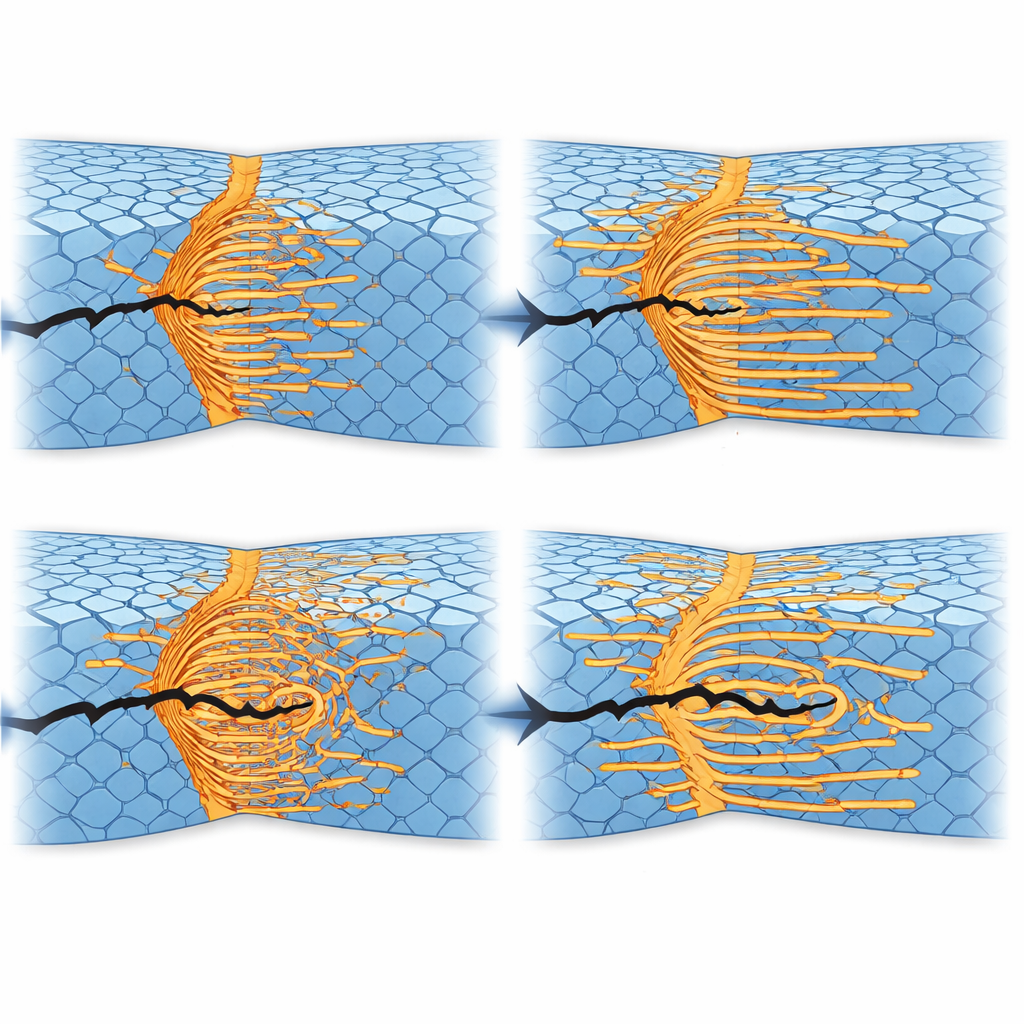
To understand why this metal lasts so long, the team examined fracture surfaces and the internal structures formed during cycling. In conventional intermetallics, cracks race along grain boundaries, producing a coarse, rock-candy-like pattern that signals brittle failure. In the new alloy, the crack path changes: grain boundaries remain intact, and cracks cut through grains in a tortuous, zigzag route. The thin disordered layers at grain borders act both as strong glue and as launch pads for controlled deformation in the ordered cores. Under high cyclic stress, they emit lines of atomic defects that organize into bands and networks, and eventually into ultra-thin twins—mirror-like regions in the crystal. These features redistribute strain, slow the advance of cracks, and roughen the fracture path, all of which dramatically reduce the rate of damage accumulation.
What this means for future machines
In plain terms, the authors have shown that adding a carefully designed, disordered nanolayer around ordered grains can turn a usually brittle family of alloys into materials that are both strong and surprisingly fatigue-resistant. By letting grain boundaries act as flexible, tough interfaces instead of weak links, and by triggering rare deformation modes that spread strain more evenly, the alloy resists crack initiation and growth even under extreme repeated loading. This design concept—using atomic-scale “glue” at internal borders—offers a powerful blueprint for creating next-generation structural metals that could make aircraft, power plants, and other critical systems both lighter and more reliable.
Citation: Li, Q., Jing, L., Duan, F. et al. Increasing fatigue resistance in ordered intermetallic alloys with multi-element symbiosis. Nat Commun 17, 4122 (2026). https://doi.org/10.1038/s41467-026-70838-w
Keywords: fatigue resistance, intermetallic alloys, grain boundaries, nanostructured metals, aerospace materials