Clear Sky Science · en
A statistical understanding of oxygen vacancies in distorted high-entropy perovskite oxides
Why tiny gaps in crystals matter for clean energy
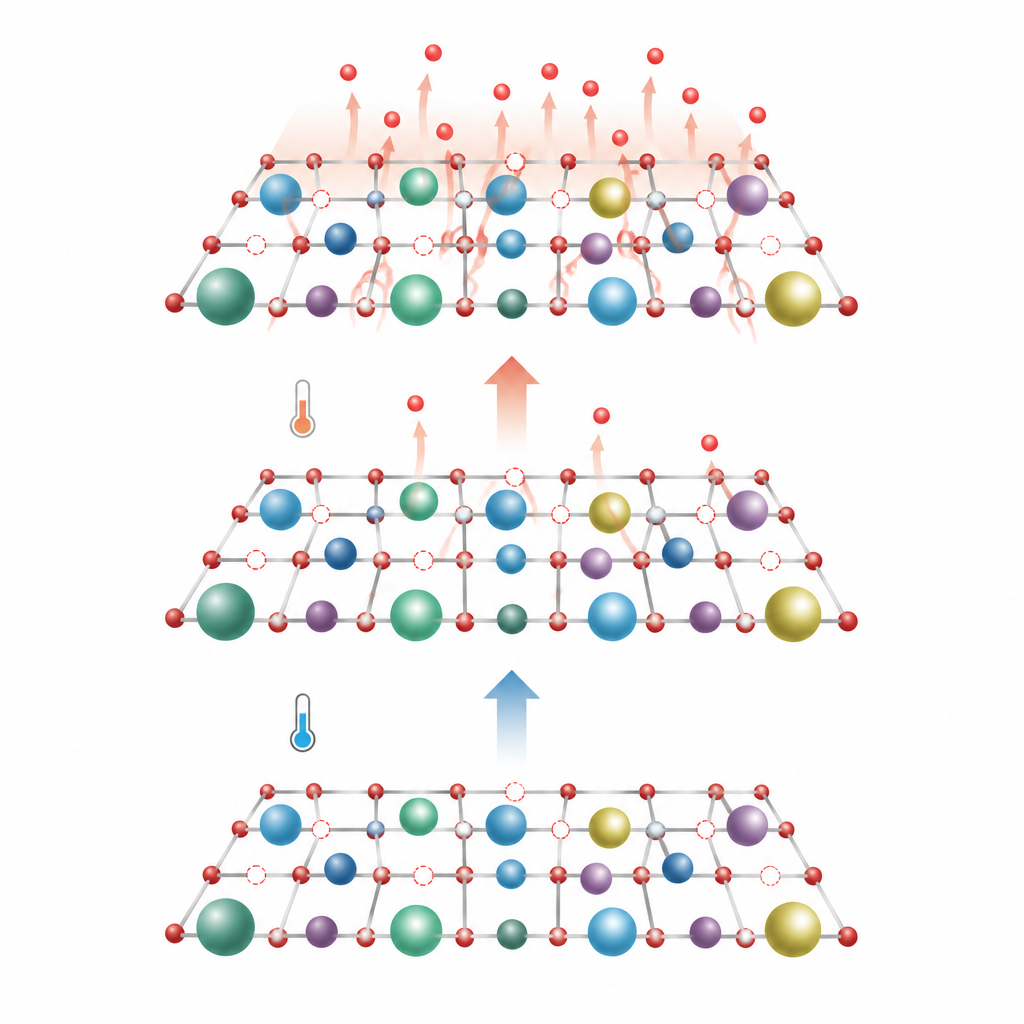
Solid oxide electrolysis cells can turn electricity and heat into hydrogen fuel, but their performance depends sensitively on what happens inside their ceramic electrodes. This study looks at high‑entropy perovskite oxides, a new class of mixed‑metal crystals, and asks a simple question with big consequences: how do countless tiny missing oxygen atoms, known as oxygen vacancies, form and change with temperature in these complex materials?
Crystals that power hot hydrogen factories
Perovskite oxides are a family of materials used as anodes in high‑temperature solid oxide electrolyzers, devices that split steam into hydrogen and oxygen. In these crystals, oxygen ions move by hopping into vacant spots in the oxygen lattice, so the number of vacancies helps control how fast ions travel, how much the material expands when heated, and how stable it remains. High‑entropy perovskites mix five or more different metals on one site in the crystal, which is thought to improve stability at high temperature. But this chemical complexity also makes it difficult to predict how many oxygen vacancies will appear under operating conditions and how that number will vary as the device heats up.
Measuring missing oxygen in complex mixtures
The researchers synthesized fourteen perovskite compositions based on a widely used electrode material called LSCF, some with only a few types of metal on the A‑site of the crystal and others with many, qualifying as high‑entropy. They heated powdered samples in air from 500 to 1000 degrees Celsius and used thermogravimetric analysis to track very small changes in mass as oxygen left the lattice. From these measurements they extracted how the oxygen vacancy concentration changed with temperature and used established defect chemistry models to calculate the effective energy and entropy associated with forming vacancies in each composition.
Two knobs that control vacancy behavior
The team found that vacancy concentration is governed mainly by two simple quantities that describe the A‑site metals. The first is the fraction of divalent cations, metals such as strontium, calcium, or barium that carry a 2+ charge. This fraction sets an upper limit on how many vacancies can form because their charge must be balanced by missing oxygen. The second, newly highlighted factor is the spread in ionic sizes among the A‑site metals, described as the A‑site size variance. High‑entropy samples, with a larger spread in A‑site sizes, tend to host more vacancies at moderate temperatures and show a more linear, less sharply rising increase in vacancies as the material heats up.
How atomic disorder reshapes vacancy energetics
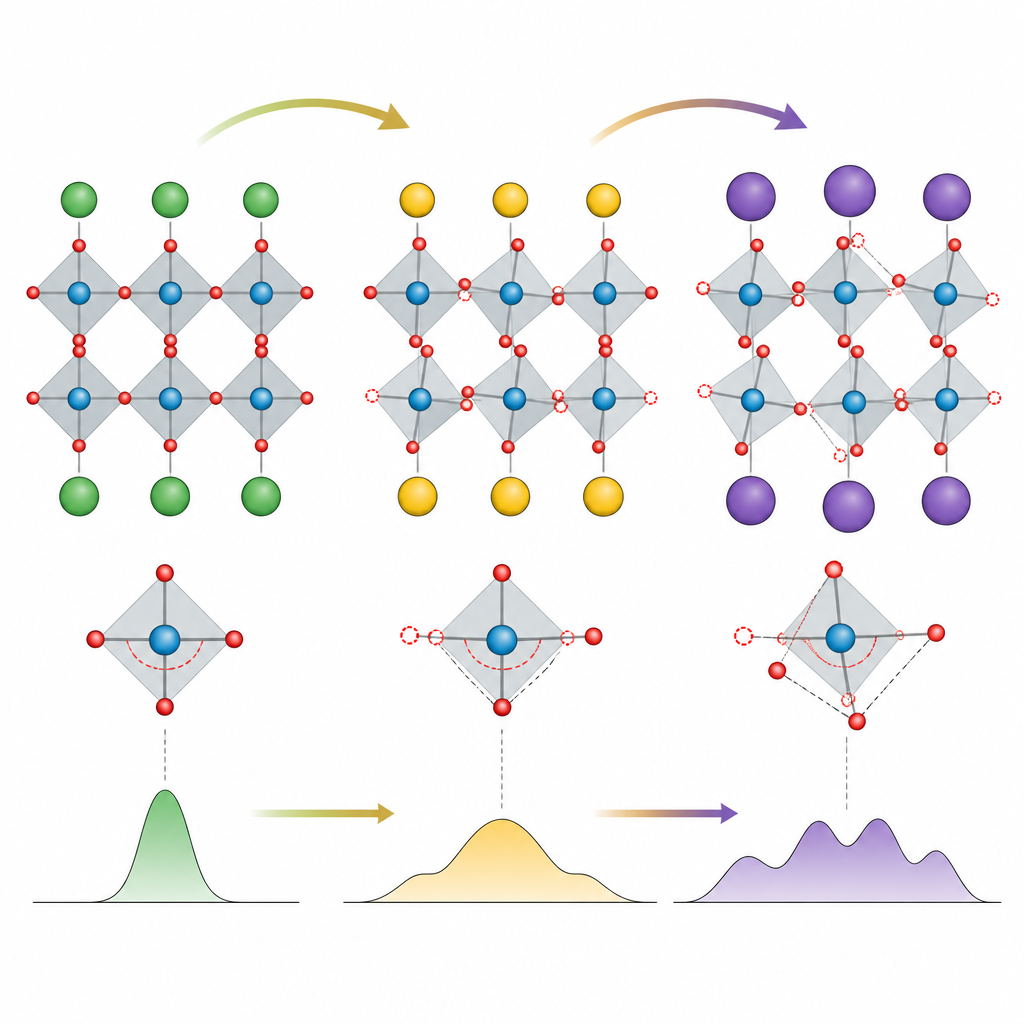
To understand why size variance matters, the authors turned to atomistic simulations using a machine‑learned interatomic potential. They modeled large perovskite supercells with randomly mixed A‑site metals and calculated the energy cost of removing oxygen at hundreds of different lattice sites. When the A‑site metals differed strongly in size, the surrounding octahedra of oxygen around the B‑site metals became more distorted, and the energies required to create vacancies spread out into a wider distribution. Rather than having one characteristic vacancy energy, the material exhibited many slightly different local environments, some of which made forming a vacancy easier.
Using statistics to predict defects
Building on this picture, the researchers treated vacancies statistically, viewing each oxygen site as having its own formation energy drawn from a distribution. Using tools from statistical thermodynamics, they showed that greater spread in vacancy energies lowers both the effective enthalpy and entropy of vacancy formation. Importantly, when these statistical formulas were supplied with the simulated energy distributions, they accurately reproduced the experimentally measured vacancy energies, entropies, and temperature‑dependent vacancy concentrations. In contrast, traditional models that assume a single average vacancy energy failed to capture key differences between low‑entropy and high‑entropy compositions.
What this means for future energy materials
For readers interested in clean energy technology, the takeaway is that the mix of metal sizes in these complex oxides offers a practical design handle. By increasing the size variance among A‑site metals, material scientists can make the number of oxygen vacancies less sensitive to temperature, which in turn can stabilize properties like thermal expansion and ionic conductivity across a wide operating range. The study shows that thinking statistically about where defects form, instead of assuming every site is the same, is essential for designing the next generation of robust, high‑performance ceramic electrodes.
Citation: Potter, A., Wang, Y., Hamkins, K. et al. A statistical understanding of oxygen vacancies in distorted high-entropy perovskite oxides. Nat Commun 17, 4621 (2026). https://doi.org/10.1038/s41467-026-70835-z
Keywords: high-entropy perovskite oxides, oxygen vacancies, solid oxide electrolyzer, defect thermodynamics, ionic conductivity