Clear Sky Science · en
Solvation-mediated isomerization of surface motifs tunes emissions and electron transfer dynamics in gold nanoclusters
Colorful Light from Tiny Gold Particles
Household LEDs and display screens rely on materials that glow in specific colors, but most such materials are hard to finely tune. This study explores a new way to control color using ultra-small gold particles that behave more like molecules than metal chunks. By changing the liquid and chemical environment around these particles, the researchers can smoothly shift their glow from sky-blue to deep near‑infrared, opening doors for smart sensors, imaging tools, and future lighting technologies.
What Makes These Gold Particles Special
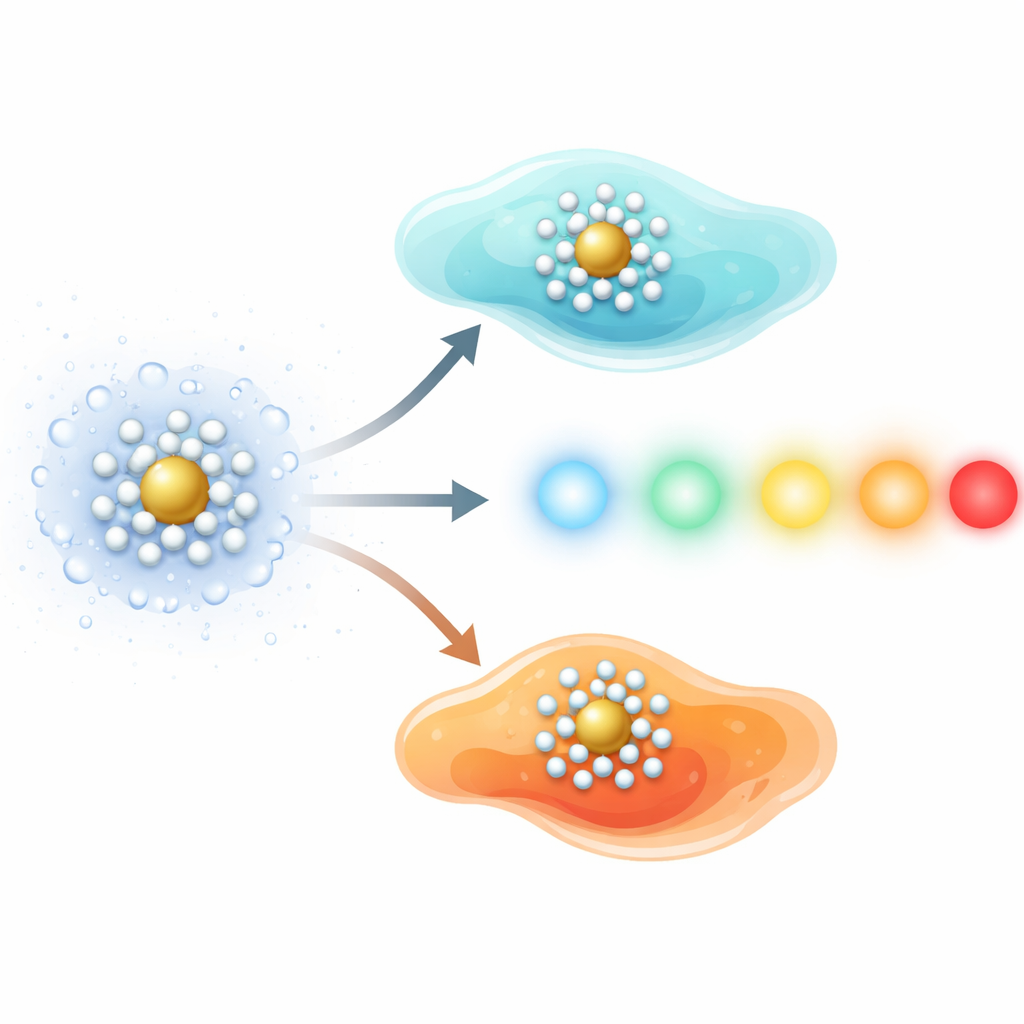
The work focuses on gold nanoclusters—tiny groups of just eight gold atoms wrapped in six organic molecules derived from a drug-like compound called 6‑mercaptopurine riboside. These clusters are so small that they no longer act like bulk metal; instead, they show sharp, molecule-like light emission. The organic molecules that protect the gold can adopt two slightly different shapes, or isomers, on the surface. In one shape, the sulfur–carbon group behaves more like a “thione,” and in the other, more like a “thiol.” These two surface states, called R1 and R2 domains, turn out to be crucial: R1 mainly gives a yellow–orange glow around 590 nm, while R2 mainly produces a deep red to near‑infrared glow around 770 nm.
Using Acidity to Switch Surface Structures
First, the researchers learned how to steer the balance between the R1 and R2 domains using the acidity (pH) of water. At lower pH, the surface ligands keep their extra proton and favor the thione-like R1 form. At higher pH, they lose that proton and shift toward the thiol-like R2 form. Sophisticated X‑ray and mass spectrometry measurements confirmed that the clusters keep the same gold core, while the nitrogen and sulfur atoms on the ligands change bonding patterns as pH rises. This surface rearrangement parallels a striking optical change: as the solution goes from mildly acidic to strongly basic, the yellow–orange emission linked to R1 gradually gives way to the near‑infrared emission linked to R2, with both bands coexisting and trading intensity along the way.
Protons, Electrons, and a Subtle Energy Dance
To understand where the light really comes from, the team probed how the clusters respond to temperature, oxygen, and even heavy water. Both emission bands behave like phosphorescence—light coming from long‑lived excited states involving the gold–sulfur interface. In the R1-rich state, electrons excited in the gold core can move to the ligands in a coupled step that also shifts a proton, a process known as proton‑coupled electron transfer. This extra step creates a special “electron transfer state” that emits at shorter wavelengths and is highly sensitive to how easily protons can move. Evidence for this comes from slower behavior in heavy water, where hydrogen atoms are replaced by heavier deuterium, and from analysis showing that some protons effectively tunnel through energy barriers rather than simply hopping over them. In the R2-rich state, in contrast, the excited electrons largely remain within the gold core, relaxing directly from a triplet state to give the deeper red glow without that extra proton‑coupled step.
Solvents as Hidden Knobs for Color Control
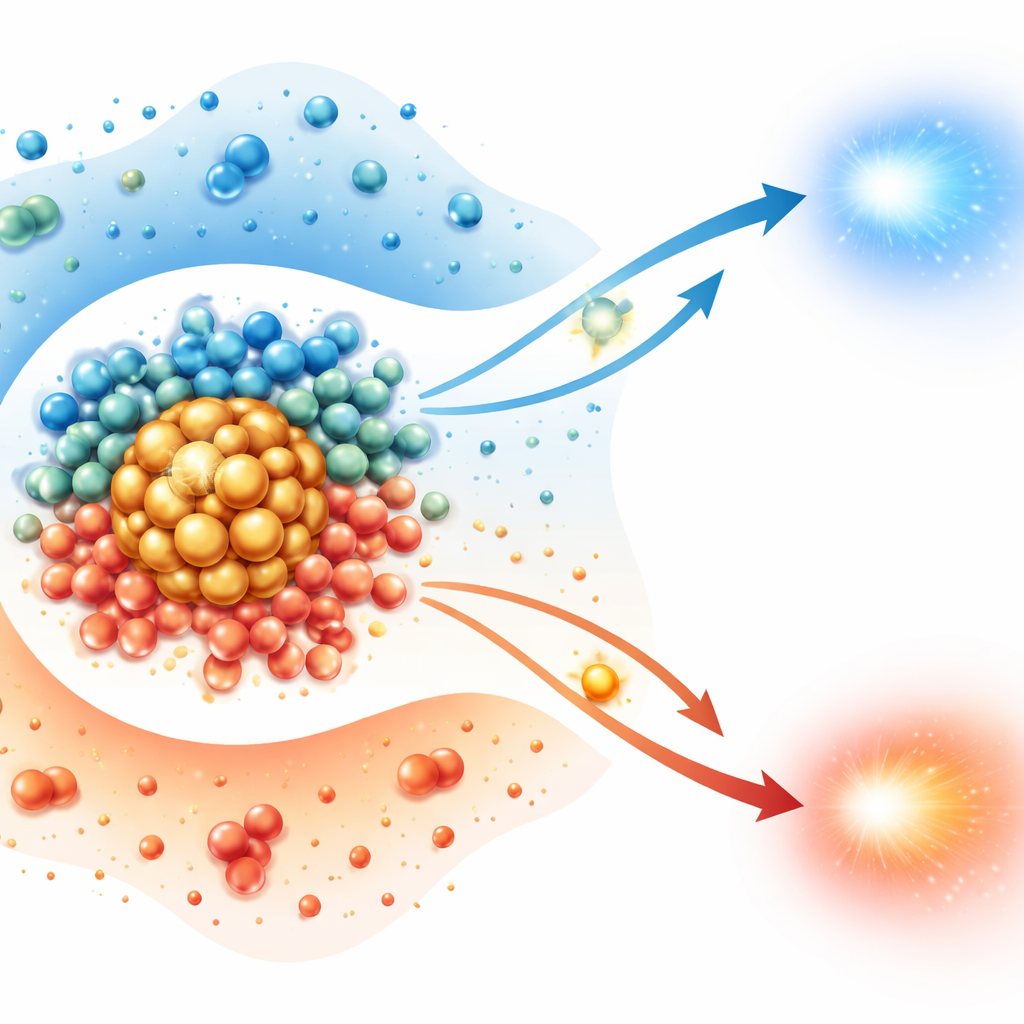
Inspired by the pH control, the researchers next used common organic liquids as “hidden knobs” to tune the surface of the clusters. They mixed the water-based gold solutions with fourteen different solvents grouped by how sticky, polar, and chemically coordinating they are. Strongly coordinating, non‑proton‑giving solvents like dimethyl sulfoxide prefer to bind to particular sites on the ligands and gradually convert R1 into R2, suppressing the proton‑coupled pathway and boosting the deeper red emission. In contrast, thick, hydrogen‑bond‑donating liquids like glycerol push the balance toward R1, but their high viscosity also stiffens the surface, slowing motions needed for proton‑coupled transfer and subtly shifting the color. Across these mixtures, the emission spans nearly the entire visible range, with brightness enhanced up to about five times compared with water alone.
How Structure and Motion Work Together
Advanced X‑ray techniques show that different solvents do more than just sit around the clusters. They adjust how sulfur, nitrogen, and oxygen atoms on the ligands coordinate to gold, slightly contract the gold core, and strengthen stacking between neighboring ligands. Ultrafast laser experiments reveal matching changes in the timing of electronic events: rapid relaxation within billionths to trillionths of a second, followed by a proton‑coupled step that can be stretched or entirely turned off depending on the solvent. When this step is slowed or suppressed, the emission pattern and efficiency shift in predictable ways. The picture that emerges is a finely tuned interplay where solvent choice reshapes the surface, alters electron and proton motion, and thereby programs both the color and intensity of the light.
Why This Matters for Future Light‑Based Technologies
In everyday terms, this research shows that the glow of ultra‑small gold particles is not fixed by their size alone; it can be dialed in by adjusting the chemical “jacket” they wear and the liquid they swim in. By exploiting a reversible switch between two surface forms and a controllable proton‑assisted electron pathway, the team achieves smooth, robust color tuning from blue‑green to near‑infrared in a single type of nanocluster. This strategy—using the surrounding solvent to rearrange surface structures and manage tiny energy flows—could inspire new designs for sensors that report local acidity or solvent conditions through color, tunable emitters for imaging deep in tissue, and more efficient light‑emitting or photocatalytic materials that respond dynamically to their environment.
Citation: Wang, X., Zhong, Y., Li, T. et al. Solvation-mediated isomerization of surface motifs tunes emissions and electron transfer dynamics in gold nanoclusters. Nat Commun 17, 4123 (2026). https://doi.org/10.1038/s41467-026-70812-6
Keywords: gold nanoclusters, solvent effects, color-tunable emission, proton-coupled electron transfer, surface ligand isomerization