Clear Sky Science · en
High-speed energy-efficient memristor confined in sub-5 nm space with elemental oxygen reservoir layer
Smarter, Faster Memory for Future Electronics
Today’s computers burn a lot of energy just moving data back and forth between memory and processors. Engineers want tiny devices that can both store and process information, more like the way our brains work, while wasting very little power. This article reports a new type of ultra-thin electronic memory element, called a memristor, that switches extremely fast, uses very little energy, and could serve as a building block for brain-inspired computing systems.

What Makes This New Memory Different
Traditional memristors often rely on the random motion of tiny defects inside an oxide layer, which leads to unpredictable behavior and early device failure. The authors tackle this problem by building an ultra-thin stack of carefully chosen materials only a few billionths of a meter thick. At the heart of the device is a 4.5-nanometer-thick layer of hafnium oxide that acts as the switching region. Just beneath it, they add a 3.5-nanometer-thick “elemental oxygen reservoir” layer, sandwiched between two ultraflat sheets of two-dimensional materials called HfS₂ and MoS₂, with gold electrodes on top and bottom. The key idea is that these atomically smooth interfaces keep the electric field uniform and tightly confine where the active defects can move.
How the Tiny Layers Are Built and Checked
To fabricate the device, the researchers first peel thin MoS₂ flakes and place them onto pre-patterned gold contacts. They then stack HfS₂ flakes on top to form a layered junction. A controlled ozone treatment gently converts parts of the HfS₂ into hafnium oxide without roughening the surface, creating a sandwich of hafnium oxide, remaining HfS₂, and more hafnium oxide. At the MoS₂ interface, oxygen accumulates to form the special reservoir layer. Using tools such as atomic force microscopy, Raman spectroscopy, and advanced electron microscopy, the team shows that the resulting layers are extremely smooth and that the oxygen-rich reservoir is well confined at the interface. Chemical analyses reveal oxygen-related species that can easily gain or lose electrons, confirming that this region acts as a flexible buffer for oxygen exchange.
Fast, Stable Switching with Very Little Leakage
Electrical tests demonstrate that the new memristor switches reliably between a high-resistance “off” state and a low-resistance “on” state over a wide range of operating conditions. Because the oxygen reservoir works as a barrier against unwanted leakage paths, the off-state current is extraordinarily small, while the on/off current ratio is extremely large. The device can switch in just a few billionths of a second—about 8 nanoseconds to turn on and 15 nanoseconds to turn off—and it can endure at least one hundred thousand switching cycles without noticeable degradation. It also retains its state for at least one hundred thousand seconds, even at elevated temperatures. These results suggest that the motion of the oxygen-related defects is well controlled within the narrow switching layer, leading to consistent behavior from device to device.
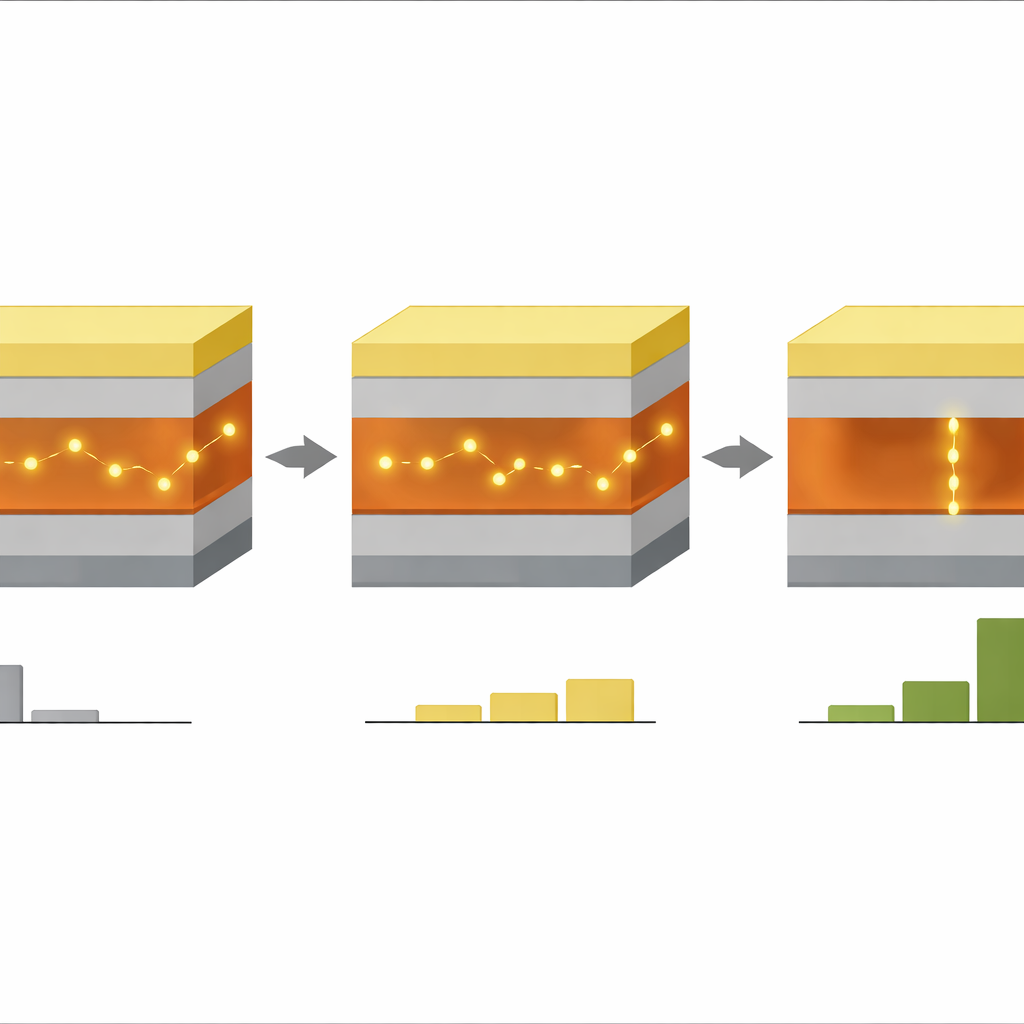
How the Device Works on the Inside
Inside the hafnium oxide layer, missing oxygen atoms act like movable charge carriers. When a positive voltage is applied, these vacancies drift and connect to form a thin conductive path, turning the device on. Reversing the voltage pulls oxygen from the reservoir into this path, healing it and breaking the connection so the device turns off. Because the active region is confined between smooth, defect-poor boundaries, the conductive path forms and dissolves in a controlled way instead of wandering unpredictably. Measurements of current and voltage at different temperatures show that both simple conduction through this path and space-charge effects in the insulating regions play roles in the overall behavior, but the carefully engineered stack keeps these processes highly repeatable.
Toward Brain-Inspired, Low-Power Computing
Beyond acting as a simple switch, the device can gradually change its conductance in response to tailored voltage pulses, much like a biological synapse strengthens or weakens with repeated activity. The authors use these measured responses to simulate a neural network that recognizes handwritten digits. In these tests, a network built from the characteristics of their memristor reaches about 97 percent accuracy on a standard dataset, close to the performance of idealized components. In plain terms, the work shows that by tightly confining oxygen motion in an atomically smooth, ultra-thin stack, it is possible to build memory elements that are fast, energy-efficient, highly reliable, and well suited for future low-power “in-memory” and neuromorphic computing architectures.
Citation: Li, C., Niu, W., Wan, D. et al. High-speed energy-efficient memristor confined in sub-5 nm space with elemental oxygen reservoir layer. Nat Commun 17, 4117 (2026). https://doi.org/10.1038/s41467-026-70806-4
Keywords: memristor, neuromorphic computing, hafnium oxide, two-dimensional materials, low-power electronics