Clear Sky Science · en
Coupled polarization dynamics and charge tunneling enable reconfigurable heterojunctions
Smarter chips for a data hungry world
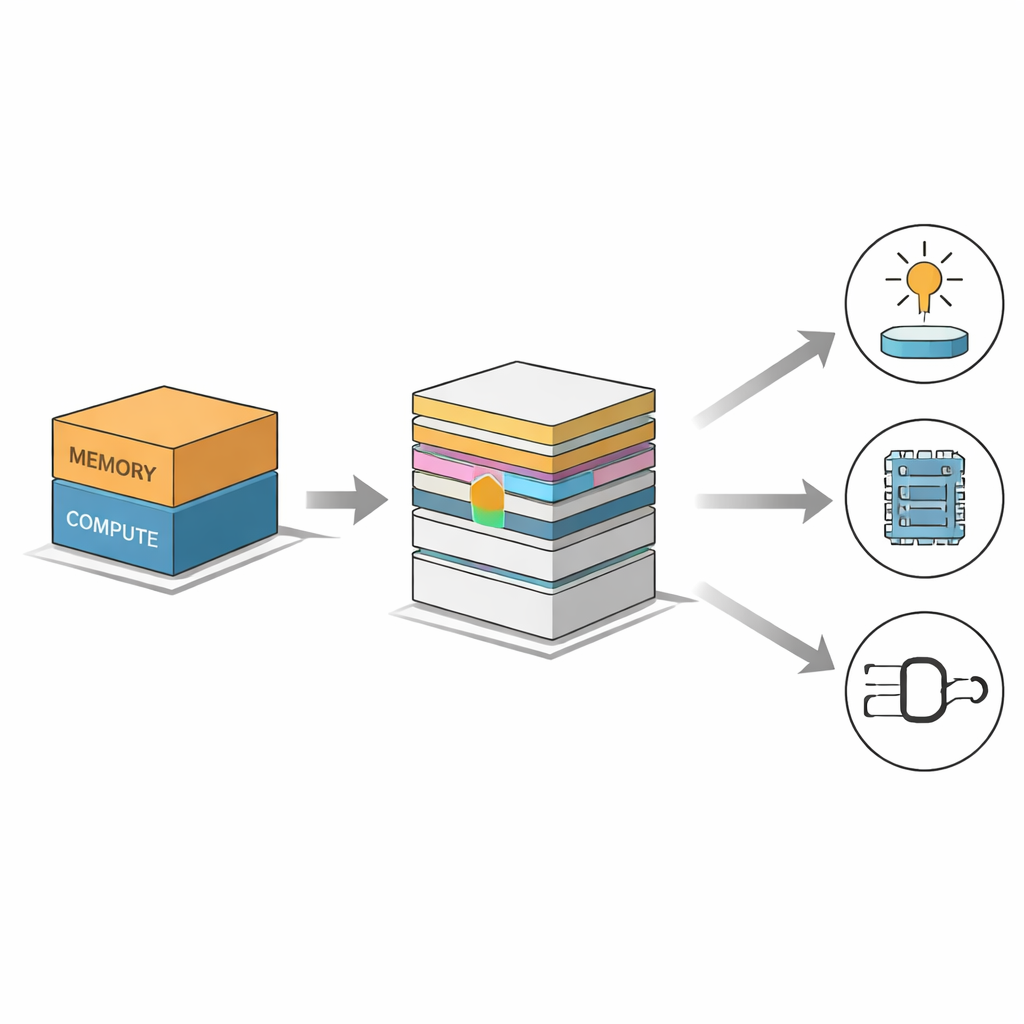
From phones that recognize voices to cameras that understand scenes, modern electronics are drowning in data. Shuttling information back and forth between separate memory and processor chips wastes time and energy. This research explores a tiny device that can remember, calculate, and sense light all in one place, pointing toward leaner, faster hardware for everyday and edge computing tasks.
A single device that wears many hats
The heart of the study is a custom built transistor that stacks several ultra thin materials into a single vertical tower. A molybdenum telluride layer carries current, a boron nitride layer controls how charges can tunnel, and a special copper based crystal acts like an electric “spring” that keeps its internal orientation even when the power is off. Together with a graphene charge storage layer and a silicon control gate, this stack behaves not just as a switch, but as a programmable element that can be reshaped electrically and then left alone without losing its state.
New ways to store and tune information
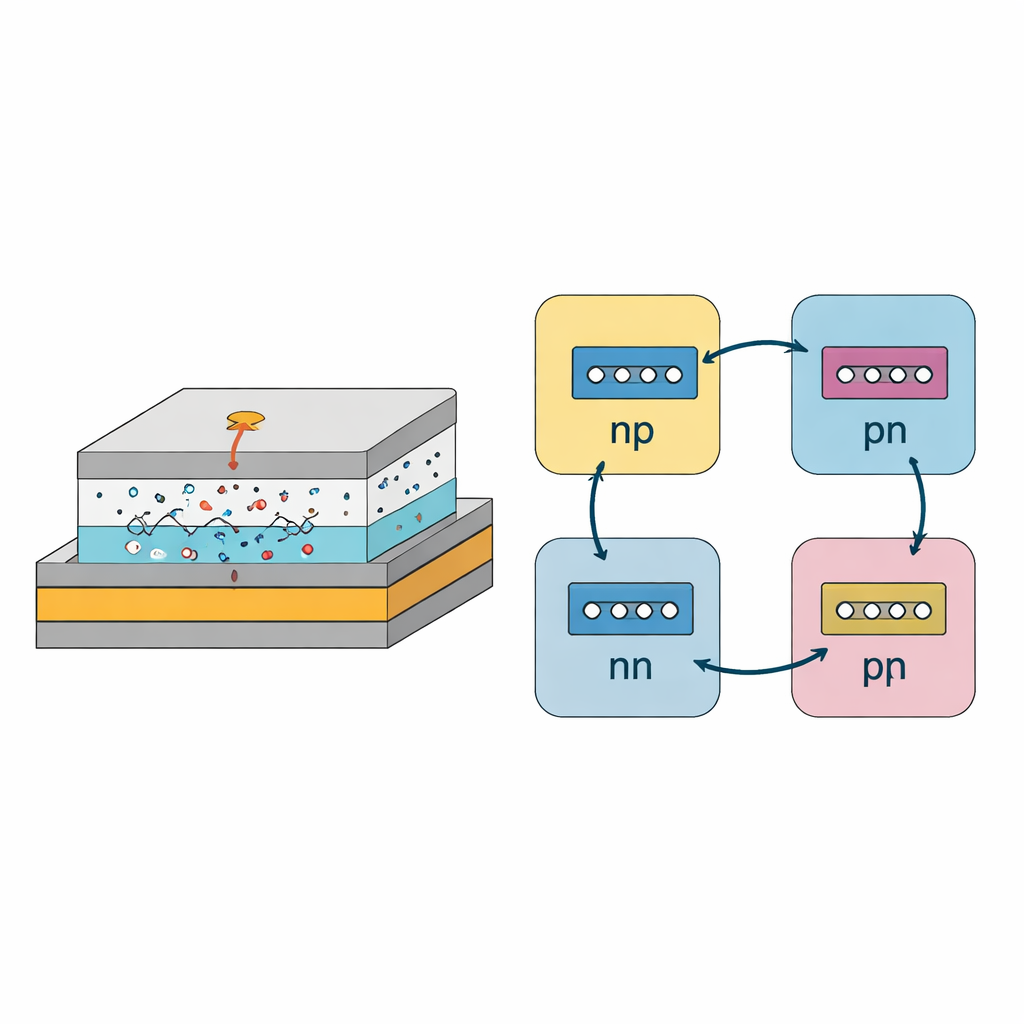
Because the device can both trap charges and flip its internal electric orientation, it offers two knobs for setting how easily current flows. The graphene layer can hold a large number of electrons or holes, giving stable multi level memory states, while the ferroelectric crystal can switch direction under relatively low voltages. The authors show that the charge based memory can endure tens of thousands of write and erase cycles and can hold at least sixteen distinct levels for over fifteen minutes without noticeable drift, hinting at fine grained storage useful for brain like computing schemes.
Switchable junctions inside one tiny element
In ordinary electronics, designers must carefully dope regions of a material to create fixed p type and n type areas that form diodes and logic gates. Here, the same transistor can be reprogrammed into four different junction types: nn, pp, np, and pn, simply by sending electrical pulses of chosen height and duration. Large pulses trigger both tunneling and ferroelectric switching, forming np or pn junctions, while smaller pulses tweak only the ferroelectric part, converting those into nn or pp modes. These programmed states are non volatile, and the resulting diodes show very strong one way conduction, meaning they are well suited for rectifying and logic tasks.
Light sensing baked into the circuit
When the device is set into a pn configuration and illuminated with green light, it behaves like a tiny solar cell. It generates a current and voltage without any applied power, and the strength of this signal scales cleanly with light intensity. The measured responsivity and detectivity place it among the best reported light detectors made from similar layered materials. The response time is only a few milliseconds, and the on off behavior remains steady over many cycles, making this structure attractive for low power vision and sensing directly on the same chip that performs the computation.
Logic that remembers inside the hardware
By treating gate pulses and light as inputs and the flowing current as an output, the team demonstrates that a single device can implement several basic logic functions that normally require multiple transistors. They realize XNOR, NOR, NAND, and even an AND gate that operates without external voltage, using light as one of the inputs. Because the device stores its configuration after the inputs are removed, it naturally merges memory with logic, cutting the number of elements needed and shrinking circuit complexity.
Toward leaner and more capable electronics
In simple terms, the work shows that carefully stacked atomically thin layers can produce a transistor that not only switches current, but also remembers past signals, reshapes its own internal junctions, and senses light without added parts. This mix of memory, computing, and detection in a single reconfigurable building block could help future chips handle data more efficiently, especially in compact gadgets and sensors that must think locally while using little power.
Citation: Li, C., Yu, T., Zhang, Z. et al. Coupled polarization dynamics and charge tunneling enable reconfigurable heterojunctions. Nat Commun 17, 4036 (2026). https://doi.org/10.1038/s41467-026-70803-7
Keywords: reconfigurable transistor, ferroelectric memory, floating gate, photodetector, logic in memory