Clear Sky Science · en
Ultrathin Quarter-Waveplates Based on Two-Dimensional Anisotropic NbOCl2
Why thinner light-control devices matter
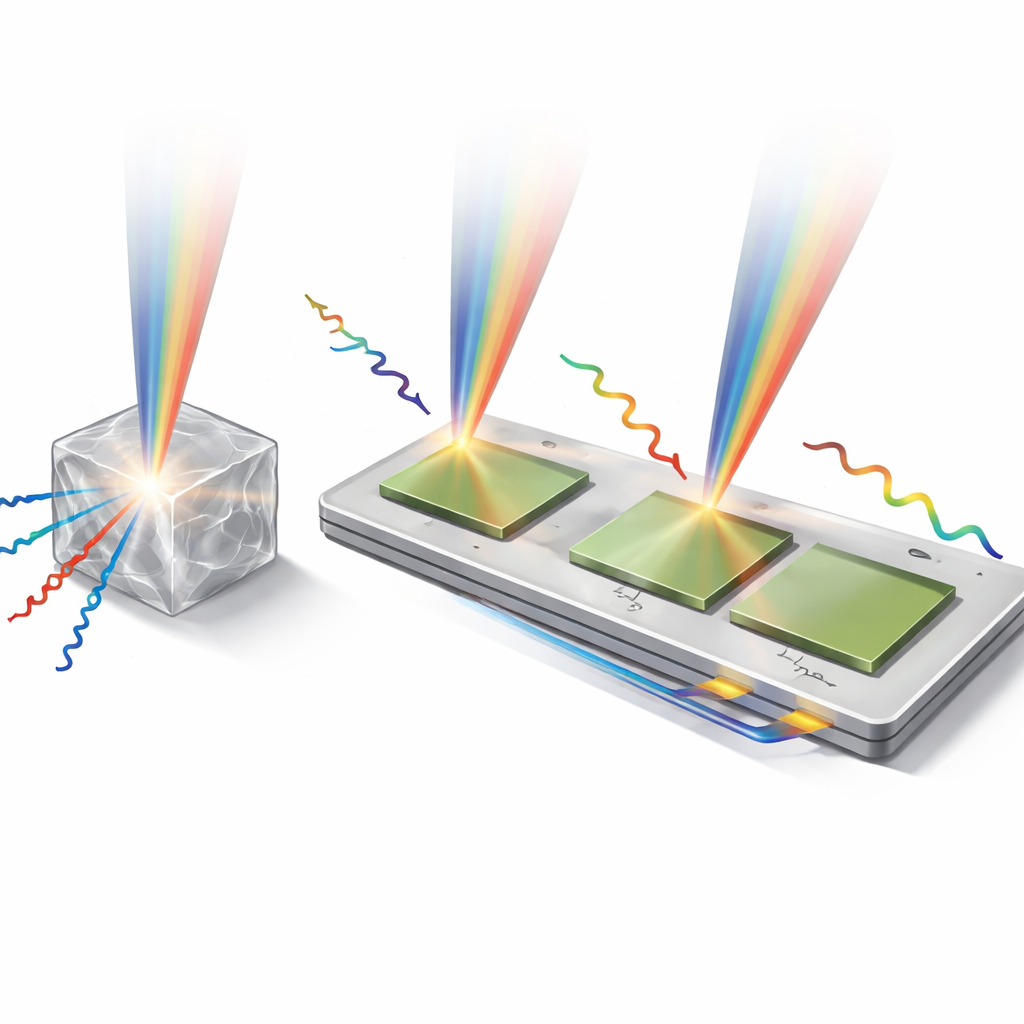
Our world increasingly relies on tiny optical components that sit directly on chips in phones, data centers, and quantum devices. A key element in many of these systems is the waveplate, a glass-like plate that twists the polarization of light—the direction in which its electric field vibrates. Conventional waveplates work well when they are relatively thick, but they become hard to make and less precise as engineers try to shrink them down. This study introduces an ultrathin alternative, built from sheets of a two-dimensional material called niobium oxychloride (NbOCl₂), that can control light with high accuracy at a fraction of the thickness of commercial devices.
From bulky glass plates to atomically flat sheets
Traditional waveplates are carved and polished from crystals like quartz or sapphire, or formed from polymer films sandwiched in glass. When these are made extremely thin, their weak internal optical contrast and unavoidable surface roughness scatter light and distort its polarization. Achieving the required flatness and uniformity becomes extremely challenging and expensive, and most commercial devices are therefore limited to sub-millimeter thicknesses. The authors instead turn to layered “van der Waals” crystals—materials made of atomically flat sheets that can be peeled like graphite. These two-dimensional materials naturally offer mirror-smooth surfaces without mechanical polishing and can be integrated on silicon photonic chips, making them attractive for miniaturized optics.
A special crystal that strongly reshapes light
Among many candidate two-dimensional materials, NbOCl₂ stands out because it responds very differently to light polarized along two in-plane directions of its crystal lattice. This pronounced anisotropy—much stronger than in most conventional crystals—means it can delay one polarization component of light more than the other over very short distances. The researchers first determined the orientation of the crystal axes using polarized optical microscopy and angle-resolved Raman spectroscopy, techniques that reveal how the crystal vibrates and interacts with polarized light. Atomic force microscopy confirmed that the exfoliated NbOCl₂ flakes remain extremely smooth, with height variations far smaller than one percent of their total thickness, a crucial property for clean, low-scatter polarization control.
Turning linear light into circular light with thickness control
To operate as a quarter-waveplate, a device must convert linearly polarized light into circularly polarized light by introducing just the right phase delay between two perpendicular polarization components. The team exfoliated NbOCl₂ flakes of many different thicknesses onto silicon-based substrates and measured how they reflected polarized light across visible wavelengths. By analyzing two key metrics—how the polarization plane rotates and how close the reflected light is to perfectly circular polarization—they mapped out which thicknesses best serve as quarter-waveplates at specific colors of light. They found that by selecting the right number of layers, NbOCl₂ flakes could act as compact, high-performance waveplates across a broad visible range, with predictable and repeatable behavior that matched theoretical models.
Ultrathin devices that rival commercial performance
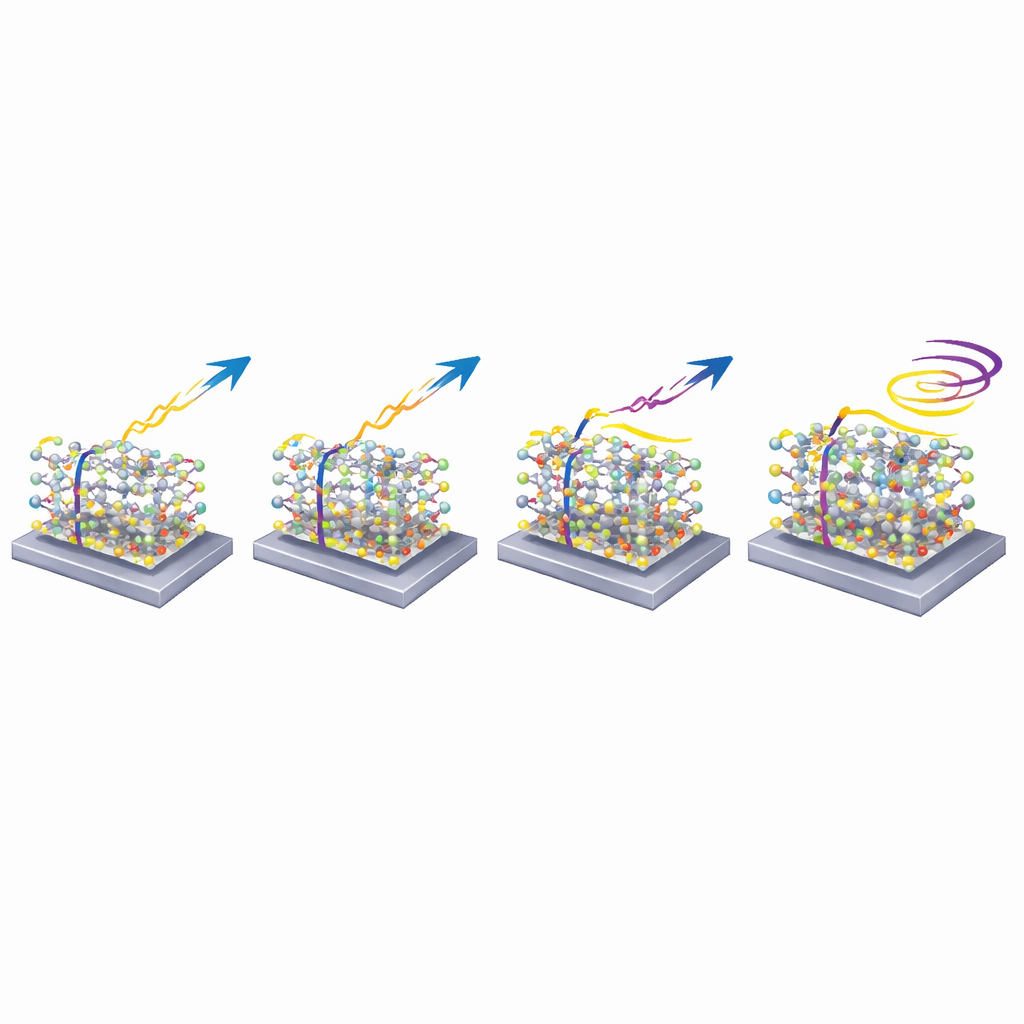
Having identified promising thickness–wavelength combinations, the researchers rigorously tested individual NbOCl₂ devices as true quarter-waveplates. They measured how the output intensity changed as both the sample and a downstream polarizer were rotated, and compared the data to the ideal mathematical description of a quarter-waveplate. Several flakes—only a few hundred nanometers thick—showed nearly perfect agreement. One standout device was just 269 nanometers thick and operated at a wavelength of 614 nanometers, well below the thickness of typical commercial plates working at similar colors. When benchmarked against standard products, these NbOCl₂ waveplates exhibited comparable or even tighter control over phase delay, maintaining their target behavior within a very narrow tolerance window.
What this means for future photonic technologies
To illustrate real-world relevance, the authors placed an NbOCl₂ waveplate after a commercial quarter-waveplate and aligned their axes so that one undid the other’s effect. The resulting light returned to a purely linear state, confirming that the ultrathin device provided precise, controllable phase retardation. Overall, the study shows that two-dimensional NbOCl₂ can deliver subwavelength, high-fidelity polarization control in a format compatible with chip-based photonics. For non-specialists, the key message is that this material enables waveplates that are hundreds to thousands of times thinner than a human hair, yet still perform as well as—or better than—traditional components. Such ultracompact, tunable polarization elements could help pack more functions into smaller optical circuits, advancing fields from quantum information and secure communications to miniaturized sensors and imaging systems.
Citation: Gao, J., Wang, C., Sow, C.H. et al. Ultrathin Quarter-Waveplates Based on Two-Dimensional Anisotropic NbOCl2. Nat Commun 17, 4118 (2026). https://doi.org/10.1038/s41467-026-70788-3
Keywords: polarization optics, two-dimensional materials, waveplates, nanophotonics, integrated photonics