Clear Sky Science · en
Mid-infrared to ultraviolet efficient multiphoton frequency upconversion in NbOI2 crystals
Turning Invisible Light into Useful Signals
Most of the warmth and chemical fingerprints in our world live in the mid‑infrared region of light, which our eyes and ordinary cameras cannot see. This makes it hard to build simple tools to image, sense, or analyze many important gases, biomolecules, and materials. This study introduces a new crystal, called NbOI2, that can efficiently convert this invisible mid‑infrared light into visible and ultraviolet colors that regular silicon cameras and detectors can easily pick up, opening the door to compact, affordable devices for advanced imaging and sensing.
A Special Crystal for Bending Light
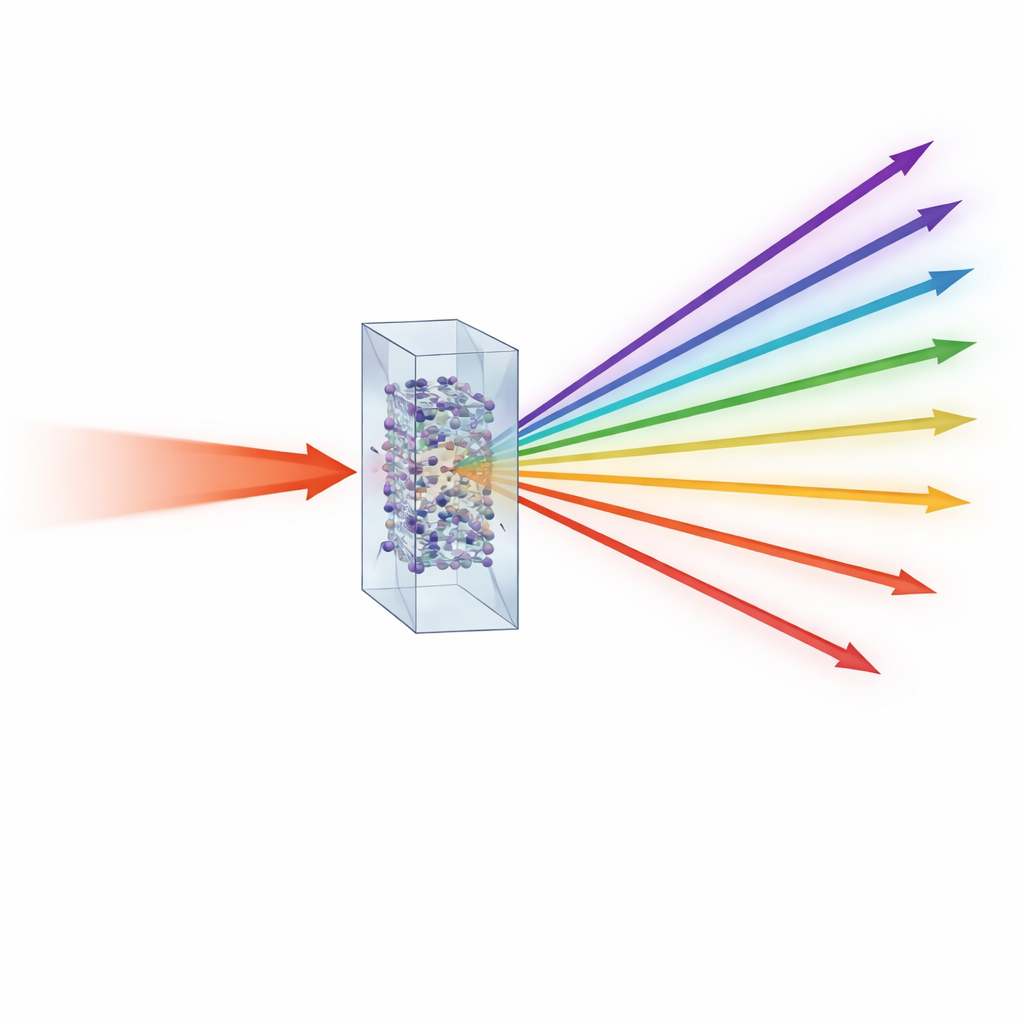
The key player in this work is a van der Waals layered crystal, NbOI2, which has a built‑in electrical asymmetry that strongly boosts its nonlinear optical response—the way it reshapes light when the light is intense. Because of its crystal structure, NbOI2 can generate both even and odd harmonics of incoming light, meaning it can transform a single mid‑infrared color into many higher‑energy colors all at once. Unlike many conventional nonlinear crystals, it does not need delicate phase‑matching conditions, a kind of internal alignment that usually restricts the usable wavelengths and device geometries. This “phase‑matching‑free” behavior makes NbOI2 particularly attractive for broadband, chip‑scale photonics.
From Mid‑Infrared to Ultraviolet in One Step
When the researchers shined powerful mid‑infrared pulses onto thin flakes of NbOI2, they observed harmonic light up to the 11th order—meaning eleven times the original light frequency. These new colors spanned from the mid‑infrared all the way to the ultraviolet, going far beyond the crystal’s own electronic bandgap. Although higher harmonics naturally appear with lower efficiency, the team still achieved conversion levels comparable to, or better than, many engineered metasurfaces that are specifically designed for strong nonlinear response. Crucially, the crystal’s nonlinear strength remained high across a wide range of wavelengths, which is important for real‑world systems that rarely operate at one perfectly fixed color.
Shaping Light with Direction and Mixing
NbOI2 does more than simply multiply colors: it also responds differently depending on the direction of the incoming light’s polarization within the crystal plane. By rotating the polarization, the team measured how efficiently the crystal produced second‑ and third‑harmonic light, finding very large anisotropy—up to more than tenfold differences between directions. This directional sensitivity can be used as a built‑in knob to tune or encode information in light. The researchers also drove the crystal with two different beams at once, one near the visible and one in the mid‑infrared. Inside the crystal, these beams mixed to produce new colors through sum‑frequency and four‑wave mixing processes, again with high efficiency over a broad range of mid‑infrared wavelengths from 1.5 to 5 micrometers. In some cases the conversion figures surpassed leading nanostructured metasurfaces, despite using a simple unpatterned flake.
Turning Hard‑to‑See Scenes into Clear Pictures
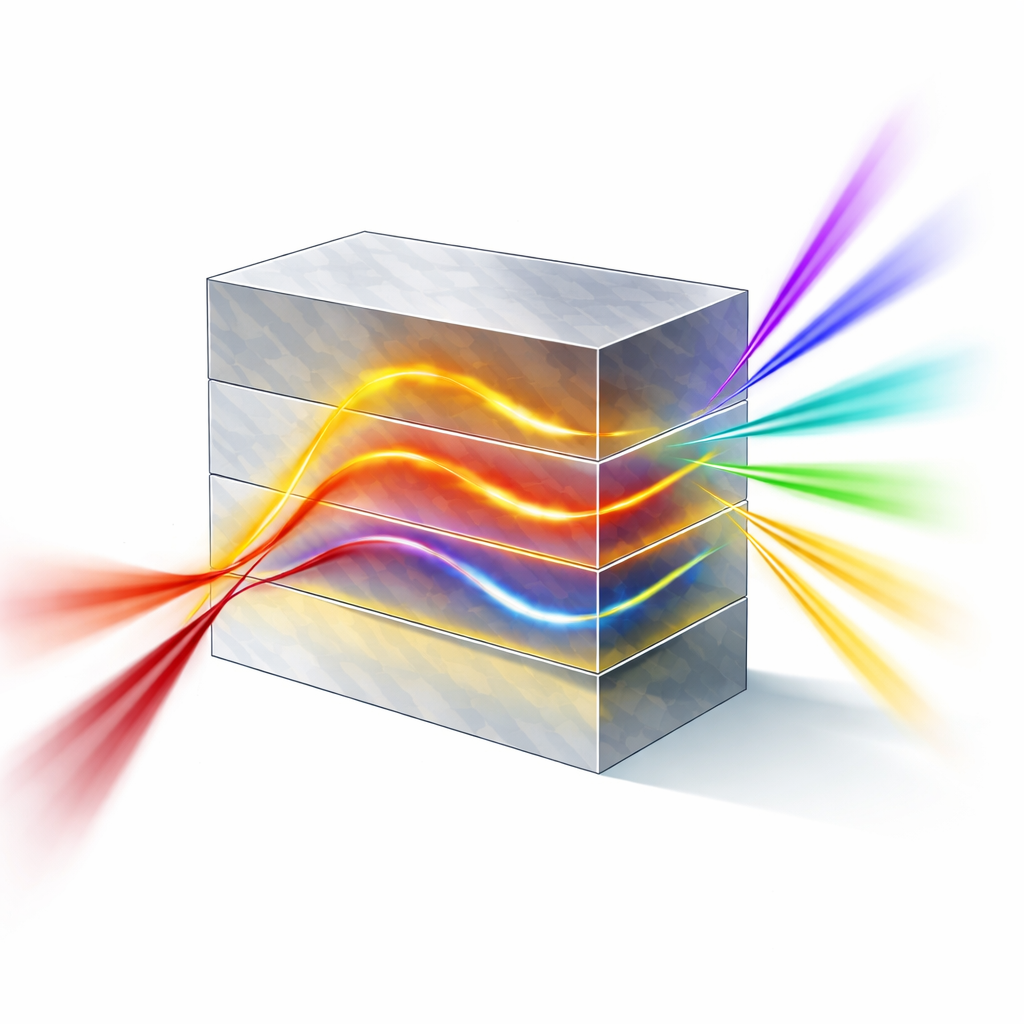
Because mid‑infrared cameras are expensive and often slow or noisy, a powerful idea is to convert mid‑infrared images into visible light that standard silicon cameras can capture cleanly. The authors implemented exactly this using a thin NbOI2 flake as the active element. They projected a patterned mid‑infrared scene and a 1030‑nanometer pump beam onto the crystal so that they overlapped. The crystal upconverted the mid‑infrared image into visible light by sum‑frequency generation, and an ordinary silicon camera recorded the resulting image. This scheme worked over a broad mid‑infrared band from 2.7 to 4 micrometers at room temperature. They also showed that the clarity of images formed from second‑harmonic signals depends strongly on the polarization direction, directly reflecting the crystal’s anisotropic response.
What This Means for Future Devices
In everyday terms, this work shows that a very thin slice of NbOI2 can act like a powerful “color translator” that turns hard‑to‑detect mid‑infrared light into visible and ultraviolet light, without the usual design and alignment headaches that plague traditional crystals. Its combination of strong nonlinear response, sensitivity to polarization, broad wavelength coverage, and compatibility with standard silicon cameras makes it a promising building block for compact sensors, spectrometers, and imaging systems that can see heat signatures and molecular fingerprints with high detail. With further engineering into resonant structures or large‑area films, NbOI2‑based devices could help bring sophisticated infrared detection and imaging technologies into more practical and widely accessible forms.
Citation: Zhu, S., Mao, X., Yan, C. et al. Mid-infrared to ultraviolet efficient multiphoton frequency upconversion in NbOI2 crystals. Nat Commun 17, 3927 (2026). https://doi.org/10.1038/s41467-026-70781-w
Keywords: mid-infrared upconversion, nonlinear optics, NbOI2 crystal, harmonic generation, infrared imaging