Clear Sky Science · en
Roll-to-Roll AgNWs Networks/Ag Finger by Self-Masking Protection for Large-Area Monolithic Flexible Organic Solar Cells
Solar power you can roll up
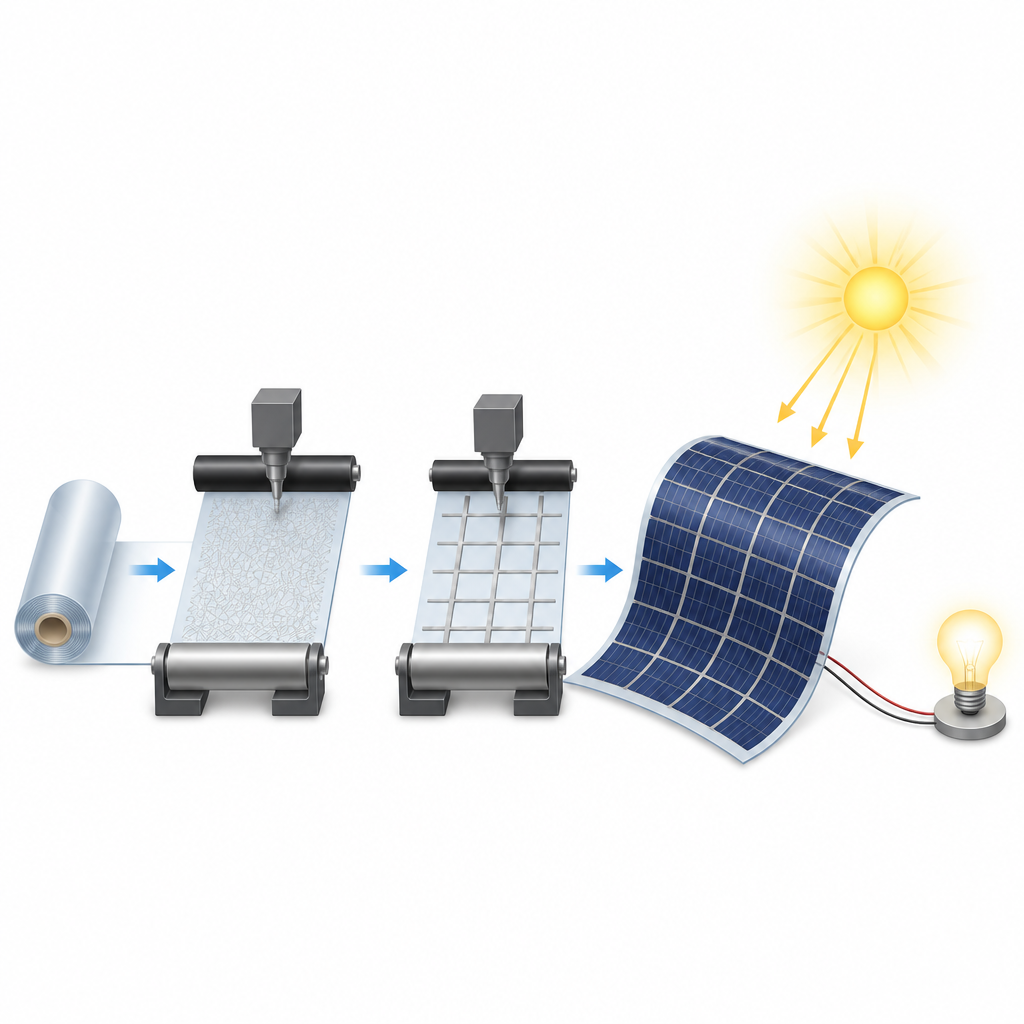
Imagine solar panels as thin and bendable as a sheet of plastic, wrapped around backpacks, tents, or clothing. Flexible organic solar cells promise exactly that, but when engineers try to make them larger, their performance usually drops. This study shows a way to build large, flexible solar cells that keep high efficiency by redesigning the invisible metal network that carries electricity inside the device.
Why bigger flexible panels are hard to build
Flexible organic solar cells use transparent, conductive films to collect the electric current created by sunlight. A popular choice is a web of silver nanowires, which is clear and bendable but not quite conductive enough when devices grow wider. As the panel width increases, electricity must travel farther through this thin film, wasting energy as heat and lowering the power output. Past attempts to fix this often relied on complex laser patterning or thick metal lines that can damage the delicate organic layers, limiting how well large, one-piece (monolithic) flexible panels can work.
Adding hidden silver highways
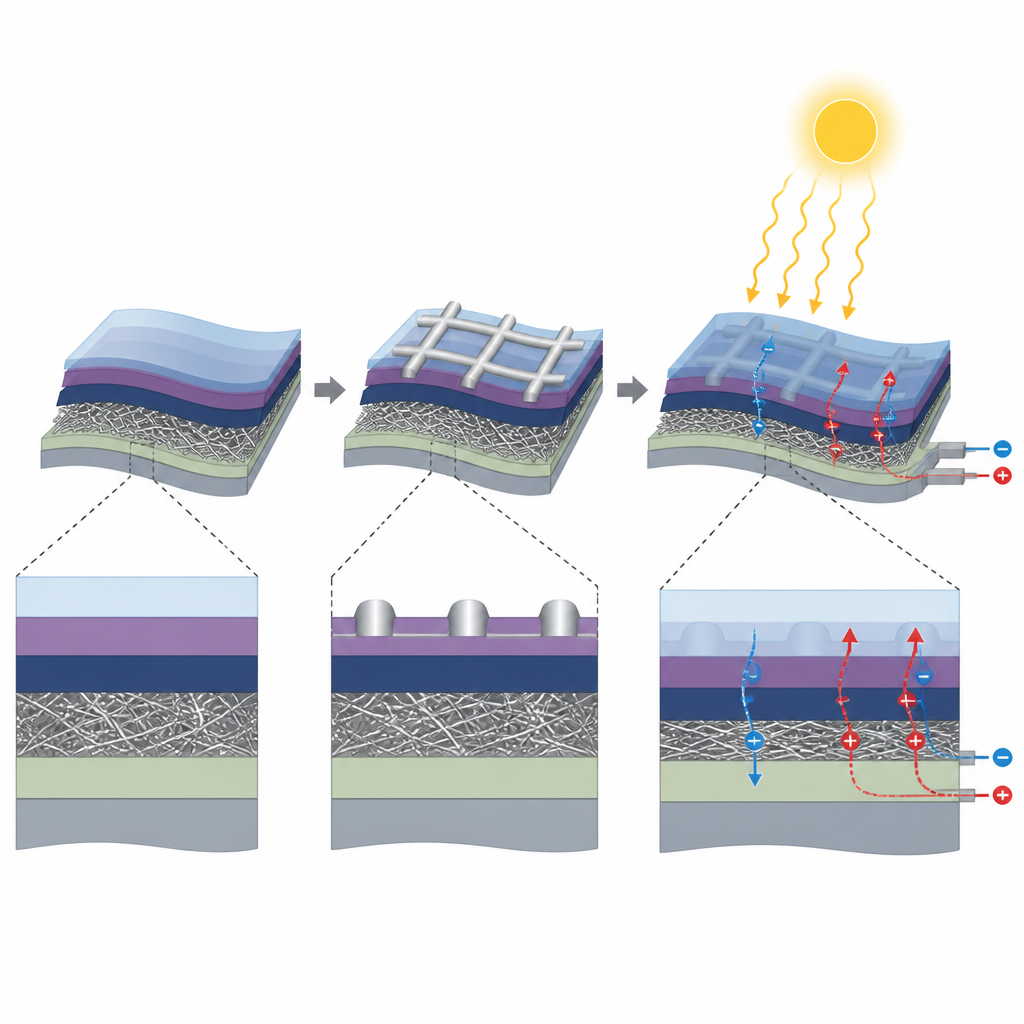
In this work, the researchers design a new transparent electrode that combines two kinds of silver: a fine nanowire network for transparency and flexibility, and narrow metallic grid fingers that act like hidden highways for current. Both are made using roll-to-roll printing, a process similar to newspaper printing that is well suited for mass production. By carefully choosing the width and spacing of the grid lines, they reduce the effective resistance of the electrode from about 15 to as low as 1 to 2 ohms per square, a level usually needed only in rigid silicon panels. A numerical model guides this design, balancing how much light is blocked by the metal against how much electrical loss is saved.
Protecting the delicate active layers
Simply adding thick silver lines would normally cause short circuits, because the metal stands much taller than the thin organic layers deposited on top. To avoid this, the team introduces a self-masking photoresist layer that selectively covers the grid. They coat a light-sensitive insulating material over the entire surface, then shine ultraviolet light from the plastic side. The raised silver grid scatters and blocks the light in just the right places, so after development, the photoresist remains mainly over the grid lines, forming a smooth, protective cap about 1 to 2 micrometers thick. This protection prevents the metal from poking into the active layers while leaving most of the nanowire area uncovered for good electrical contact.
Modeling losses to guide the design
The researchers analyze where power is lost in large-area cells: in the transparent film, in the metal fingers, and from light blocked by the grid. For electrodes without a grid, they show that power loss grows quickly with both film resistance and device width, making wide flexible cells impractical. Their model reveals that if the effective resistance can be brought down to around 1 to 2 ohms per square, panels roughly 5 centimeters wide can still operate with modest losses. They then use this model to find an optimal grid geometry: lines about 100 to 110 micrometers wide and spaced a few millimeters apart minimize overall loss while keeping the surface smooth enough for uniform coatings.
High efficiency, durability, and yield
Using this composite electrode and self-masked protection, the team builds flexible organic solar cells with active areas of 4 and 16 square centimeters. The smaller cells reach a power conversion efficiency of 15.20 percent, and the larger ones still achieve 14.24 percent, showing very little drop as size increases. Without the silver grid, similar large cells lose much more current and voltage. The insulated grid also greatly improves reliability: devices show almost no electrical leakage, maintain most of their efficiency after many hours of storage, and survive thousands of bending cycles with minimal performance change. The process delivers nearly 100 percent working devices, a key requirement for real manufacturing.
What this means for future flexible solar panels
For a layperson, the key message is that the authors have found a practical way to scale up bendable solar cells without sacrificing efficiency. By printing hidden silver highways and covering them with a smart protective coating, they turn a flimsy, resistive film into a robust, low-loss power collector. This approach could help future flexible panels power wearable electronics, light portable shelters, and other large surfaces while remaining thin, light, and rollable.
Citation: Han, Y., Chen, Z., Fang, L. et al. Roll-to-Roll AgNWs Networks/Ag Finger by Self-Masking Protection for Large-Area Monolithic Flexible Organic Solar Cells. Nat Commun 17, 4444 (2026). https://doi.org/10.1038/s41467-026-70740-5
Keywords: flexible organic solar cells, silver nanowire electrodes, roll-to-roll printing, metal grid electrodes, large-area photovoltaics