Clear Sky Science · en
Tropical volcanism triggers pan-Asian monsoon droughts via circumglobal teleconnection
Why Distant Volcanoes Matter for Asian Rains
When a giant volcano erupts in the tropics, ash and gas can dim sunlight around the globe. This study shows that such blasts do more than cool the planet for a year or two: they can also set off a chain reaction high in the atmosphere that brings synchronized summer droughts to huge swaths of Asia. For people who depend on the monsoon for farming, water supply, and power generation, understanding this hidden link between eruptions and rainfall can improve preparation for future climate shocks. 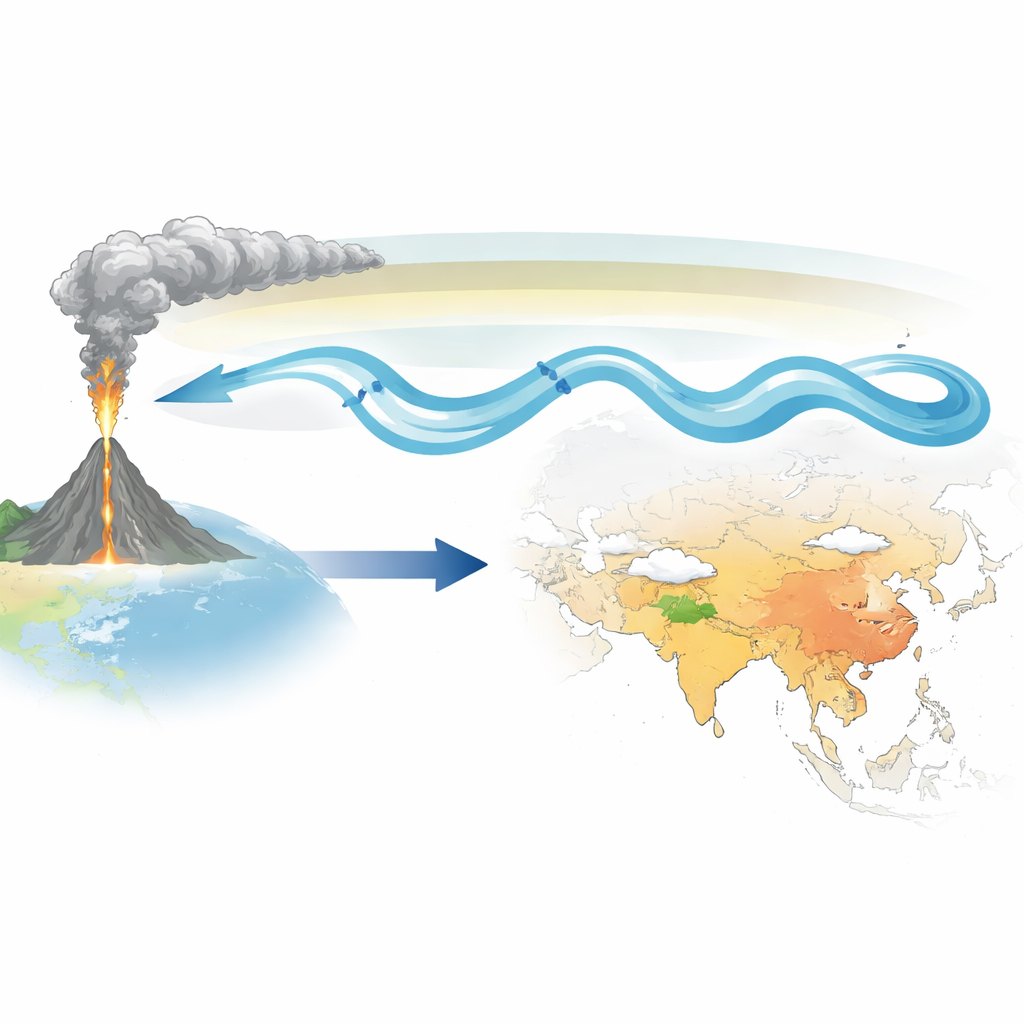
Big Blasts and Failed Rains
The authors examine large tropical eruptions over the past thousand years, focusing on how they affected summer rains in South Asia (including India and surrounding regions) and northern East Asia (including northern China and nearby areas). Historical documents and tree rings already hinted that eruptions like Tambora in 1815 and Pinatubo in 1991 were followed by droughts in these regions. However, it was unclear whether this pattern was just coincidence, the result of internal climate swings like El Niño, or a repeatable response of the atmosphere to volcanic pollution.
Reading the Past from Trees and Models
To answer this, the team combined several lines of evidence. They used tree-ring records that reflect past soil moisture to reconstruct drought across Asia, and built a new record of a key wind pattern high in the atmosphere, called the circumglobal teleconnection, using tree rings from across Eurasia. They compared these reconstructions with state-of-the-art climate model simulations spanning the last millennium. In both the natural evidence and the model world, big volcanic eruptions were followed, in the very next summer, by clear drops in rainfall and stronger drought in South Asia and northern East Asia. These dry spells appeared quickly, were strongest in the first year, and could sometimes linger into the second. 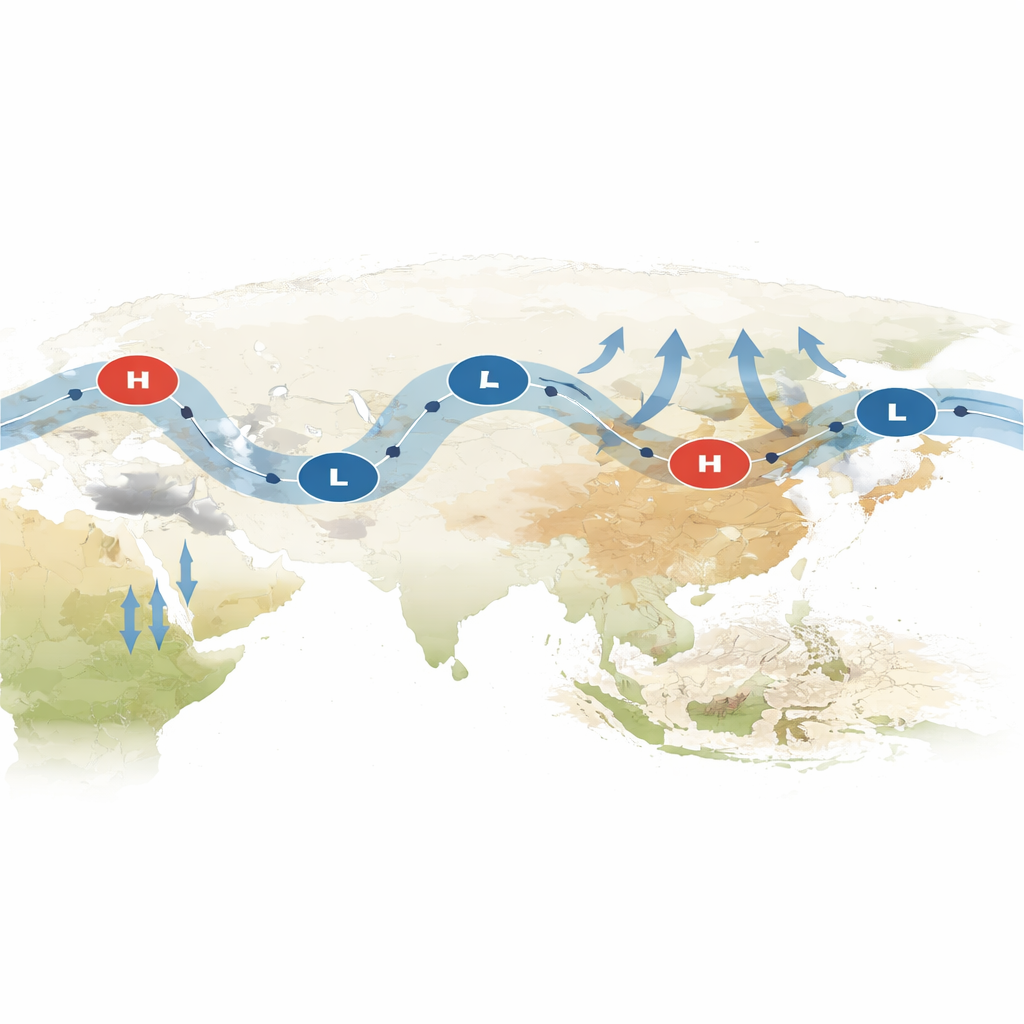
A High-Altitude Wave Train as the Hidden Bridge
The key to tying this pattern together lies in what happens high above the ground. When volcanic aerosols in the stratosphere block sunlight, they cool the surface and weaken the rising air over the Indian monsoon region. That reduced upward motion means less heating of the upper atmosphere over South Asia. In turn, this change behaves like a push that sends a wave-like disturbance along the fast-moving jet stream that circles the Northern Hemisphere. The resulting chain of high and low pressure systems, known as a circumglobal teleconnection, tends to settle into a particular “negative” pattern after eruptions. In this pattern, winds high above East Asia blow more from the north, and air sinks over northern East Asia, both of which suppress summer rainfall. Moisture-budget calculations in the models show that this enhanced sinking motion and vertical air movement account for most of the lost rain in both South Asia and northern East Asia.
Not Just El Niño or Ocean Quirks
Climate scientists often look to slow swings in ocean temperatures, such as El Niño in the Pacific or the Indian Ocean Dipole, to explain shifts in monsoon rains. The authors carefully removed the influence of these internal ocean patterns, and also examined eruptions that happened when the tropical oceans were near neutral. Even in those cases, the same high-altitude wave pattern and Asian droughts emerged after eruptions. Statistical tests confirmed that volcanic forcing itself helps predict changes in the circumglobal pattern, while interaction terms with El Niño or the Indian Ocean Dipole are weak. In years when the atmosphere happens to fall into the opposite, “positive” phase of the pattern after an eruption, the drying is much weaker, showing that this wave train is the main atmospheric “conduit” that turns volcanic cooling into real-world drought.
What This Means for Future Risks
By uncovering this volcanic–wave–drought chain, the study reveals a powerful but previously underappreciated route by which tropical eruptions can disrupt water supplies across a continent. It explains how one event in the tropics can, within a single summer, coordinate droughts thousands of kilometers apart. As future eruptions occur in a warming world with shifting jet streams and warmer oceans, their impact on this high-altitude pattern—and thus on Asian monsoon rains—may change in complex ways. But the basic lesson is clear: monitoring volcanic activity and the state of upper-level winds could provide valuable early warning of heightened drought risk across monsoon Asia after the next major tropical blast.
Citation: Nie, W., Xia, J., Kino, K. et al. Tropical volcanism triggers pan-Asian monsoon droughts via circumglobal teleconnection. Nat Commun 17, 2701 (2026). https://doi.org/10.1038/s41467-026-70710-x
Keywords: tropical volcanism, Asian monsoon drought, atmospheric teleconnections, jet stream wave patterns, climate extremes