Clear Sky Science · en
A nanoscale robotic cleaner
Tiny cleaners in a sea of germs
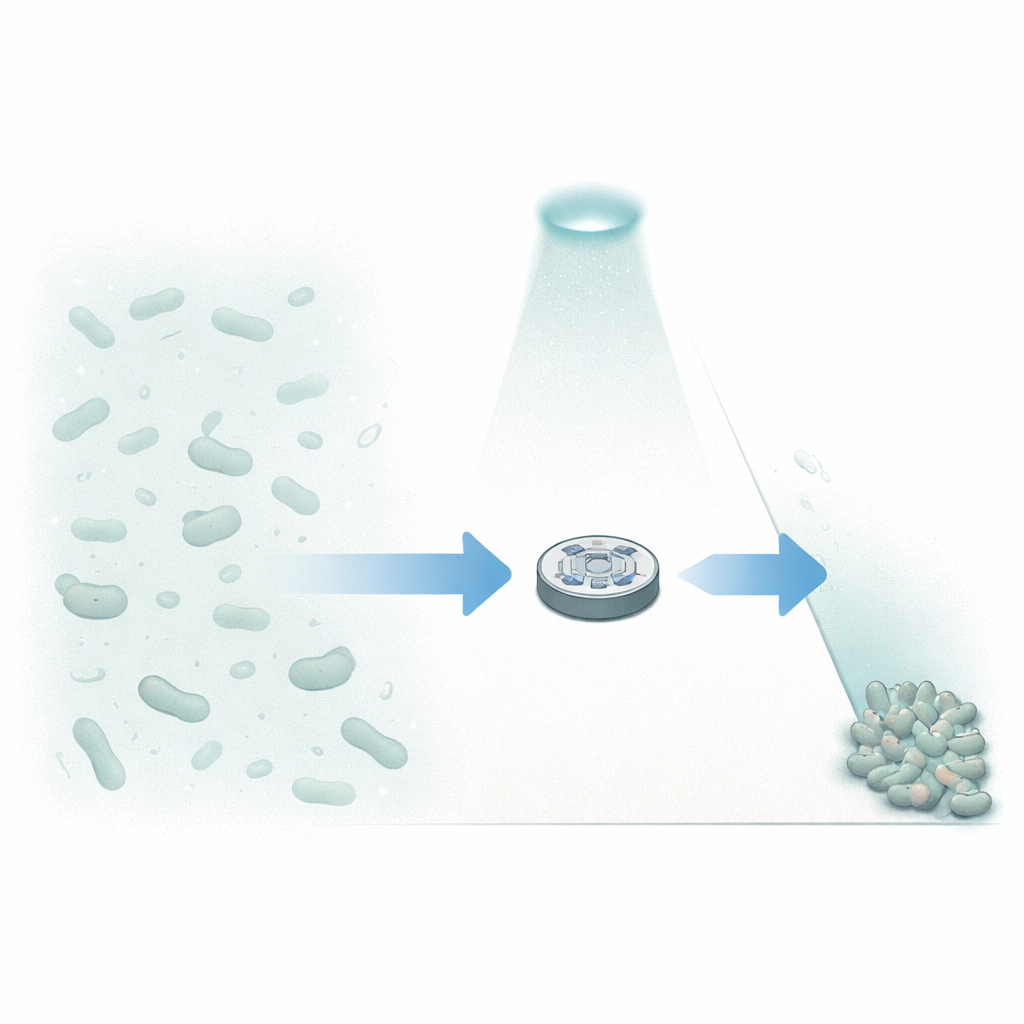
Imagine a vacuum cleaner so small that it can swim through a drop of water and round up individual bacteria without harming them. This study presents just such a device: light-driven micro- and nanorobots, smaller than a single bacterial cell, that can be steered with high precision to collect, transport, and release living microbes. These nanoscale “robotic cleaners” hint at future tools for gentle medical treatments, lab-on-a-chip devices, and ultra-local sensing inside complex fluids.
How light can push tiny machines
When light hits a very small object, it can transfer a tiny kick of momentum—like a constant drizzle of invisible ping-pong balls. The authors harness this effect using specially arranged gold structures that act like miniature antennas. Under infrared laser light, these antennas scatter light more strongly in one direction than the other. The imbalance creates a net push that drives a micrometer-scale disc through water, turning it into a self-propelled vehicle powered purely by light. Because the disc’s mass is extremely small, even minute optical forces are enough to produce surprisingly high speeds, tens of micrometers per second.
Staying on course in a jittery world
At such tiny scales, water behaves like a constantly shaking bath, and random thermal jostling would normally spin a small object around at will. To keep their robots from tumbling, the researchers build in a self-stabilizing feature. Additional gold rods on the disc feel a torque whenever the incoming light has a preferred direction. This torque naturally aligns the robot along the light’s polarization axis, like a weather vane in a steady wind. Linear polarization keeps the robot moving straight, while brief pulses of circularly polarized light provide an extra twist to choose between left and right turns at junctions. By simply sequencing these light states in time, the team draws rectangles, spirals, and even letter-shaped paths without ever moving the laser spot.
Rounding up bacteria with gentle heat
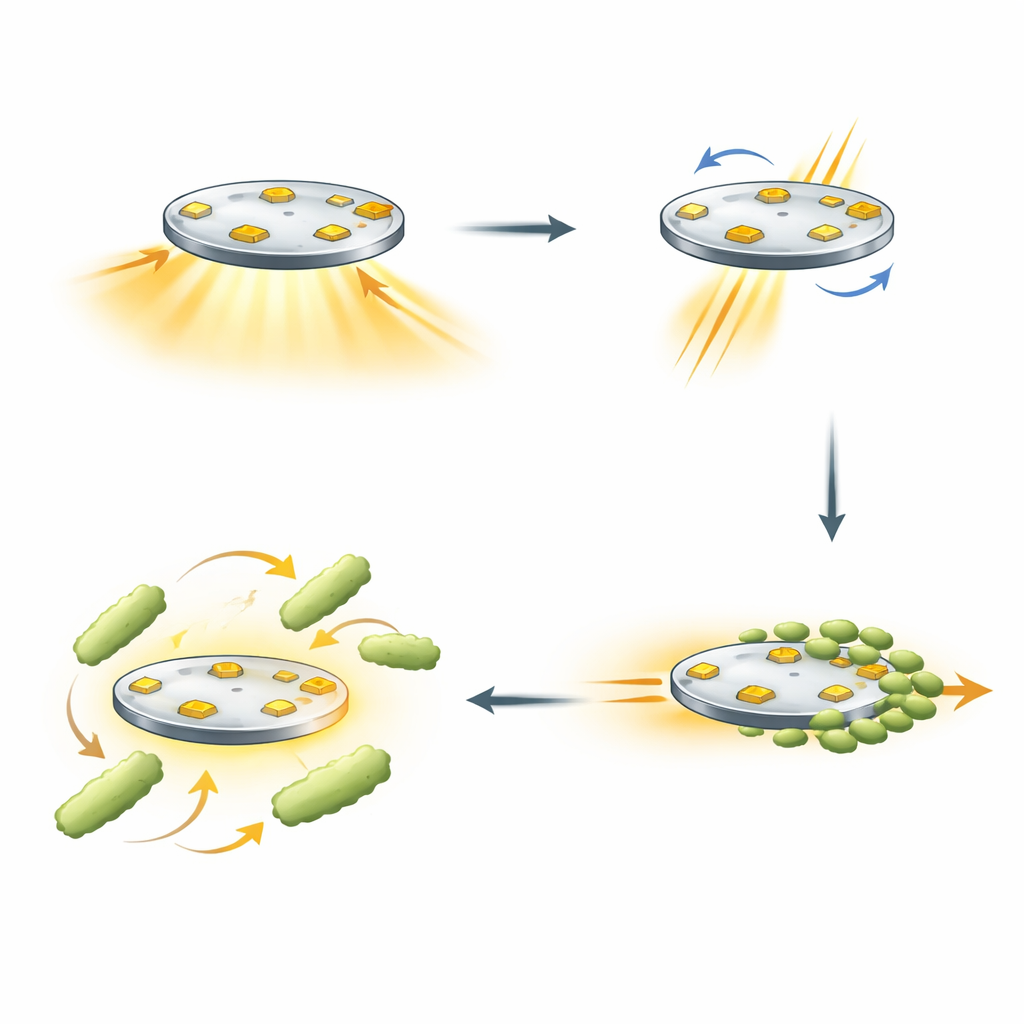
Beyond elegant motion control, the robots can interact with living microbes. The gold antennas not only scatter light but also warm their immediate surroundings by a few degrees. This mild, highly localized heating creates a temperature gradient in the water. Many biological particles, including bacteria, naturally drift along such gradients in a process called thermophoresis. In the experiments, bacteria of different shapes are drawn toward the robot, becoming trapped in a loose shell around it. As the robot moves, it pulls this cloud of microbes along its path, gathering more until a dense, roughly spherical cluster forms that can weigh hundreds of times more than the robot itself—yet the robot remains steerable.
Cleaning and releasing on demand
Because the bacteria are held only by light and temperature effects—not glued to the surface—their assembly is fully reversible. Turning off the laser removes both the optical forces and the temperature gradients, and the bacterial cluster slowly disperses as the microbes resume their random motion. By guiding a robot through a region, then steering it away and switching the light off, the researchers show that a once crowded patch of solution can be left nearly empty. They also demonstrate collection of bacteria from different heights in the fluid, illustrating how a single robot can “sweep” a three-dimensional volume, especially when combined with simple stage motion that re-centers the laser spot as needed.
Why these tiny robots matter
The work shows that carefully designed light patterns and nanostructures can turn simple discs of gold and glass into nimble, programmable cleaners at the scale of microbes. Without moving mechanical parts, and using modest laser intensities that keep temperature rises below about ten degrees, the robots can trace complex paths, stay stably oriented, and gather or release many bacteria at once. In the long run, similar devices could help sort cells, deliver drugs to very small targets, or patrol sensitive environments such as microfluidic chips or biological tissues—offering a new, non-invasive way to manipulate the microscopic world.
Citation: Qin, J., Büchner, C., Wu, X. et al. A nanoscale robotic cleaner. Nat Commun 17, 3027 (2026). https://doi.org/10.1038/s41467-026-70685-9
Keywords: nanorobots, light-driven propulsion, bacteria manipulation, plasmonic antennas, thermophoresis