Clear Sky Science · en
Templated perpendicular ferroelectricity in textured Aurivillius oxide-based thin films
Why tiny electric switches matter
From smartphones to data centers, modern electronics rely on memory elements that can hold information without constant power. Ferroelectric materials—solids whose internal electric polarization can be flipped like a light switch—are prime candidates for faster, more efficient, and even brain‑like computing hardware. Yet many of the best-known ferroelectrics either do not work well with standard silicon technology or only switch sideways within the plane of a film, whereas most real devices need the polarization to point straight up and down. This study shows how carefully arranging atoms in a layered oxide can force a normally sideways‑polarized material to develop a strong vertical polarization, opening a new path to robust, silicon‑friendly memory components.
Layered crystals with a built‑in limitation
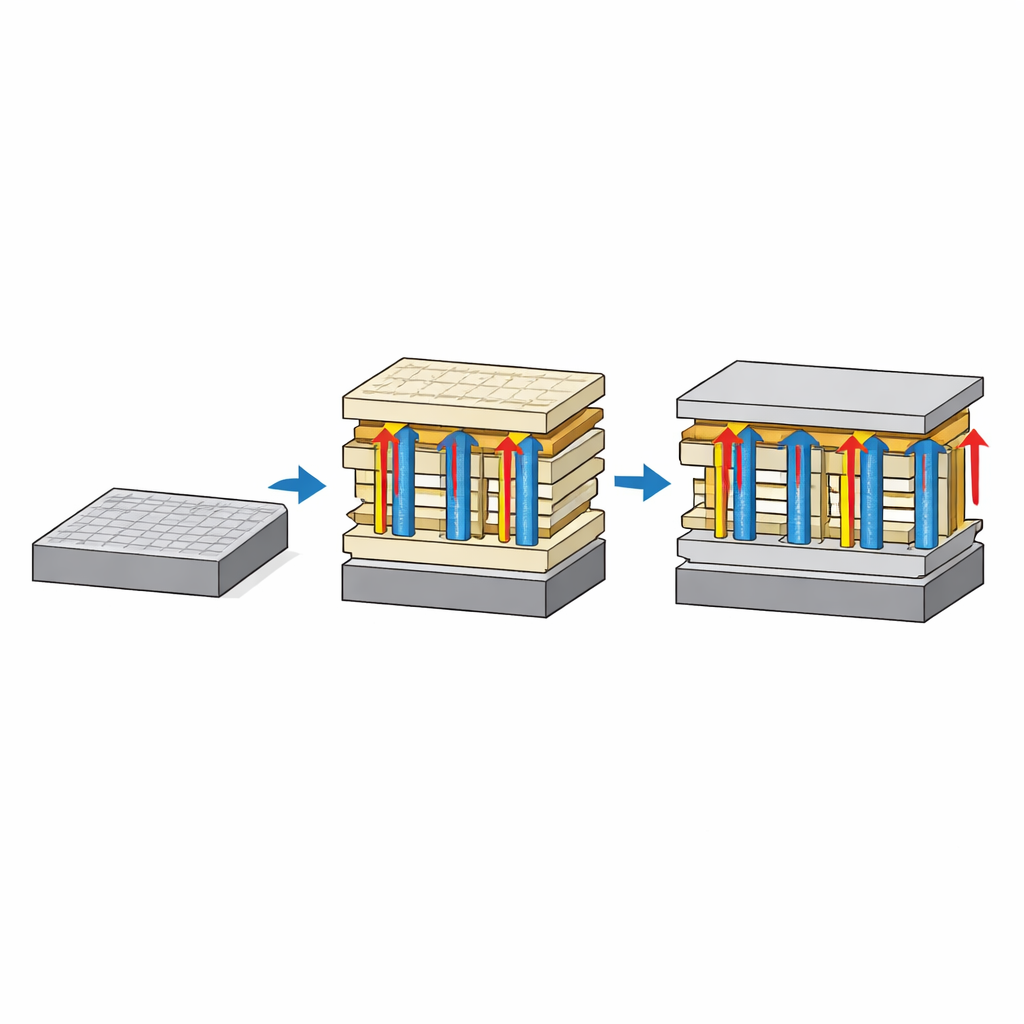
The work centers on Aurivillius oxides, a family of layered materials made of alternating charged sheets. These compounds are attractive for memory applications because they endure many switching cycles, remain stable at high temperatures, and conduct oxygen ions well. However, in most known Aurivillius ferroelectrics, including the benchmark compound bismuth tungstate (Bi2WO6), the electric polarization naturally lies within the plane of the layers. That sideways orientation clashes with mainstream device designs—such as ferroelectric transistors and tunnel junctions—which read and write information by driving charge through the thickness of a thin film. The challenge is to coax these layered oxides into supporting a strong out‑of‑plane, or perpendicular, polarization without sacrificing their stability.
Building a new phase inside an old framework
The researchers tackled this by growing thin films where small domains of tungsten oxide (WO3) are inserted into a Bi2WO6 matrix during pulsed laser deposition. High‑resolution electron microscopy reveals that the Bi2WO6 forms a high‑quality crystalline framework on a strontium titanate substrate, while nanoscale WO3 regions grow coherently inside it. Crucially, these WO3 pockets do not adopt any of the known bulk crystal forms of tungsten oxide. Instead, they are “templated” by the surrounding Bi2WO6, sharing its orientation and lattice alignment but lacking its layered structure. X‑ray diffraction and reciprocal space mapping show that the Bi2WO6 host imposes a specific strain pattern—compressed in the plane and stretched out of the plane—that helps lock in this unusual, metastable WO3 structure that would not normally appear on its own.
How shifted oxygen atoms create switchable polarity
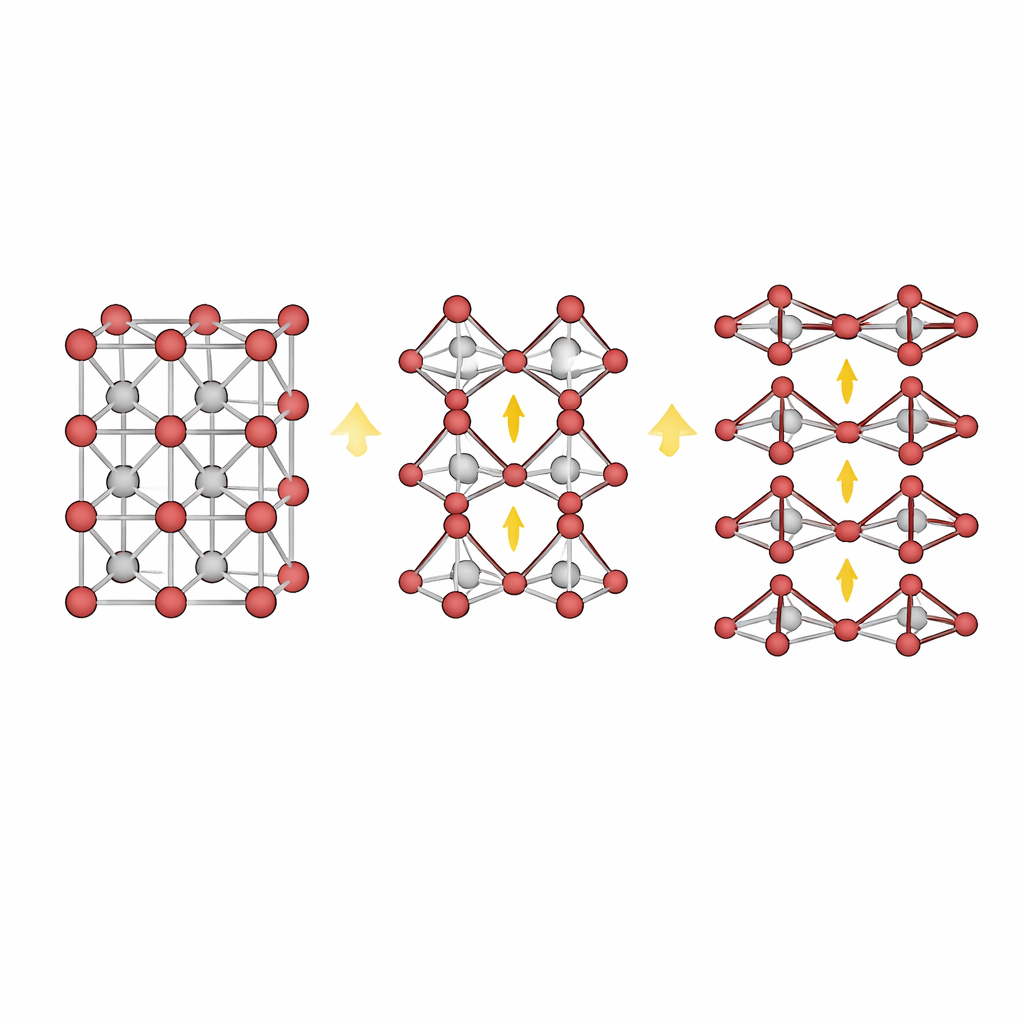
Guided by the microscopy images, the team built a structural model for the embedded WO3 and tested it using quantum‑mechanical calculations. In this model, each tungsten atom sits at the base of a slightly distorted pyramid made of five oxygen atoms, rather than the more symmetric six‑oxygen octahedra typical of many oxides. One oxygen sits above each tungsten, while four more form a shared base plane. Because all of these pyramids tilt in the same direction, their tiny dipoles add up to a large net polarization pointing perpendicular to the film. Calculations show that this phase has an out‑of‑plane polarization comparable to some of the strongest known ferroelectrics, and that switching it involves modest energy barriers linked to oxygen atoms migrating between positions. Simulations of diffraction patterns from this model match the experimental data, supporting the picture of an oxygen‑displacement‑driven ferroelectric WO3 phase stabilized only inside the Bi2WO6 framework.
Turning atomic shifts into practical devices
To test whether this engineered structure truly delivers useful perpendicular ferroelectricity, the authors probed the films with piezoresponse force microscopy and macroscopic electrical measurements. Pure Bi2WO6 films showed only in‑plane switching, confirming earlier work. By contrast, the composite WO3/Bi2WO6 films displayed clear, reversible out‑of‑plane domain patterns with 180‑degree phase contrast, robust hysteresis loops over many cycles, and operation up to at least 250 °C at the nanoscale and 350 °C in larger devices. The measured remnant polarization of about 10 microcoulombs per square centimeter, arising mainly from the WO3 domains, is strong enough for practical use. When integrated into prototype ferroelectric field‑effect transistors using a monolayer of MoS2 as the channel, the films produced on/off current ratios above a million. As two‑terminal memristor elements, they exhibited reliable switching between high‑ and low‑resistance states across a wide temperature range.
What this means for future electronics
By using one oxide as a structural template to stabilize a new, strongly polar phase of another, this study overcomes a key geometric limitation of layered ferroelectrics: their tendency to polarize only sideways. The templated WO3/Bi2WO6 films combine CMOS‑compatible processing, robust perpendicular polarization, and high‑temperature stability, all desirable traits for next‑generation non‑volatile memories and neuromorphic circuits. More broadly, the work offers a blueprint for “designer ferroelectrics,” where subtle control of atomic geometry and strain inside complex oxides is used to produce new polar phases and tailor the direction and strength of their switchable electric moments.
Citation: Zhou, S., Zhong, S., Zhang, S. et al. Templated perpendicular ferroelectricity in textured Aurivillius oxide-based thin films. Nat Commun 17, 3890 (2026). https://doi.org/10.1038/s41467-026-70676-w
Keywords: ferroelectric thin films, Aurivillius oxides, tungsten oxide, non-volatile memory, oxide electronics