Clear Sky Science · en
Tropical cyclone rainfall extends inland
Why storms far from the shore now matter
For many people, the danger from hurricanes and typhoons seems greatest right at the coast, where fierce winds and storm surge hit first. This study shows that the threat does not stop at the shoreline. Heavy rain from tropical cyclones is reaching farther inland than it used to, putting communities that once felt relatively safe at growing risk of flash floods and washouts.
Tracking how far the rain reaches
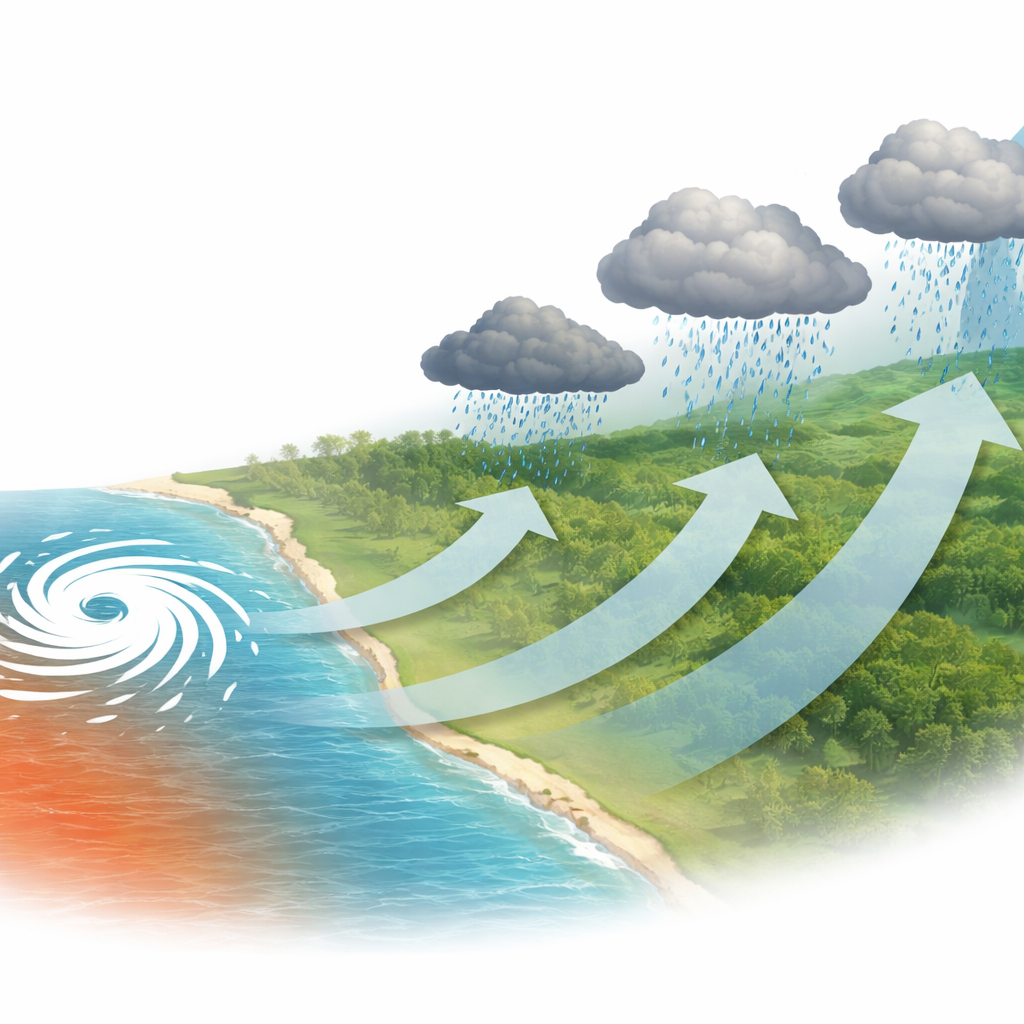
The researchers examined satellite-based rainfall records from 1980 to 2023, focusing on short bursts of very heavy rain linked to tropical cyclones around the world. They measured how far inland this intense rain fell compared with nearby coastlines, using a consistent method across continents. While most cyclone rain still occurs within about 200 kilometers of the coast, the center of heavy rainfall has been creeping landward over time. Along the continental coasts of the Northern Hemisphere, the landward reach of heavy cyclone rain increased by nearly 4 kilometers per decade. This pattern holds across different datasets, definitions of storm size, and ways of filtering out uncertain measurements, making the trend statistically robust.
Where the changes are strongest
The inland shift is not the same everywhere. It is clearly seen along several busy coastlines in the Northern Hemisphere: the western North Atlantic (including the southeastern United States and Mexico), the Bay of Bengal (including eastern India and Bangladesh), and the western North Pacific (including eastern China and parts of Southeast Asia). In contrast, similar trends are not yet evident along some Southern Hemisphere coasts such as eastern Mozambique and northern Australia. The difference partly reflects where tropical cyclones form most often, and partly where human activity along coasts has changed the most in recent decades.
Warmer coastal seas and growing cities
To understand why heavy rain is shifting inland, the team looked at changes in sea-surface temperature near coasts and at detailed computer simulations of storms. Nearshore waters in the three Northern Hemisphere regions with strong rainfall shifts have warmed noticeably since 1980, mainly due to greenhouse gas emissions. When the researchers mathematically removed the warming signal from the data, the landward trend in heavy rainfall largely disappeared. This suggests that warmer coastal seas are a key driver: they add more moisture and energy to storms, making it easier for heavy rain bands to survive and intensify as they pass over land just beyond the shore.
How cities help pull rain inland
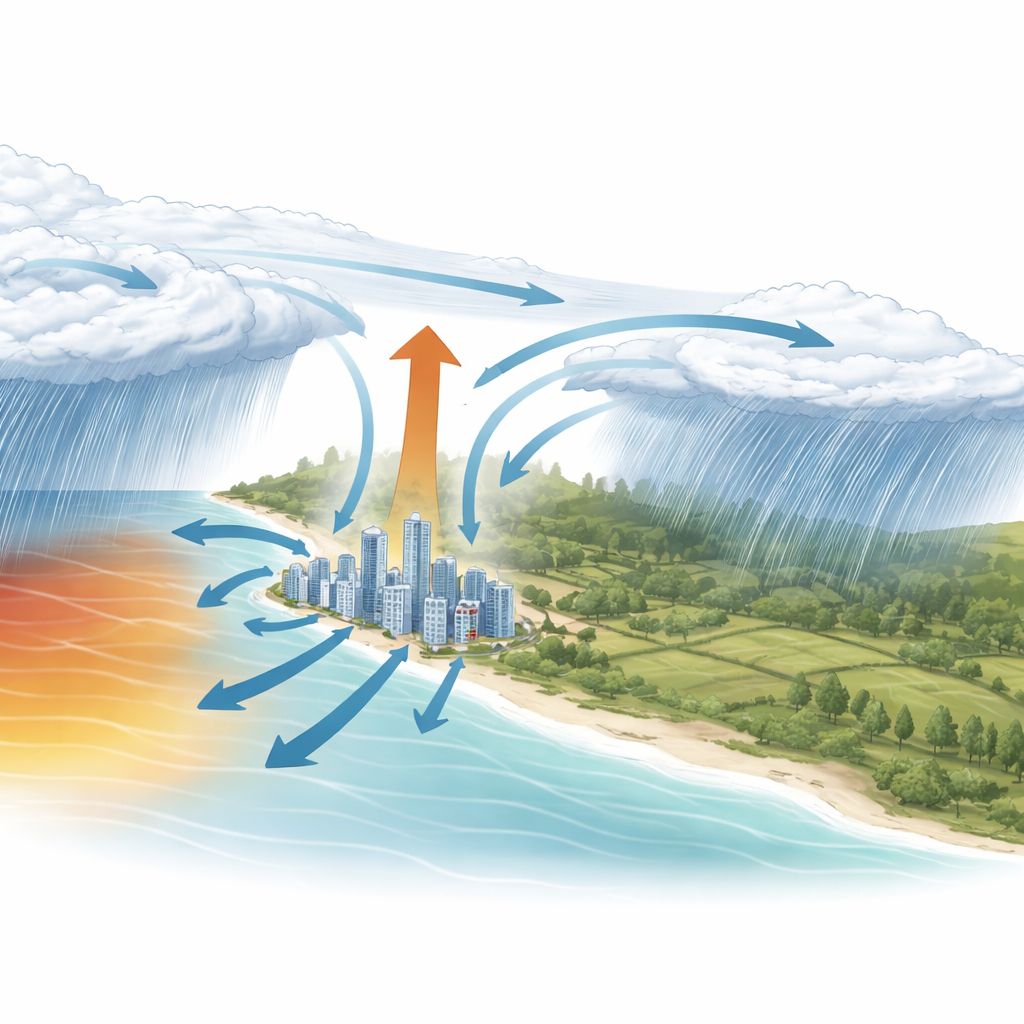
The study also explored the role of expanding coastal cities. Satellite maps show that urban areas along the same coastlines have been spreading farther inland over the past few decades. Idealized high-resolution weather model experiments indicate that, when coastal seas are warmer, larger and rougher urban surfaces can further enhance low-level air convergence and rising motion over land. This acts like an extra "brake" and "ramp" combined: rough urban landscapes slow the near-surface winds and help funnel moist air upward, reinforcing heavy rain bands and nudging them inland. These friction-driven effects are subtle and not well captured by current global climate models, but become clear in fine-scale simulations that can represent city structure.
What this means for people inland
The combination of creeping inland rainfall and growing inland populations has important consequences. Even though the average shift of about 4 kilometers per decade may sound small, it overlaps with rapidly expanding suburbs and towns beyond the traditional coastal strip. In the western North Pacific region alone, the number of people exposed to heavy tropical cyclone rain more than 100 kilometers from the coast has risen by millions per decade. While flood risk also depends on local land cover, drainage, and terrain, the findings indicate that storm-related flooding will increasingly strike communities that have limited experience and infrastructure for dealing with such extremes. In a warming climate, planning for tropical cyclone hazards can no longer focus solely on the immediate coast; it must also account for heavier rain and rising flood danger well inland.
Citation: Deng, E., Xiang, Q., Ouyang, DH. et al. Tropical cyclone rainfall extends inland. Nat Commun 17, 3926 (2026). https://doi.org/10.1038/s41467-026-70647-1
Keywords: tropical cyclone rainfall, inland flood risk, coastal urbanization, sea surface warming, climate change impacts