Clear Sky Science · en
Cell type-specific enhancers regulate IL-22 expression in innate and adaptive type 3 lymphoid cells
Guardians at the Body’s Borders
Our skin and gut face a constant barrage of microbes and irritants, yet most of the time they stay intact and healthy. One key protector is a molecule called IL-22, made by immune cells that live near these barrier surfaces. This study asks a deceptively simple question with big implications: how do immune cells decide exactly when, where, and how much IL-22 to make? The answer reveals hidden “dimmer switches” in our DNA that fine‑tune protection from infection while limiting the risk of chronic inflammatory diseases such as psoriasis.
Why IL-22 Matters for Everyday Health
IL-22 acts like a direct hotline from the immune system to barrier tissues, including the intestines, lungs, liver, skin, and breast. When IL-22 binds to its receptor on epithelial cells, it triggers programs that boost antimicrobial defenses, promote tissue repair, and help cells survive damage. In the gut, for example, IL-22 is crucial for fending off bacteria such as Citrobacter rodentium, a mouse stand‑in for harmful strains of E. coli. Too little IL-22 leaves tissues vulnerable to infection and injury; too much can fuel chronic inflammation and even cancer. Patients with psoriasis, a painful skin disorder, often have elevated IL-22 that tracks with disease severity. Because drugs that target IL-22 or its signaling pathway are under active clinical testing, understanding how IL-22 is controlled at the DNA level is both a basic and a medical priority.
Hidden DNA Switches for a Single Key Molecule
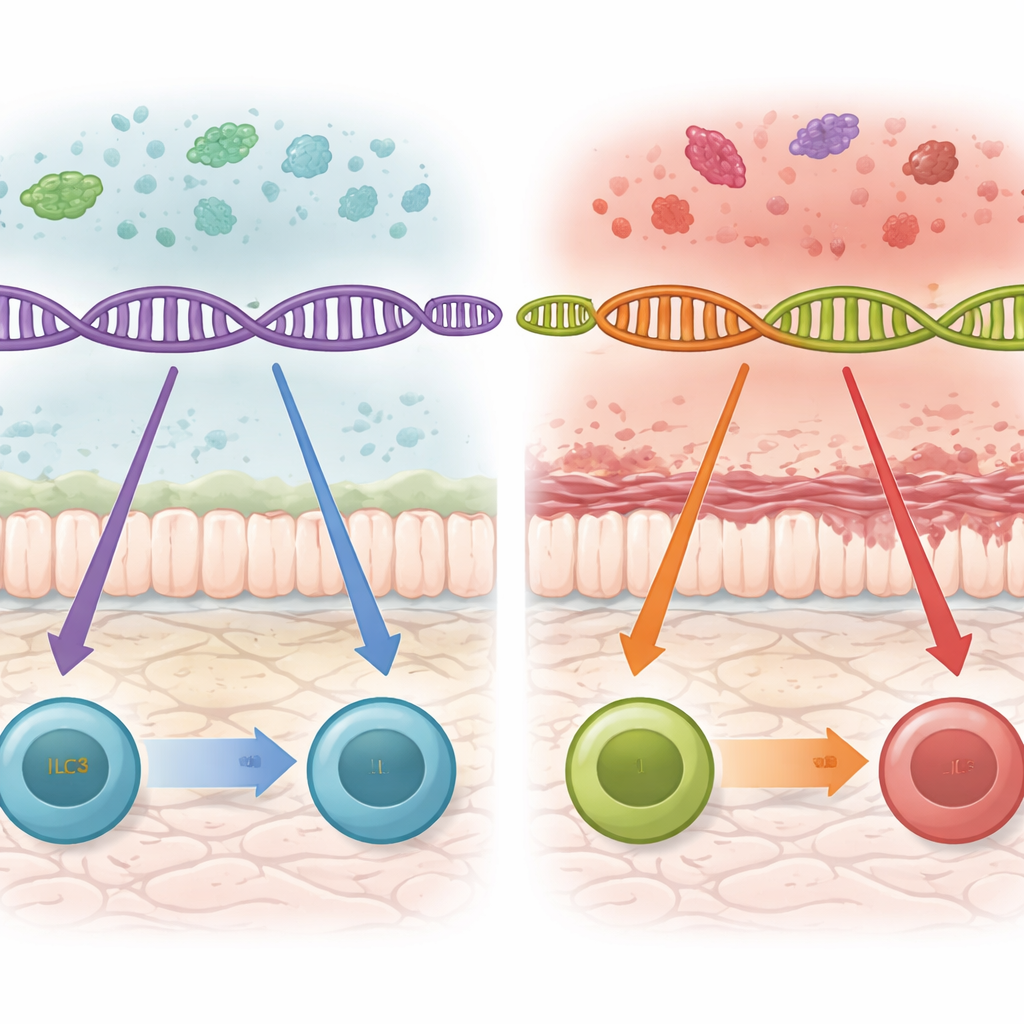
The authors focused on immune cells known as “type 3 lymphoid cells,” which include innate lymphoid cells (ILC3s) and related T helper cells (Th17/Th22). These cells share similar jobs but differ in how quickly they respond and how they are triggered. Using a powerful CRISPR interference screen in a model ILC3 cell line, the team scanned a 1.5‑million‑letter stretch of DNA around the IL-22 gene. They systematically silenced hundreds of DNA regions that looked active in immune cells and asked which ones were truly needed for IL-22 production. Among many candidates, two standout enhancers—short regulatory DNA segments—emerged as especially important. Named E22‑1 and E22‑2, they sit tens of thousands of bases upstream of the IL-22 gene and are conserved between mice and humans, suggesting an evolutionarily important role.
Dividing the Labor Between Innate and Adaptive Cells
To test how these enhancers work in living animals, the researchers engineered mice lacking E22‑1, E22‑2, or both. Strikingly, deleting both switches sharply reduced IL-22 production not only in ILC3s but also in other IL-22‑producing cells, including certain T cells and natural killer–like cells, without disturbing nearby genes. These mice had lower baseline levels of antimicrobial genes in their intestinal lining and were more susceptible to gut infection: after challenge with C. rodentium, they lost more weight and carried higher bacterial loads than normal mice. When E22‑1 alone was removed, IL-22 fell broadly across both innate and adaptive type 3 cells, essentially mimicking the double knockout. In contrast, deleting E22‑2 mainly impaired IL-22 in ILC3s and a subset of γδ T cells, while leaving conventional T helper cells largely unaffected. Reporter mice carrying only E22‑2 driving a fluorescent marker confirmed this pattern: strong activity in ILC3s across many tissues, faint or rare activity in other lymphocytes, and almost none in classic T helper cells—even during infection.
From Protection to Psoriasis
Because excess IL-22 can be harmful, the team next asked how these enhancers influence skin inflammation. They used a standard mouse model in which repeated application of the immune stimulant imiquimod causes psoriasis‑like lesions. Normal mice developed thick, red, scaly ears and showed high IL-22 levels in the skin. All three enhancer‑deficient strains—whether missing E22‑1, E22‑2, or both—were protected: their ears were thinner, with milder redness and scaling, and their skin expressed much less IL-22 while levels of related cytokines IL‑17A and IL‑17F remained similar. Notably, loss of the “innate‑biased” enhancer E22‑2 alone was as protective as loss of the broadly acting E22‑1, implying that IL-22 from skin‑resident innate cells such as ILC3s and γδ T cells is sufficient to drive psoriasis‑like disease.
How the Switches Work at the Molecular Level
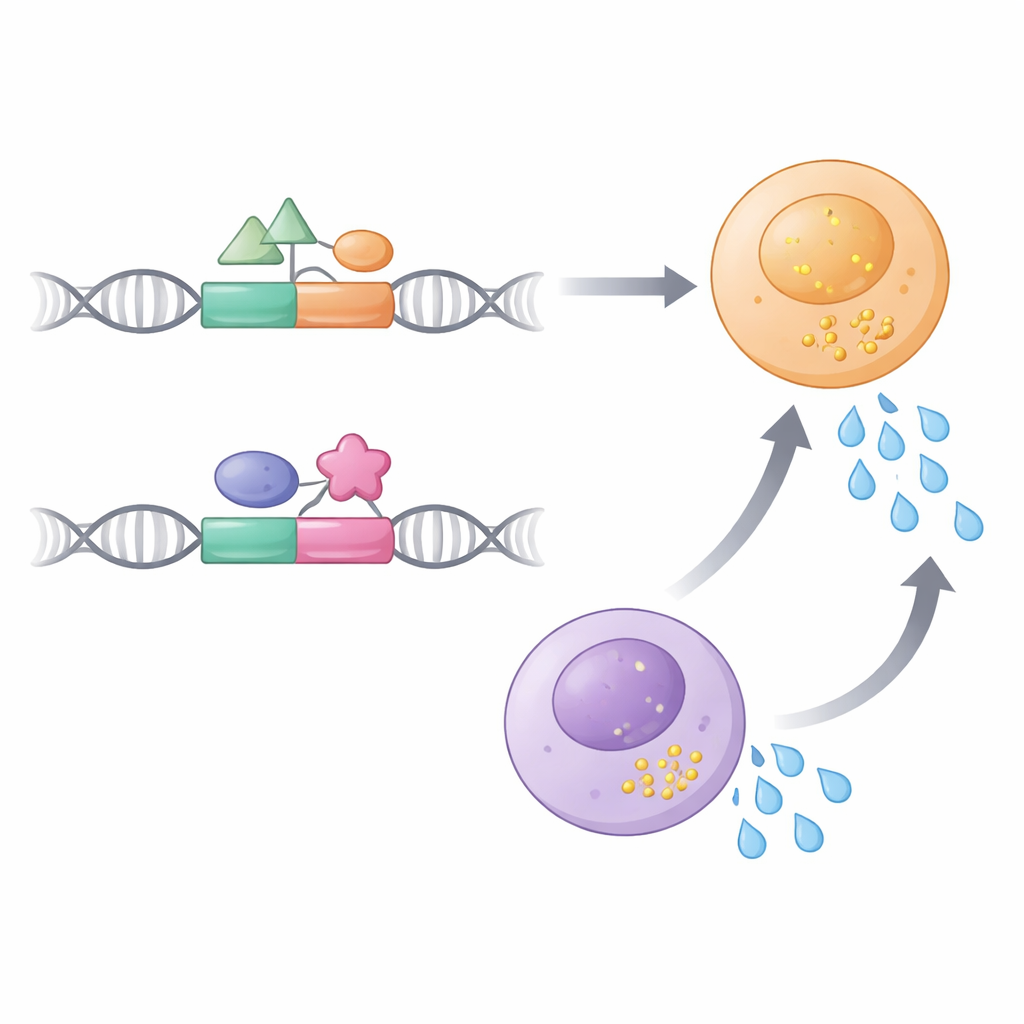
Diving deeper, the authors dissected the internal architecture of these enhancers. Both E22‑1 and E22‑2 contain docking sites for transcription factors—proteins that sense signals and turn genes on. In ILC3s, E22‑2 depends critically on multiple binding sites for Runx3, a factor known to guide innate lymphoid development, and on partner factors of the AP‑1 family. Chromosome‑folding experiments showed that E22‑2 must physically contact the IL-22 promoter to work, and this contact is itself dependent on the presence of E22‑1. Removing E22‑1 greatly reduced E22‑2’s accessibility and its ability to loop to the gene, revealing a “contingent enhancer” relationship: E22‑1 primes the landscape so that E22‑2 can fully function. A key twist is that, unlike E22‑1, E22‑2 lacks an effective binding site for RORγt, a transcription factor strongly expressed in both ILC3s and Th17/Th22 cells. When the authors experimentally swapped in a stronger RORγt site from E22‑1, E22‑2 suddenly gained robust activity in T helper cells. This suggests that a single subtle DNA motif can restrict an enhancer’s activity to innate cells while sparing adaptive counterparts.
Balancing Defense and Damage
Overall, the study reveals a layered control system in which two cooperating DNA enhancers fine‑tune IL-22 output across different kinds of lymphoid cells. E22‑1 acts as a broadly shared switch for both innate and adaptive responses, while E22‑2 is tuned for ILC3s and a few γδ T cells, providing baseline protection at barrier surfaces and rapid innate boosts when trouble arises. Their combined action helps maintain antimicrobial defenses in the gut and, when overactivated, contributes to inflammatory skin disease. By mapping this regulatory circuitry in detail, the work explains how the immune system can use the same molecule, IL-22, to both safeguard tissues and, when misregulated, promote chronic inflammation—insight that may guide more precise therapies that adjust IL-22 at the level of its DNA control switches rather than blocking it everywhere.
Citation: Saini, A., Hopkins, L.S., Serna, V.A. et al. Cell type-specific enhancers regulate IL-22 expression in innate and adaptive type 3 lymphoid cells. Nat Commun 17, 3960 (2026). https://doi.org/10.1038/s41467-026-70636-4
Keywords: IL-22, innate lymphoid cells, gene enhancers, barrier immunity, psoriasis