Clear Sky Science · en
Asymmetric sulfonamide design enabling high-voltage sodium-ion pouch cells in wide temperature
Why colder, safer batteries matter
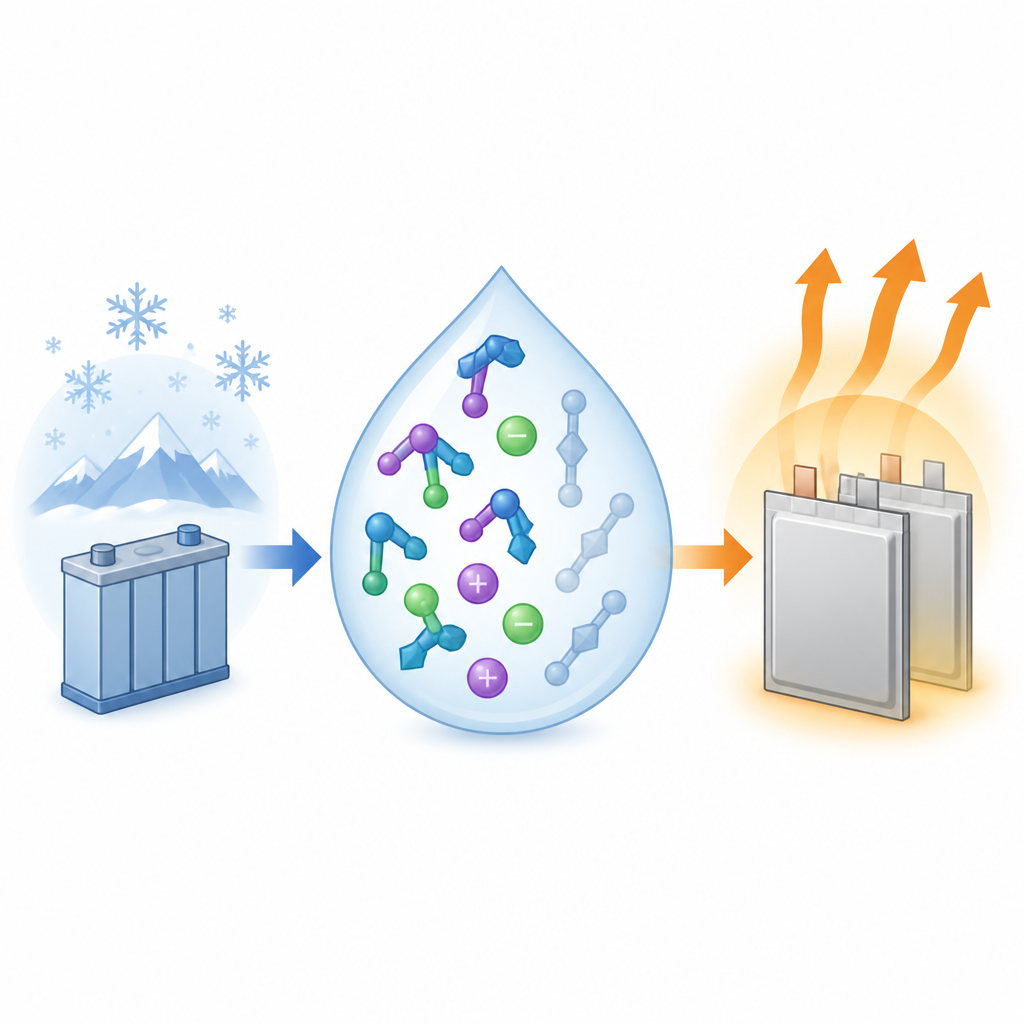
From electric cars in winter to grid batteries backing up wind and solar farms, we increasingly depend on rechargeable batteries that work safely in all seasons. Today’s leading technology, the lithium-ion battery, faces cost and resource limits, so scientists are exploring sodium-ion batteries as a cheaper alternative. But sodium cells struggle at very low temperatures and high charging voltages, especially in practical, large-format pouch cells. This study presents a new liquid inside the battery, called an electrolyte, that keeps sodium-ion batteries running across a wide temperature range while also making them more stable and safer.
Redesigning the liquid inside the battery
The authors focus on the solvent molecules that dissolve the sodium salt and carry ions between the electrodes. Conventional solvents can freeze or become sluggish in the cold, and they may also break down when the battery is charged to high voltages. The team designed a new sulfonamide solvent, N-ethyl-N-methyl-trifluoromethanesulfonamide (EMTMSA), with a deliberate asymmetry: one short and one slightly longer side group create a small “kink” in the molecule. This geometric twist prevents the molecules from packing neatly into a crystal when cooled, giving EMTMSA a very low melting point of about minus 86 degrees Celsius. At the same time, it remains stable under the high voltages needed to boost the battery’s energy.
Keeping ions mobile in the deep cold
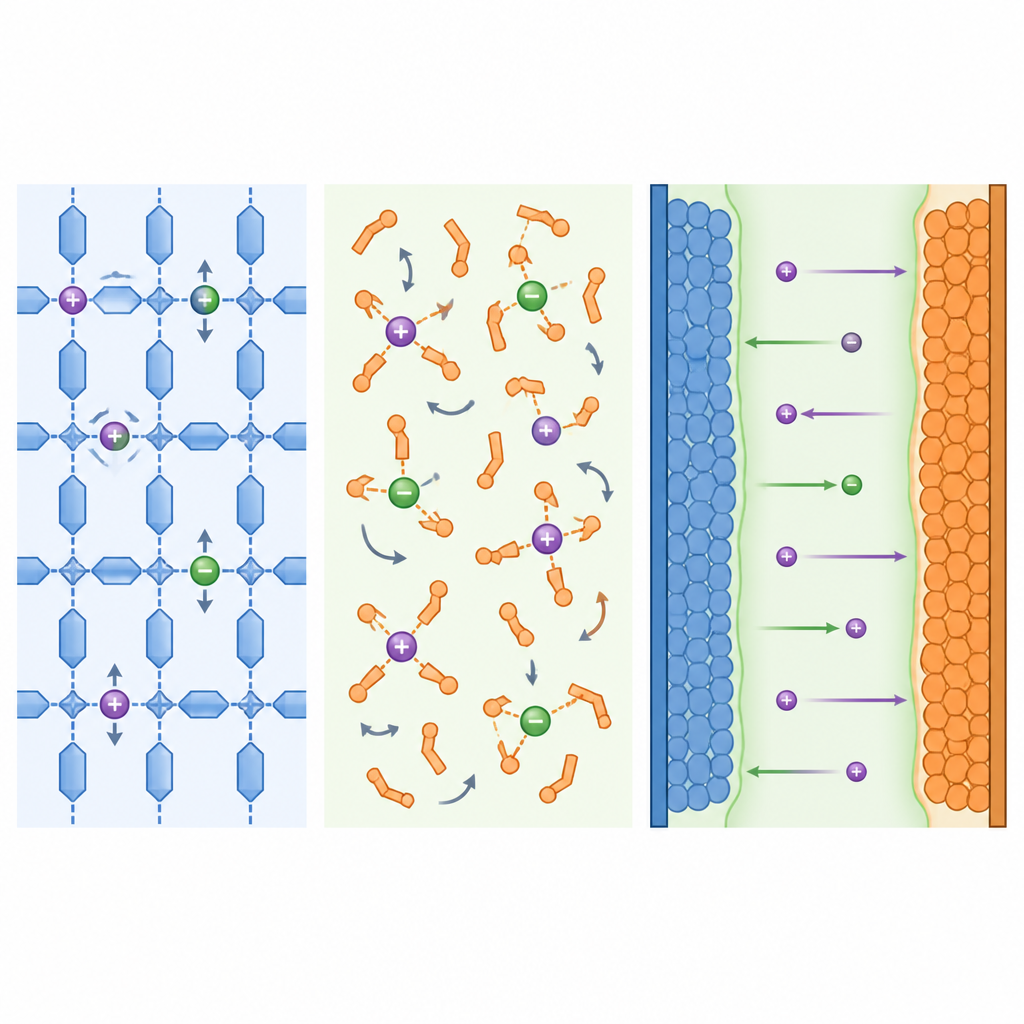
By combining EMTMSA with two common carbonate solvents and a sodium salt, the researchers created an electrolyte that stays liquid and conductive down to extreme cold. Nuclear magnetic resonance experiments showed that molecular motion and rotation in this mixture remain active even at low temperatures, in contrast to a standard carbonate blend that becomes thick and sluggish. The EMTMSA-based electrolyte encourages sodium ions to form close-knit pairs and small clusters with the salt anions. These structures weaken the grip between ions and solvent, making it easier for ions to shed their solvent shell and move into the electrodes, which is crucial when the battery is cold.
Stable surfaces on both sides of the battery
Battery performance over many charge and discharge cycles depends on thin layers that naturally form where the liquid meets the solid electrodes. With the EMTMSA electrolyte, these layers become thin, uniform, and rich in inorganic compounds like sodium fluoride. On the negative hard-carbon electrode, this stable film prevents unwanted sodium metal from plating out as mossy deposits, which would otherwise consume active material and raise resistance. On the positive NaNi1/3Fe1/3Mn1/3O2 electrode, the EMTMSA-based liquid forms a compact protective layer that limits oxygen loss and metal dissolution, avoiding the growth of a thick, poorly conducting “rock-salt” surface region that can choke ion transport.
Performance in real-world sized cells
Crucially, the team tested their electrolyte not just in tiny lab cells, but in ampere-hour scale pouch cells with thick, high-loading electrodes similar to those needed for practical devices. With the EMTMSA-based electrolyte, these sodium-ion pouch cells retained about 70 percent of their room-temperature capacity even at minus 60 degrees Celsius and over 40 percent at minus 70 degrees, while cells with standard carbonate liquids failed almost completely at such low temperatures. At room temperature and elevated cut-off voltages of 4.15 and 4.2 volts versus sodium, the EMTMSA cells kept 90.0 and 81.6 percent of their initial capacity after 1500 and 1000 cycles, respectively, outperforming conventional formulations. The new liquid also resisted ignition and delayed the onset of thermal runaway in safety tests.
What this means for future sodium batteries
For a non-specialist, the takeaway is that tweaking the shape of solvent molecules inside the battery can have a big impact on how well it works in harsh conditions. By introducing a simple kink into a sulfonamide molecule, the researchers created an electrolyte that stays fluid in extreme cold, tolerates high charging voltages, and forms protective layers that keep both electrodes healthy over many cycles. This approach makes sodium-ion pouch cells more efficient, longer lasting, and safer across a wide temperature range, bringing them a step closer to practical use in large-scale energy storage and other applications where cost and robustness are key.
Citation: Cui, X., Li, Q., Chang, G. et al. Asymmetric sulfonamide design enabling high-voltage sodium-ion pouch cells in wide temperature. Nat Commun 17, 4378 (2026). https://doi.org/10.1038/s41467-026-70592-z
Keywords: sodium-ion batteries, electrolyte design, low-temperature batteries, battery safety, pouch cells