Clear Sky Science · en
A corticothalamic circuit modulates pain sensitivity and mediates innate fear-induced analgesia in male mice
When Fear Numbs Pain
Anyone who has slammed a finger in a door yet barely noticed until later has glimpsed the brain’s power to quiet pain during danger. This study asks a deeper question: when an animal is both scared and hurt, how does the brain decide which feeling wins? By tracking neural activity in mice exposed to a predator-like odor, the authors uncover a specific brain circuit that turns down pain when fear takes center stage, hinting at new ways to treat stubborn chronic pain.
A Smell That Signals Danger
The researchers used a synthetic chemical related to fox scent that mice instinctively fear. When this odor filled the testing chamber, mice froze in place—a classic sign of innate fear, meaning it does not have to be learned. The team then measured how sensitive the animals were to various painful stimuli, from brief heat and needle pricks to persistent inflammatory and nerve injuries that mimic chronic pain. Across nearly all tests, the predator odor raised pain thresholds and reduced protective withdrawal responses, in both normal and chronically injured animals. Crucially, this effect was not due to sluggish muscles or clumsy movement: grip strength, balance, and coordination were unchanged. 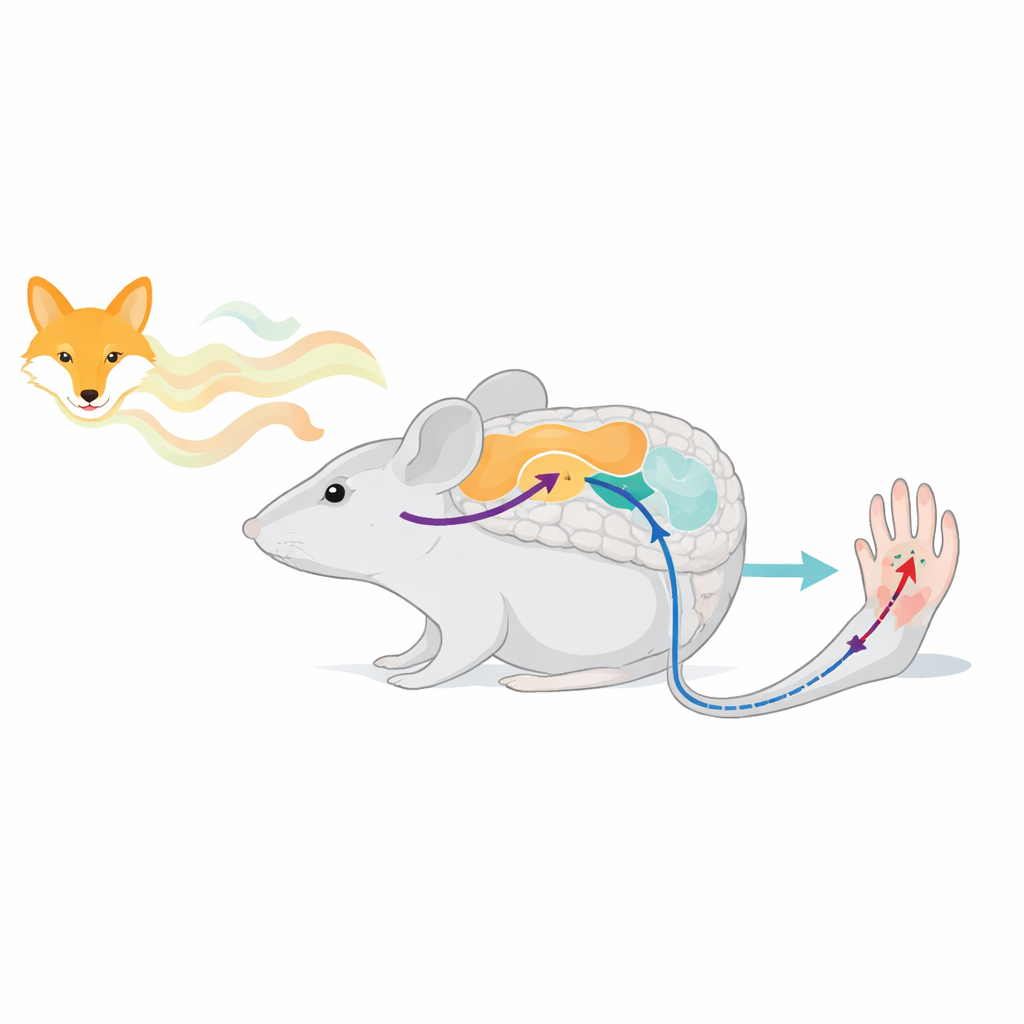
Finding the Fear–Pain Switch in the Brain
Because the trigger was a smell, the scientists looked to the brain’s primary odor center, the piriform cortex. Within its front portion, called the anterior piriform cortex, they found a set of inhibitory (GABA-producing) neurons that lit up strongly when mice encountered the predator odor, far more than during exposure to a neutral smell. Using calcium imaging, they showed that these inhibitory cells responded robustly and reliably to the fear odor across repeated trials, while neighboring excitatory neurons responded similarly to both neutral and threatening smells. This suggested that the inhibitory population carries a special “danger” signal embedded in the scent.
Turning Neurons Off and On to Control Pain
To test whether these anterior piriform inhibitory neurons actually control pain, the team used chemogenetic tools—designer receptors that can be switched off or on with an injected drug. Silencing these neurons made mice more sensitive to both mechanical and heat stimuli, and it greatly weakened the pain relief normally produced by predator odor. In contrast, activating the same neurons reduced pain responses and produced a place preference in mice with nerve injury, implying that the animals experienced relief as rewarding. When the authors selectively targeted only those inhibitory neurons that had been active during predator-odor exposure, inhibiting them specifically erased fear-induced analgesia without altering baseline pain, while activating them alone was enough to mimic the fear-driven pain relief. 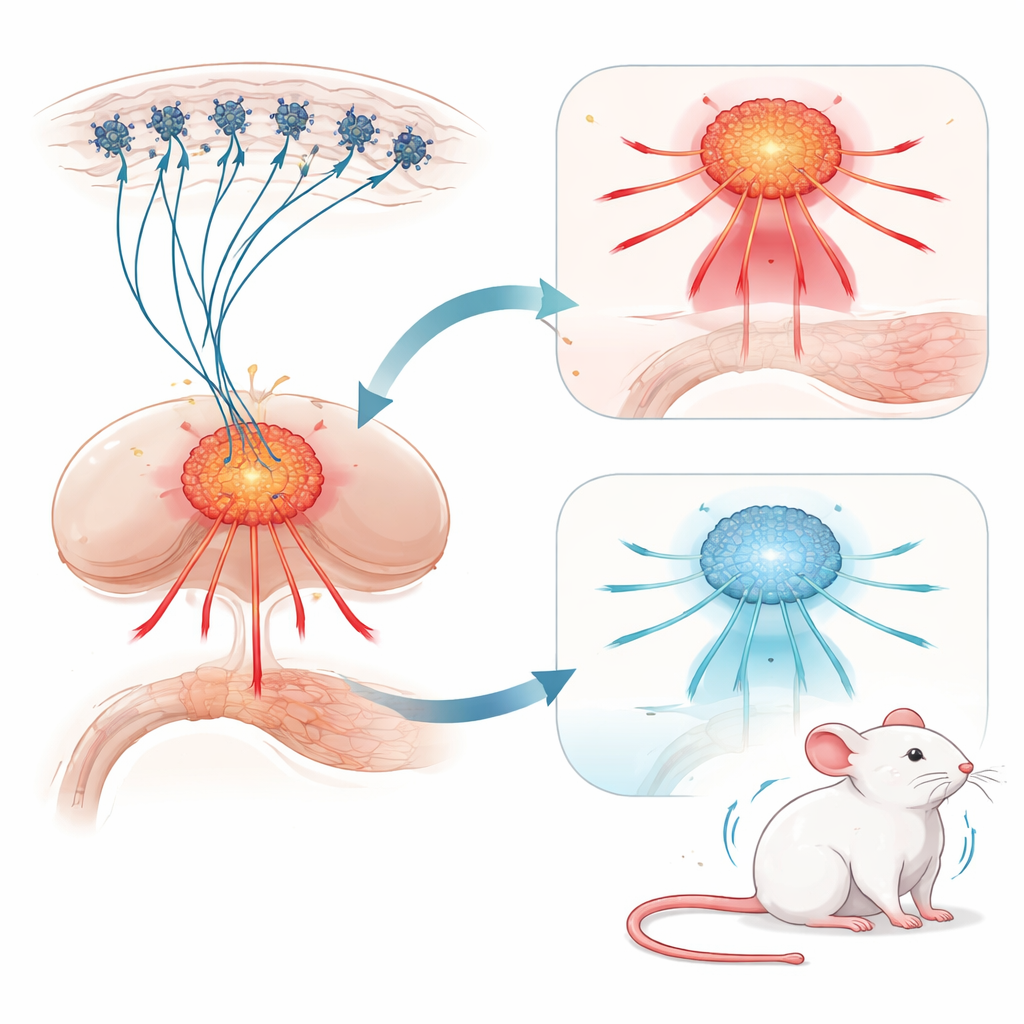
A Direct Route From Smell to Pain Control
Where do these fear-encoding inhibitory neurons send their signals? Tracing their axons, the researchers found strong projections to the mediodorsal thalamus, a deep brain hub that receives odor information and also participates in pain and emotion processing. In mice with nerve injury, neurons in this thalamic region became hyperexcitable, firing more readily than normal. Predator odor exposure reversed this hyperactivity, increasing inhibitory input and restoring firing properties toward healthy levels. When the team blocked the connection from anterior piriform inhibitory neurons to the mediodorsal thalamus, the predator odor could no longer normalize thalamic activity or relieve pain. Conversely, directly shining light on these inhibitory terminals in the thalamus was sufficient to dampen pain behaviors and was experienced as rewarding in animals with chronic pain.
Fear Comes First
Interestingly, pain did not push back on fear. Whether mice had just endured acute heat or pinprick, or lived with inflammation or nerve injury, their freezing and avoidance responses to the predator odor remained just as strong. This asymmetry suggests a hierarchy: when immediate threat looms, the brain actively suppresses pain to keep attention fixed on survival, but painful states do not dilute that fear response.
What This Means for Chronic Pain
In simple terms, the study reveals a smell-driven control knob for pain. A specialized group of inhibitory neurons in the anterior piriform cortex senses predator danger and sends calming signals to the mediodorsal thalamus, which in turn reduces how strongly pain is processed and felt. This pathway not only explains how innate fear can briefly make animals “forget” their pain, it also provides constant background braking of pain signals in everyday life. By pinpointing this corticothalamic circuit, the work opens the door to therapies that might selectively boost its activity—using drugs, stimulation, or even carefully chosen sensory cues—to ease chronic pain without numbing the entire nervous system.
Citation: Jia, WB., Wang, XY., Xia, XX. et al. A corticothalamic circuit modulates pain sensitivity and mediates innate fear-induced analgesia in male mice. Nat Commun 17, 3914 (2026). https://doi.org/10.1038/s41467-026-70580-3
Keywords: fear-induced analgesia, corticothalamic circuit, piriform cortex, mediodorsal thalamus, chronic pain