Clear Sky Science · en
Self-reorganization and information transfer in large-scale models of fish schools
Why fish crowds matter to us
From swirling sardine shoals to murmuring flocks of starlings, nature’s moving crowds are among the most captivating sights in the wild. This study uses large-scale computer simulations of fish schools to ask a deceptively simple question with broad relevance: what happens when a crowd becomes very large? The answer touches on how groups stay together, how they share information about danger, and how physical forces in the environment may shape animal behavior and even evolution.
From steady groups to restless crowds
The researchers built a detailed model of schooling fish, calibrated with experimental data. Each virtual fish swims at a constant speed, watches nearby neighbors with a front-focused field of view, and generates a small flow in the surrounding water. For small and medium groups, up to about a thousand fish, these rules produce compact, well-aligned schools that move like a single organism. The group stays cohesive and often turns together, much as observed in laboratory and field studies of real fish.
When more fish means less unity
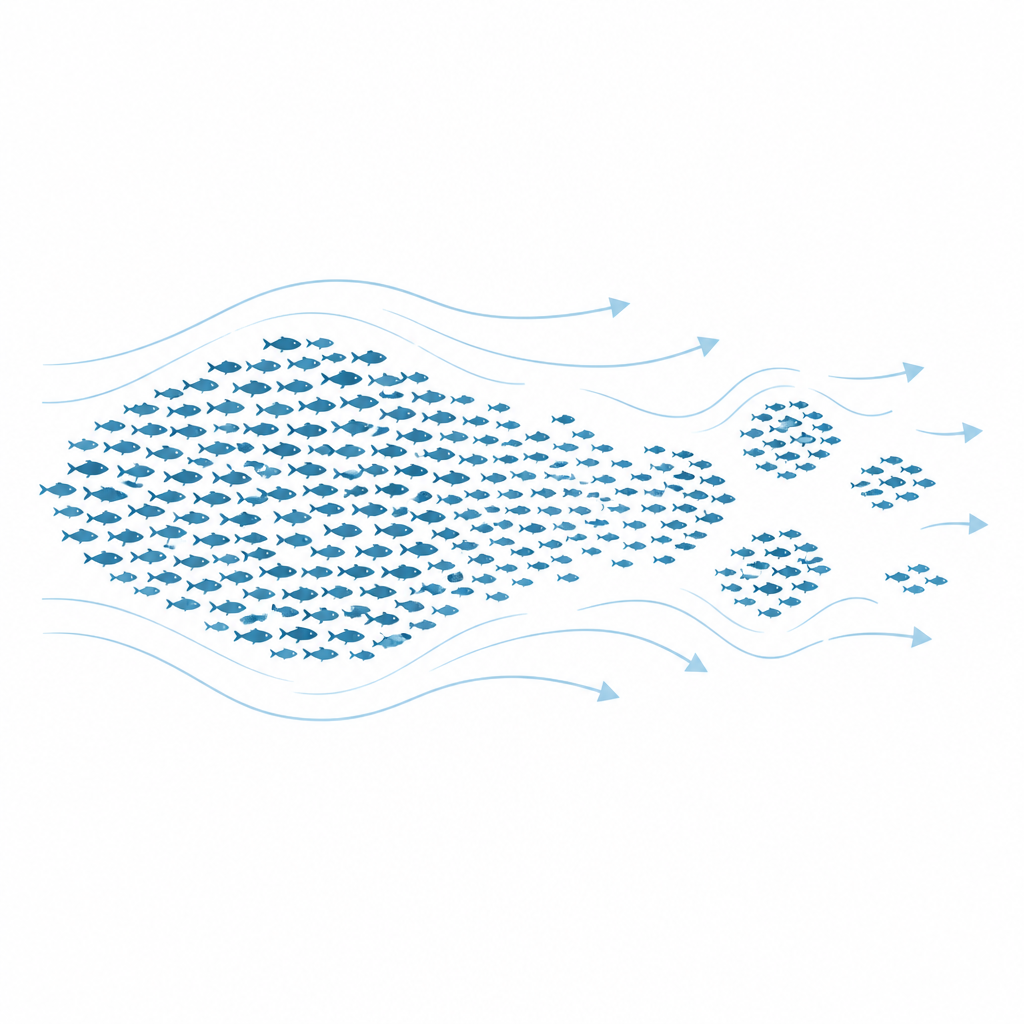
As the team scaled their simulations up to ten thousand and even fifty thousand swimmers, “more is different.” Instead of one unified school, they saw continual breaking and re-forming. The fish spontaneously organized into several dense, polarized clusters that split, drifted apart, and merged again. Surprisingly, this restless behavior did not come from random noise or from the visual rules alone. It was driven mainly by the flows each fish created in the water, which nudged neighbors into faster in-line formations and ultimately destabilized very large schools. The model suggests that stronger swimmers, which stir the water more, can maintain cohesion only in smaller numbers, whereas smaller, weaker swimmers can form larger stable schools.
Hidden signals of a coming breakup
To probe how well these schools act as a single responsive unit, the authors measured how changes in one fish’s motion relate to changes in others across the group. In cohesive, well-aligned schools, these correlations are “scale free”: the range over which fish influence each other grows in step with the group’s size. That means a local disturbance, such as a predator attack, can in principle affect the entire school. But before a large school splits, a subtle shift occurs. The typical distance over which movements remain linked shrinks, even while the school still appears strongly aligned overall. This drop in correlation length is a kind of early warning sign that the group is about to fragment, implying that fragmentation temporarily weakens the collective’s ability to respond as one.
How news of a turn races through the school
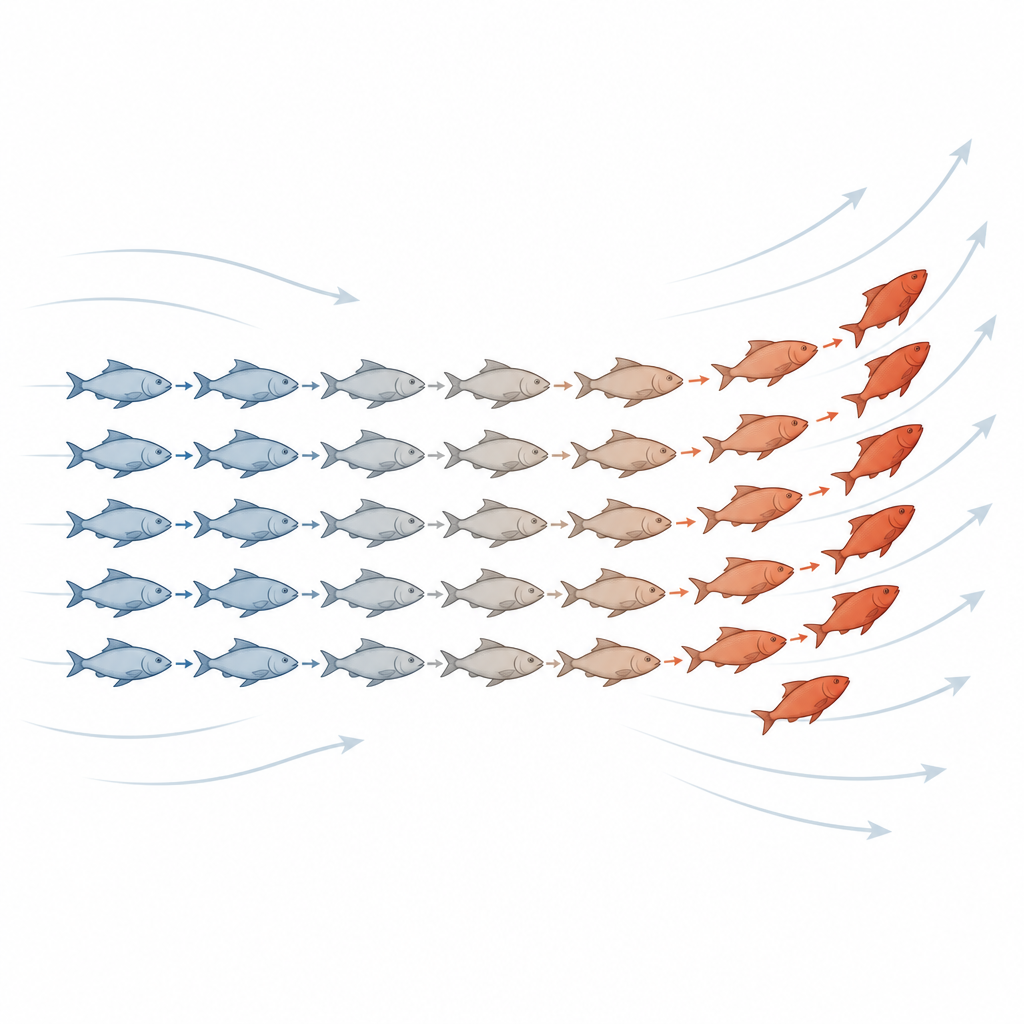
The study then examined how quickly information about a sudden turn spreads from fish to fish. By tracking the exact moment each swimmer bends its path during spontaneous turns, the authors reconstructed waves of reorientation sweeping through the school. In cohesive groups, the distance over which the “news” of the turn travels grows linearly with time, indicating a constant propagation speed many times faster than any single fish’s swimming speed. This rapid, almost ballistic spread does not rely on inertia; instead it arises from the one-sided nature of vision, in which fish mainly react to neighbors they see ahead of them. Fragmentation slows this information flow, while merging of clusters temporarily speeds it up even further. Fluid flows also boost the transfer rate beyond what vision alone would achieve.
What this means for life in moving crowds
At a broad level, the work suggests that the very flows generated by moving animals can help set natural limits on group size, shape patterns of dispersal, and influence how quickly a group can share life-saving information. For prey species, breaking a school into many pieces may confuse predators but at the cost of a slower, less coordinated response within each fragment. For ecologists and physicists, the results highlight how simple local rules, combined with the physics of the surrounding medium, can give rise to complex crowd behavior that changes qualitatively as the group grows.
Citation: Hang, H., Huang, C., Barnett, A. et al. Self-reorganization and information transfer in large-scale models of fish schools. Nat Commun 17, 4324 (2026). https://doi.org/10.1038/s41467-026-70569-y
Keywords: fish schools, collective behavior, information transfer, hydrodynamic interactions, animal groups