Clear Sky Science · en
Molecular mechanism underlying regulation of chalcone synthase by chalcone isomerase-like protein
Plant Colors and Human Health
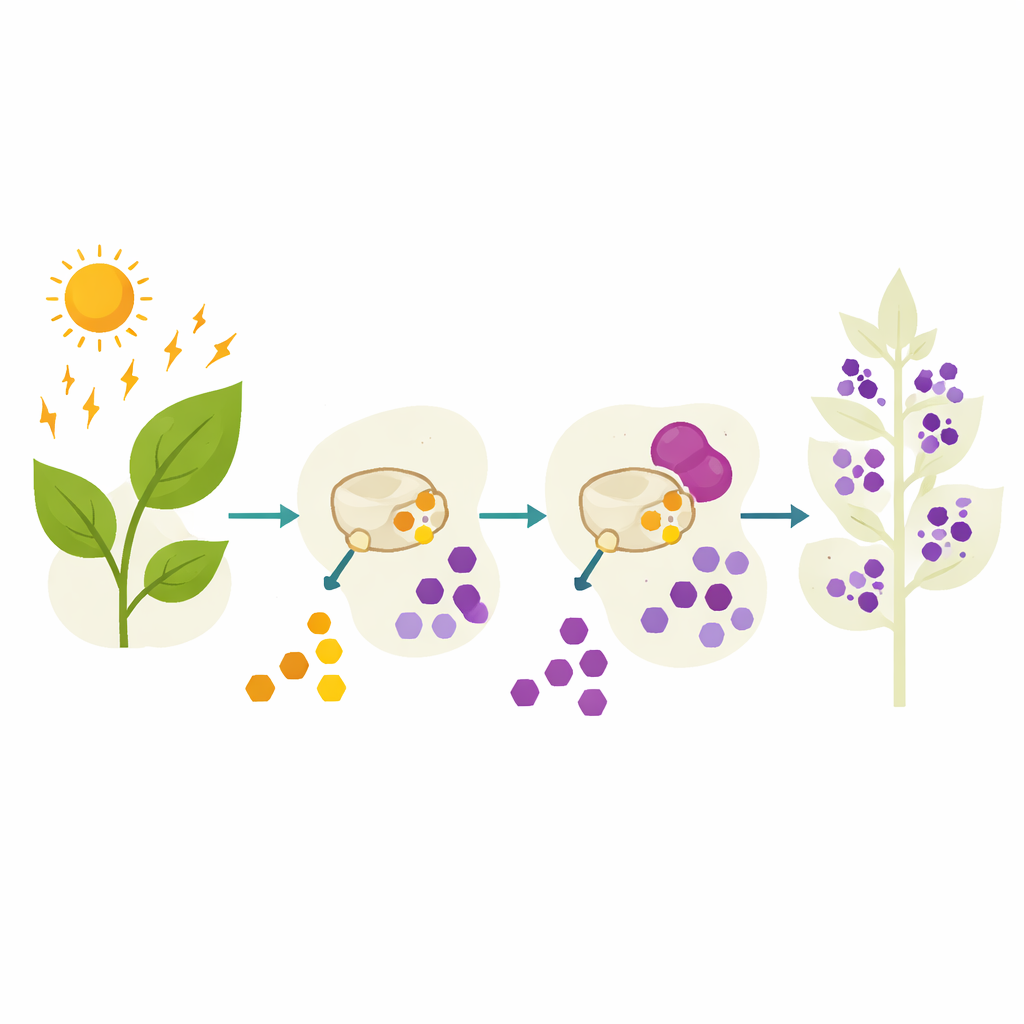
Many of the vivid reds, purples, and yellows we see in flowers, fruits, and leaves come from flavonoids—plant chemicals that also act as powerful antioxidants in the human diet. This study looks under the molecular hood of how plants control the first key step in building flavonoids, and shows how a small helper protein can tune that process to make more of the “right” products. Understanding this control switch could help breeders and biotechnologists boost beneficial flavonoids in crops and improve plants’ resilience to stress.
Why Flavonoids Matter
Flavonoids are a large family of natural compounds that protect plants from ultraviolet light, pathogens, and other environmental stresses, and they are linked to anti-inflammatory and heart-protective effects in humans. Plants make flavonoids through a chain of enzyme reactions starting from the common building block L-phenylalanine. One of the earliest and most crucial steps is carried out by an enzyme called chalcone synthase (CHS), which directs carbon flow into the flavonoid pathway. But CHS is not perfectly selective: while it mainly produces a chalcone that leads to health-promoting flavonoids, it also generates unwanted side products, a phenomenon known as catalytic promiscuity. This “leakiness” can waste cellular resources and limit how much flavonoid a plant can produce.
A Hidden Helper at Work
Plants also produce a related protein called chalcone isomerase-like protein (CHIL). Unlike its cousin chalcone isomerase (CHI), CHIL has lost direct catalytic activity, but previous work hinted that it physically interacts with CHS and improves its performance. In this study, the authors first confirmed that the genes for CHS and CHIL are switched on together in specific cells and stages of Arabidopsis leaves, especially in the outer cell layer where exposure to light and stress is highest. They then showed in test-tube reactions that adding CHIL to CHS reduces levels of a derailment side product and boosts formation of the desired flavonoid precursor naringenin, acting as an auxiliary factor that sharpens CHS’s product mix.
Seeing the Molecular Partnership
To understand how CHIL fine‑tunes CHS, the team solved the crystal structure of the CHS–CHIL complex at atomic resolution. The structure reveals a flower‑like assembly: a central pair of CHS enzymes, each bound on one side by a CHIL molecule. CHIL does not drastically reshape the core of CHS, but it makes contact through two main surfaces that together form an inverted “L” around part of the enzyme. One key feature is a small projecting loop on CHIL, called a β‑hairpin, which inserts right at the entrance of CHS’s substrate‑binding pocket. Mutating amino acids in these contact regions, on either protein, weakens their interaction and largely abolishes CHIL’s ability to boost CHS activity and specificity, showing that close physical docking is essential.
A Movable Gate That Speeds the Reaction
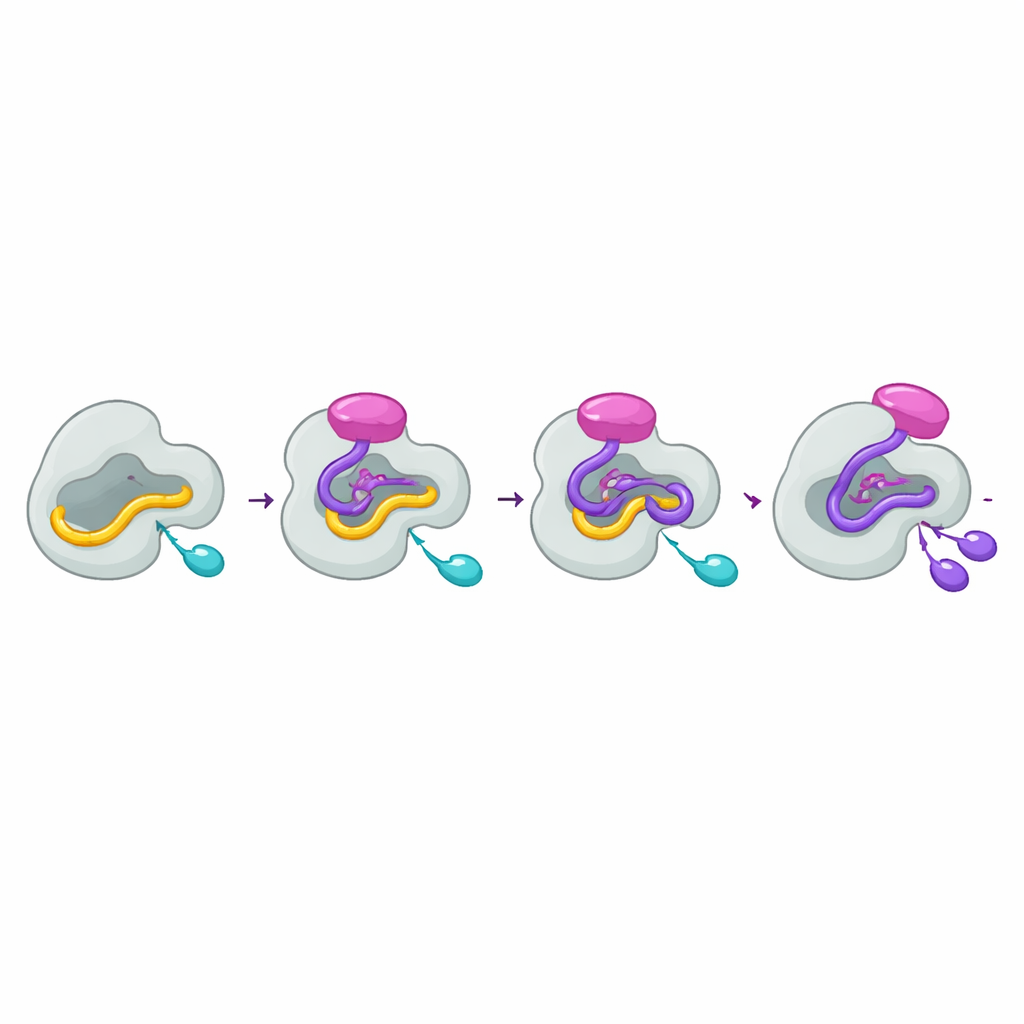
By combining structural data, biochemical tests, and computer simulations, the authors propose that CHIL acts like a movable gate over the CHS pocket. When CHS binds the starting molecules, the β‑hairpin loop of CHIL shifts position, helping guide the substrates into a more stable arrangement while making it easier for the reaction by‑product CoA to leave. This speeds up the catalytic cycle and favors formation of the main flavonoid precursor over side products. A single amino acid in CHIL’s loop, at position 36, proves especially important: changing histidine at this spot to certain hydrophobic residues, especially leucine, greatly enhances CHIL’s ability to stimulate CHS. The same substitution works not only in Arabidopsis but also when CHIL partners with CHS from rice, maize, soybean, and even ginkgo, highlighting a deeply conserved mechanism.
Evolution and Future Uses
Looking across land plants—from mosses and ferns to conifers and flowering species—the researchers found that CHIL proteins and their CHS partners are widespread and that critical contact residues are strongly conserved. In all tested species, CHILs improved the activity and product choice of their matching CHSs, with particularly strong effects in more ancient plant lineages. Guided by this evolutionary pattern, the team designed new CHIL variants, such as a double change that mimics older plant versions, and showed these can further increase CHS efficiency. This suggests that nature has experimented with slightly different gate designs over hundreds of millions of years to tune flavonoid output.
What This Means for Plants and People
In everyday terms, this work shows that CHIL is a smart molecular assistant that clips onto CHS, steadies its hands, and helps it turn more raw material into useful flavonoids instead of waste. By revealing the detailed “lock‑and‑key” contacts and the crucial loop that controls access to the enzyme’s pocket, the study offers a blueprint for engineering crops with higher levels or tailored mixes of flavonoids. Such crops could be better at withstanding sunlight, drought, and disease, and might also provide greater nutritional benefits to humans through flavonoid‑rich foods.
Citation: Wang, S., Ma, LY., Xu, ZG. et al. Molecular mechanism underlying regulation of chalcone synthase by chalcone isomerase-like protein. Nat Commun 17, 3992 (2026). https://doi.org/10.1038/s41467-026-70563-4
Keywords: flavonoid biosynthesis, chalcone synthase, protein–protein interactions, plant metabolism, metabolic engineering