Clear Sky Science · en
Electric current-driven heterogeneous microstructures in dual-phase titanium alloys
Why tougher metals matter
Modern airplanes, medical implants, and high-performance machines all rely on metals that are both strong and flexible. Strong materials resist breaking, while flexible ones can bend and stretch without snapping. Usually, improving one of these qualities makes the other worse, forcing engineers to accept a trade-off. This study shows a way to escape that compromise in widely used titanium alloys by briefly running a powerful electric current through them, reshaping their internal structure in thousandths of a second.
A quick electric jolt that reshapes metal
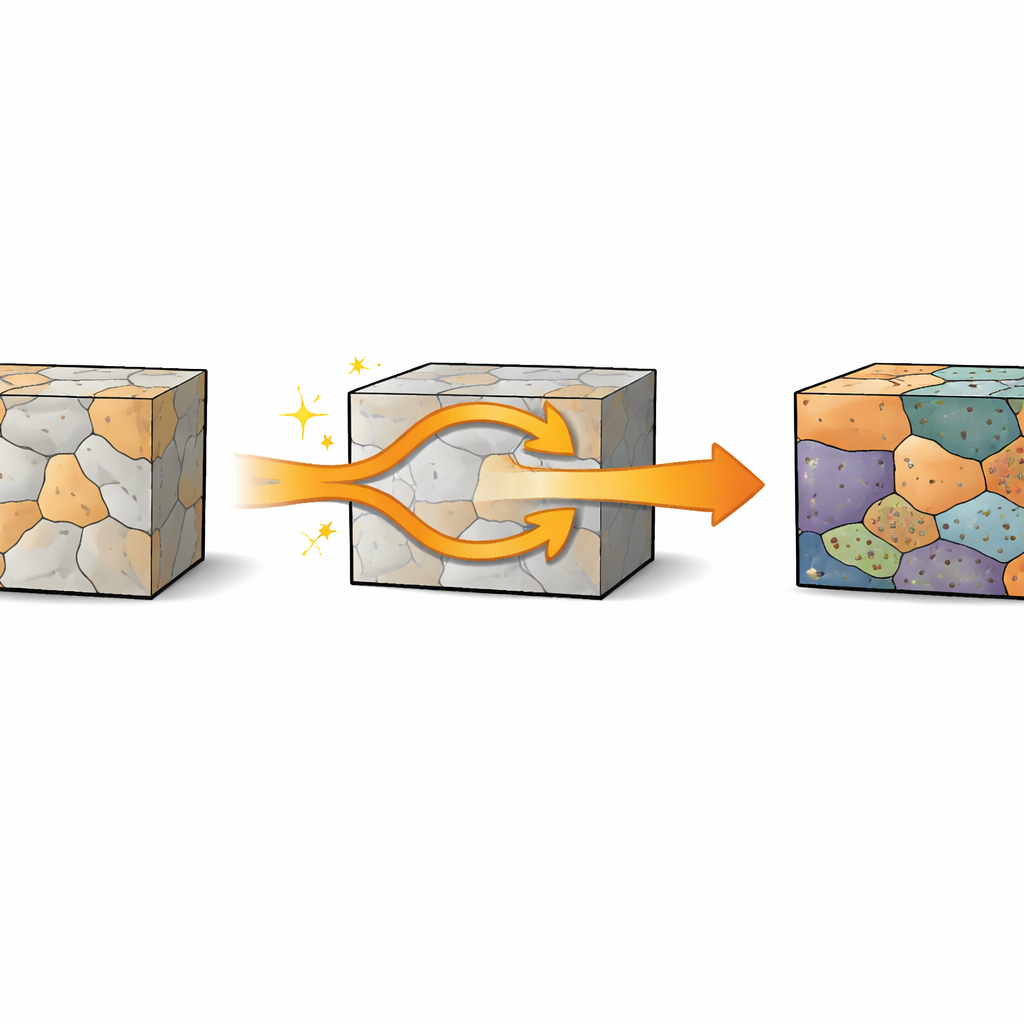
The researchers focused on two common titanium alloys, Ti-6Al-4V and Ti-6Al-7Nb, used in aircraft parts and medical devices. Normally, tuning their properties requires long, energy-intensive heat and deformation treatments. Instead, the team applied an intense, pulsed electric current for just a few milliseconds. This current rapidly heated and cooled the metal while also pushing atoms around in a way that cannot be explained by heat alone. The result was a new, highly complex internal architecture built almost instantly, without the usual multi-step processing.
A hidden landscape inside titanium
Before treatment, these alloys contain two main types of crystal regions, or phases, called alpha and beta, with fairly uniform grain sizes. After the electric pulse, this simple landscape was transformed into a rich, layered structure spanning sizes from about one nanometer to ten micrometers—five orders of magnitude. In Ti-6Al-4V, the researchers observed at least five distinct components: remnants of the original alpha and beta regions, newly formed needle-like and layered phases, and, most strikingly, extremely fine plates of a phase called martensite appearing inside the beta regions. They also found tiny zones of locally ordered atoms only a few nanometers across, showing that the electric treatment rearranged not just the shapes of grains but the way different elements clustered at the atomic scale.
How an electron wind drives change
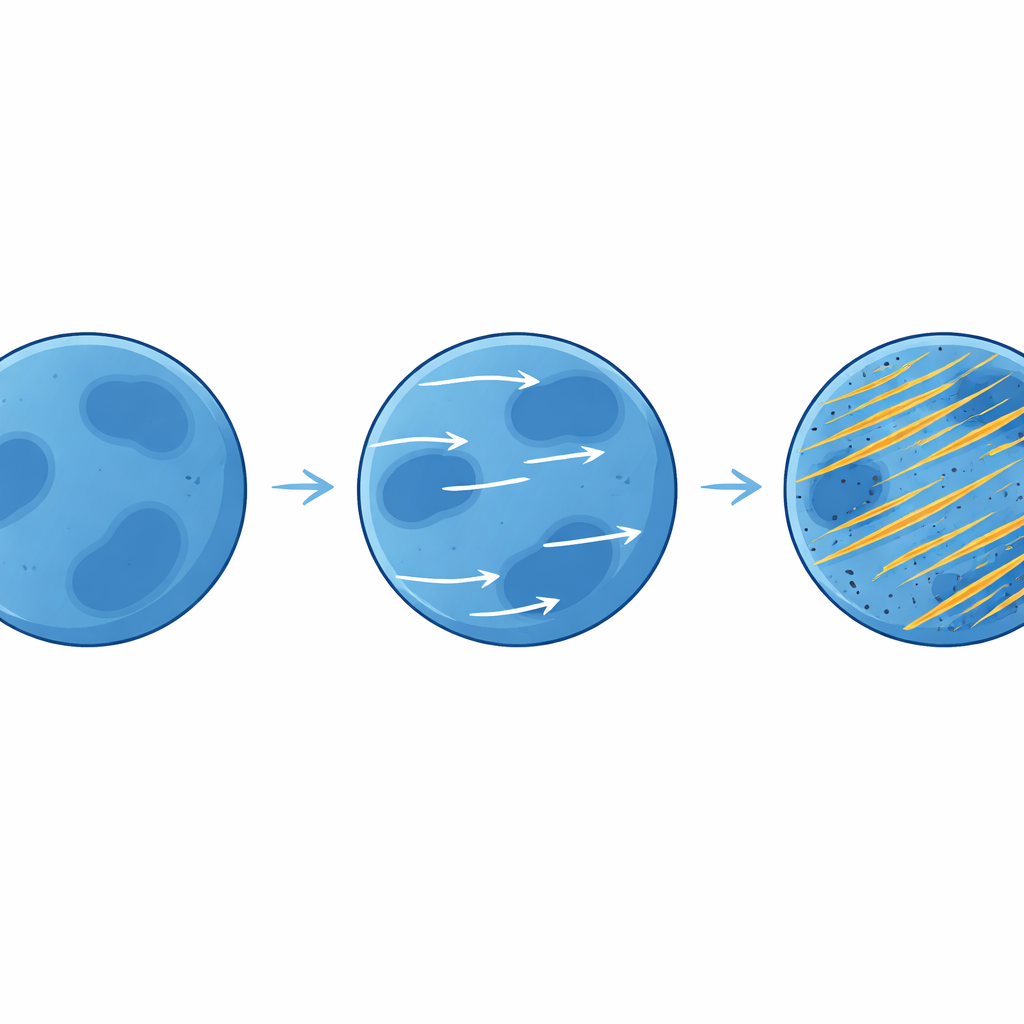
To understand how such intricate patterns formed so quickly, the team combined advanced electron microscopy with computer simulations. They showed that the electric current does more than simply heat the metal. Moving electrons exert a directional “wind” force on atoms, especially on beta-stabilizing elements like vanadium and niobium. This electron wind pushes these atoms along certain paths and creates local stress fields inside the metal. In regions where this stress is high, it helps trigger the growth of nanoscale martensite plates inside the beta phase, aligned with the direction of the internal shear. In regions with lower stress, it mainly drives the slow separation of phases and the formation of layered structures enriched or depleted in certain elements. Carefully designed micromachined samples allowed the authors to separate the effects of plain heating from these athermal electron-driven forces, showing that the latter vastly accelerates atomic motion compared with heat alone.
From inner architecture to better performance
This complex internal network of phases has a clear mechanical payoff. Normally, in these alloys the beta regions are weaker and tend to deform first, concentrating strain and promoting early cracking. After the electric-current treatment, the newly formed nanoscale martensite and chemical ordering toughen the beta regions so that they carry load more evenly with the surrounding alpha regions. Microscopy during deformation revealed dense tangles of defects—dislocations—threading through both the strengthened beta and the alpha-based phases, with the tiny ordered regions acting as anchors that resist their motion. Together, these features make it harder for cracks to start and grow. As a result, both alloys showed double-digit percentage gains in strength and in how far they could stretch before breaking, defying the usual trade-off.
A fast, energy-saving route to next-generation metals
For a non-specialist, the key message is that a brief, carefully controlled electric jolt can reorganize a metal’s interior into a finely tuned, multi-level structure that is both stronger and more stretchable, while using over 50% less energy than conventional treatments. By harnessing the directional push of moving electrons, rather than relying on heat alone, this method offers a rapid, scalable way to design tougher structural metals. Such electrically engineered microstructures could help create lighter, longer-lasting components in transportation, energy, and medical technologies, contributing to more efficient and sustainable engineering systems.
Citation: Gu, S., Kimura, Y., Cui, Y. et al. Electric current-driven heterogeneous microstructures in dual-phase titanium alloys. Nat Commun 17, 3470 (2026). https://doi.org/10.1038/s41467-026-70561-6
Keywords: titanium alloys, electric current processing, heterogeneous microstructures, strength ductility, electron wind force