Clear Sky Science · en
Unravelling the Ru-promoted dynamic evolution of Cobalt hydroxide during nitrate reduction towards ammonia production
Turning Waste into Useful Fuel
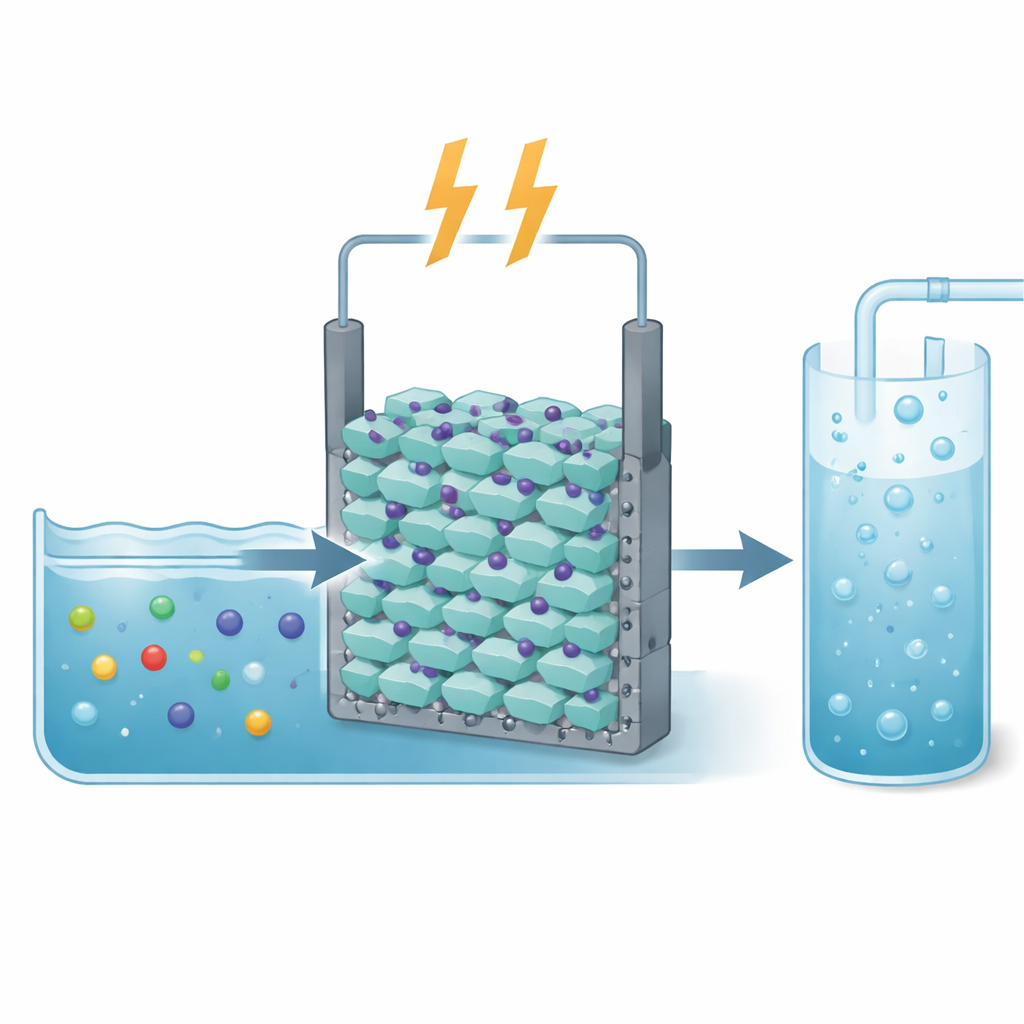
Ammonia is a key ingredient in fertilizers and many industrial products, but making it today typically relies on energy-hungry, fossil-fuel-based processes. At the same time, nitrate pollution from factories and agriculture is fouling rivers and groundwater. This study explores a way to tackle both problems at once: using electricity to turn nitrate in wastewater directly into ammonia with the help of a finely tuned solid catalyst.
A Cleaner Path from Nitrate to Ammonia
The researchers focus on an electrochemical process, where an applied voltage drives chemical reactions at the surface of a solid electrode in contact with water. Instead of starting from nitrogen gas in the air, they begin with nitrate, a dissolved form of nitrogen commonly found in contaminated water. When the right catalyst is used, incoming nitrate can be stepwise converted into ammonia while hydrogen gas formation, a common and wasteful side reaction, is kept to a minimum. This offers a route to “green” ammonia production that could also help clean up nitrate-laden wastewater streams.
Building a Smart Cobalt–Ruthenium Surface
To achieve this, the team built a catalyst made of thin nanosheets of cobalt hydroxide grown on a porous nickel foam support. They then decorated these nanosheets with tiny ruthenium particles. Cobalt hydroxide provides abundant, inexpensive active sites that can bind nitrate and its reaction intermediates, while the ruthenium nanoclusters act as strategic helpers rather than the main workhorses. Careful measurements revealed that this combination delivers very high ammonia production rates and up to about 98% of the current going into making ammonia instead of unwanted byproducts over a wide range of operating voltages, and that the performance can be maintained for hundreds of hours in both lab cells and a flow-through reactor.
A Surface that Constantly Renews Itself
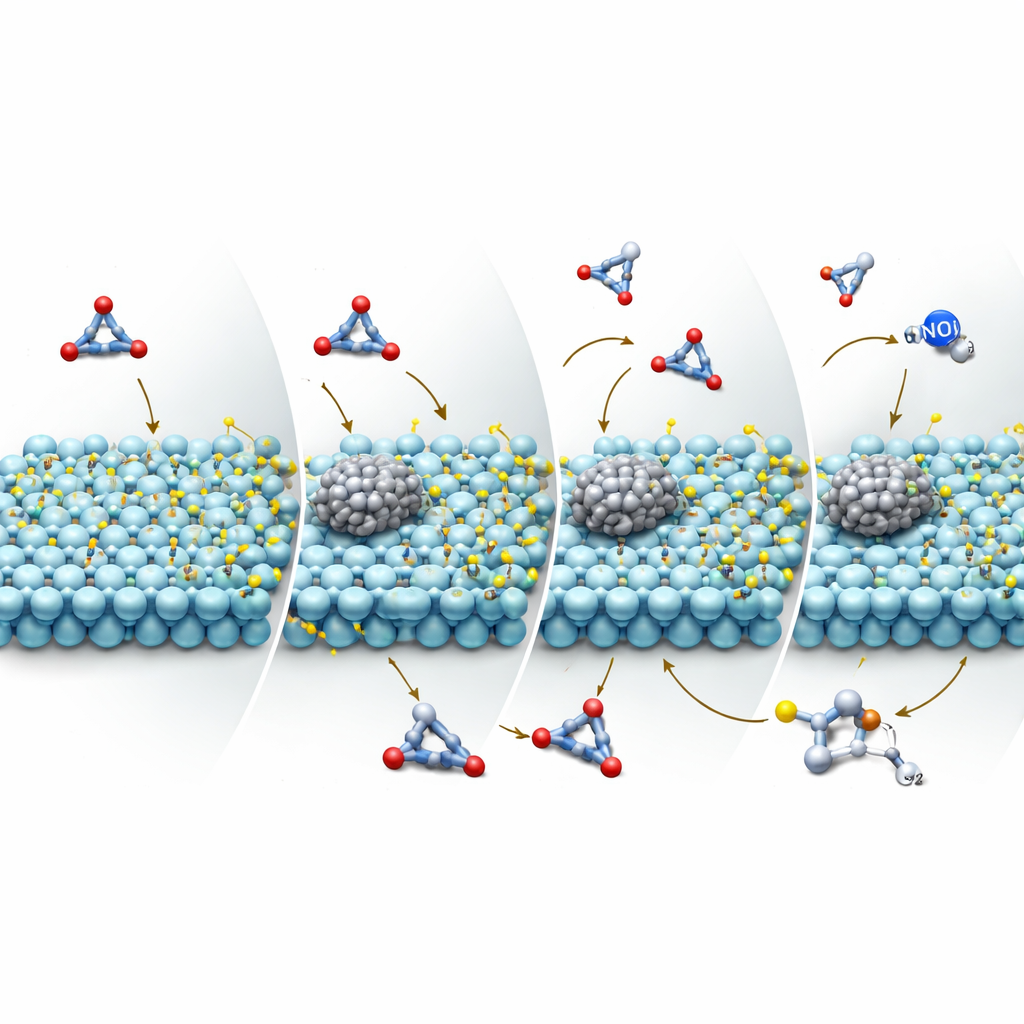
Behind this strong performance lies a surprisingly dynamic catalyst surface. Under the negative voltages used to drive the reaction, some of the hydroxyl groups (oxygen–hydrogen units) on the cobalt hydroxide surface are stripped away, creating reactive spots. At the same time, incoming nitrate molecules can break apart on the surface to regenerate new hydroxyl groups while moving closer to becoming ammonia. Using a suite of tools—including Raman spectroscopy to track vibrational signatures and isotopic substitution with heavy water—the authors showed that these surface hydroxyls are continuously consumed and re-formed, reaching a steady balance during operation. Ruthenium particles anchored on the nanosheets make this cycle easier by helping both the removal and the re-creation of hydroxyl groups, keeping the cobalt surface in an especially active configuration.
Guiding the Reaction with Gentle Hydrogen
Ruthenium also plays a second, equally important role: it supplies just the right amount of reactive hydrogen on the surface. Under applied voltage, ruthenium efficiently generates adsorbed hydrogen atoms, which then participate in the stepwise conversion of nitrate first to nitrite, and then through several nitrogen-containing intermediates to ammonia. Electrochemical tests, radical-trapping experiments, and mass spectrometry all point to these hydrogen atoms being heavily used in the nitrate reduction steps rather than recombining into hydrogen gas. Comparisons with similar catalysts containing gold or palladium show that too little or too much surface hydrogen can slow key steps or favor side reactions, whereas ruthenium creates a “moderate” hydrogen environment that both speeds up the chemistry and preserves the optimal surface structure.
Design Rules for Better Green Ammonia
In everyday terms, the study shows how a catalyst can be engineered to constantly tune and renew its own surface while gently feeding in reactive hydrogen, steering a complex set of reactions toward ammonia with high efficiency and durability. By revealing how ruthenium guides the evolution of cobalt hydroxide during operation—rather than treating the catalyst as a static material—the work provides design principles for next-generation electrocatalysts that can convert pollutants into valuable products using renewable electricity.
Citation: Liu, D., Bai, H., Chen, M. et al. Unravelling the Ru-promoted dynamic evolution of Cobalt hydroxide during nitrate reduction towards ammonia production. Nat Commun 17, 4099 (2026). https://doi.org/10.1038/s41467-026-70531-y
Keywords: electrochemical nitrate reduction, green ammonia, cobalt hydroxide catalyst, ruthenium nanoparticles, wastewater remediation