Clear Sky Science · en
Endogenous VEGF signaling acts as a guardian of human primed pluripotency
Why keeping stem cells "on standby" matters
Human embryonic stem cells can, in principle, turn into any cell type in the body, making them powerful tools for studying early development and for designing future cell-based therapies. But in the lab, keeping these cells in a healthy, flexible "standby" state is surprisingly difficult: they tend to drift toward specific fates if the surrounding signals are not just right. This paper uncovers a built-in protective system inside human stem cells—a signaling loop based on a molecule better known for building blood vessels—that quietly keeps them pluripotent and stops them from slipping into placenta-like identities.
A hidden role for a blood-vessel signal
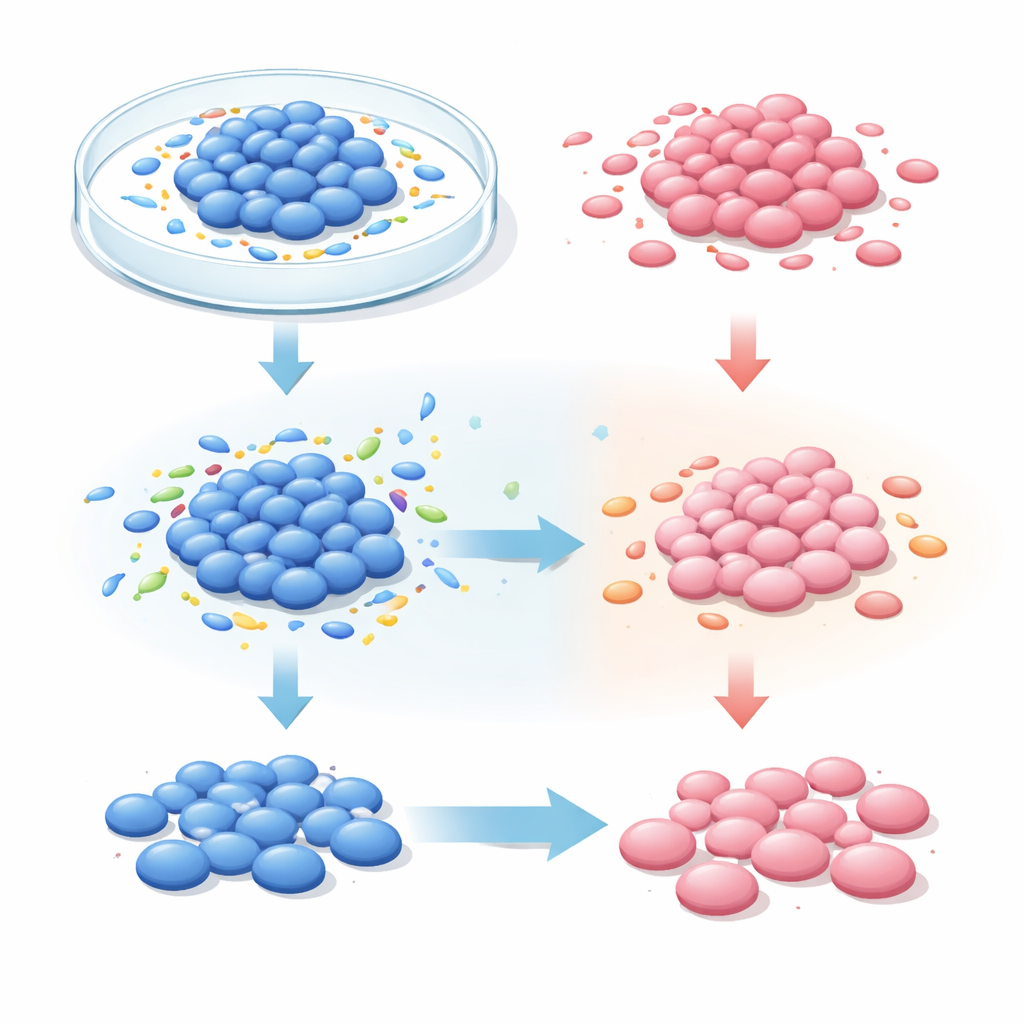
The study focuses on vascular endothelial growth factor, or VEGF, a family of proteins famous for guiding the growth of blood vessels. The authors asked whether VEGF, made by the stem cells themselves, might also help control their identity. They compared two stem cell states that mimic different stages of early embryos: a "naïve" state resembling pre-implantation cells and a "primed" state similar to post-implantation epiblast cells. They found that primed human embryonic stem cells produce high levels of VEGF and its receptors and show strong VEGF activity, while naïve cells and differentiated cells largely shut this pathway down. This pointed to an unexpected idea: VEGF, acting from within the stem cell community, could be a key guardian of the primed state.
What happens when the guardian is switched off
To test VEGF’s importance, the researchers blocked its receptors in several ways: small-molecule drugs, engineered "decoy" receptors that soak up VEGF, and CRISPR-based gene knockouts that remove VEGF receptors. Across all approaches, primed human stem cell colonies rapidly lost their tight, compact shape, many cells died, and the survivors adopted a uniform cobblestone-like form. Molecular tests showed that hallmark pluripotency genes dropped, while genes typical of trophoblast cells—precursors of the placenta—rose sharply. Surface markers, DNA methylation patterns, and the ability of these cells to proceed toward different trophoblast subtypes all supported the conclusion that, without VEGF signaling, primed stem cells exit pluripotency and become trophoblast-like rather than standard body-lineage cells.
How VEGF balances competing internal signals
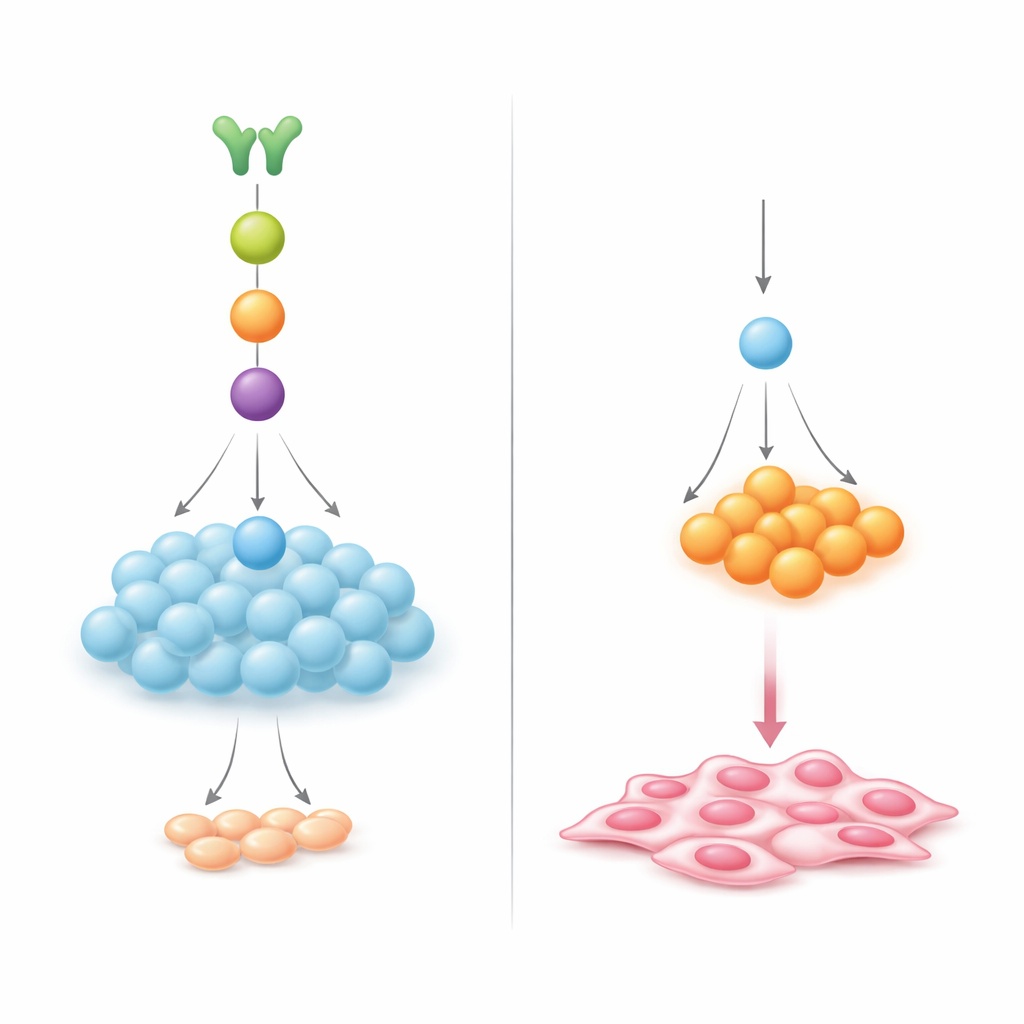
Diving deeper, the team used genome-wide RNA sequencing and protein analyses to dissect the signaling changes that follow VEGF loss. They found that blocking VEGF rapidly switches on the BMP pathway, a well-known driver of extra-embryonic fates such as trophoblast. Key BMP effectors became highly activated, and BMP pathway genes were upregulated over time. When the scientists added BMP inhibitors alongside VEGF blockers, the surge in trophoblast genes and the strong differentiation morphology were largely dampened, even though core pluripotency genes were not fully restored. This indicates that endogenous VEGF normally keeps BMP activity under control in primed stem cells, preventing them from drifting toward placenta-like fates.
A central role for a master stem cell regulator
The story did not end with BMP. Among the genes most strongly and quickly reduced when VEGF signaling was blocked was NANOG, a master regulator of pluripotency. Using engineered cell lines, the authors showed that turning NANOG back on could substantially rescue many of the effects of VEGF loss: trophoblast genes fell, BMP pathway activity dropped, and several pluripotency-related genes recovered. Genomic binding studies revealed that NANOG sits directly on control regions of multiple BMP pathway genes and key trophoblast markers, where it likely acts as a brake on their activation. NANOG also occupies regions near VEGF receptor genes, and NANOG depletion reduces at least one receptor, suggesting a positive feedback loop in which VEGF supports NANOG, and NANOG in turn helps maintain VEGF signaling capacity.
What this means for stem cell research and medicine
Taken together, the work reveals that VEGF is more than a blood-vessel cue: in human primed embryonic stem cells, it forms an internal safety system that holds the cells in a pluripotent state. Active VEGF signaling helps maintain NANOG, which simultaneously keeps pluripotency genes on and trophoblast- and BMP-related genes off. When VEGF is removed, this network collapses, BMP signaling surges, and cells are pushed into a trophoblast-like fate. Understanding this built-in guardian pathway offers clearer control over how stem cells stay flexible or commit to specific lineages, improving our ability to culture high-quality stem cells and to direct their differentiation for developmental studies, disease models, and future regenerative therapies.
Citation: Wu, X., Wen, C., Zhu, C. et al. Endogenous VEGF signaling acts as a guardian of human primed pluripotency. Nat Commun 17, 3873 (2026). https://doi.org/10.1038/s41467-026-70526-9
Keywords: human embryonic stem cells, VEGF signaling, pluripotency, trophoblast differentiation, BMP pathway