Clear Sky Science · en
Extracellular matrix rigidity controls breast cancer metastasis via TYK2-mediated mechanotransduction
How Tissue Stiffness Can Steer Cancer’s Next Move
Why do some early breast tumors stay put while others break free and spread through the body? This study looks beyond genes and chemicals to a more physical player: the stiffness of the tissue that surrounds breast cells. By asking how a hidden cell-surface protein called TYK2 responds to soft versus stiff surroundings, the researchers uncover a safety switch that can restrain or release cancer’s ability to travel.
The Feel of the Tumor’s Neighborhood
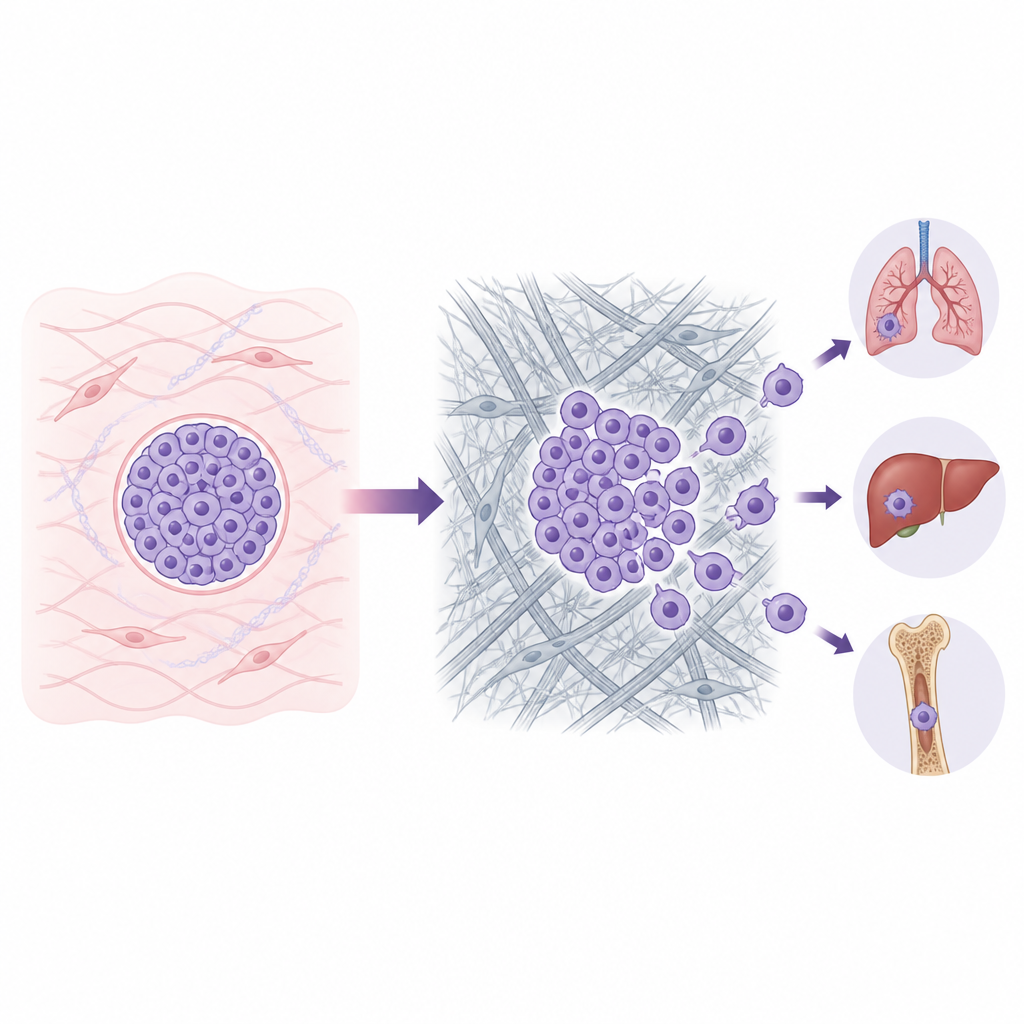
Breast cells do not live in isolation; they sit inside a mesh of proteins known as the extracellular matrix, which can feel soft like jelly or firm like scar tissue. Tumors often stiffen this mesh, and very stiff breast tumors are linked to a higher risk of metastasis and worse survival. Yet normal breast tissue is relatively soft, and some early lesions never invade. The authors set out to understand how soft tissue stiffness can actively suppress the spread of cancer, rather than simply being a passive backdrop.
A Hidden Guardian Protein Under Gentle Conditions
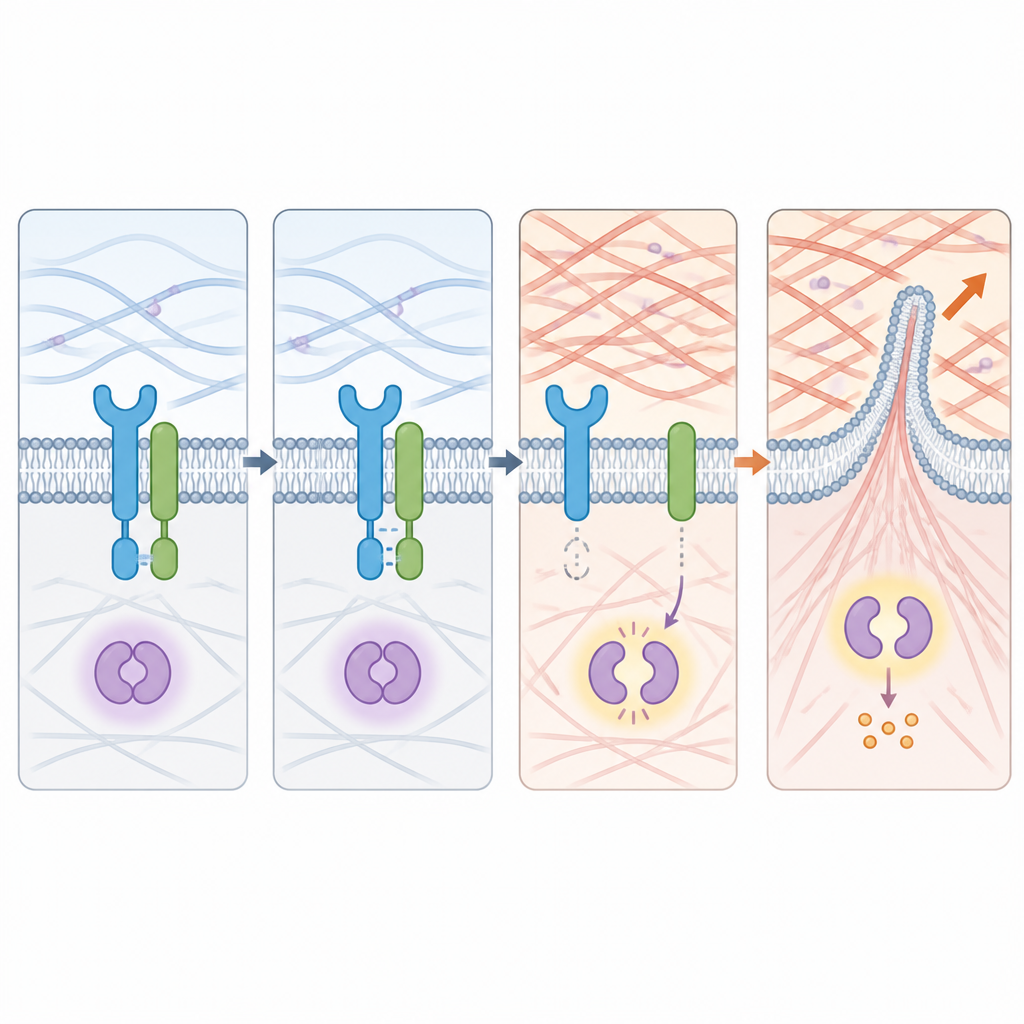
Using three-dimensional cultures that let human and mouse breast cells grow into tiny gland-like structures, the team tuned the surrounding gel to match either normal soft breast tissue or the stiffer range found in some tumors. Under soft conditions, cells formed orderly round acini with intact outer layers, mimicking healthy ducts. In this setting, the protein TYK2 sat neatly at the cell surface, partnered with another membrane protein called IFNAR1. Together, they acted as a brake on a shape-shifting program known as epithelial-mesenchymal transition, which enables cells to loosen contacts and invade. When TYK2 was removed or chemically blocked, cells began to invade even in soft gels, and patient-derived tumor organoids showed similar behavior.
How Losing TYK2’s Position Frees Tumor Cells
The researchers then zoomed in on how TYK2 controls invasion. In soft conditions, a key driver of cell plasticity, TWIST1, stayed mostly in the cell’s outer fluid, kept in check by a binding partner. Knocking down TYK2 or treating cells with TYK2 inhibitors caused TWIST1 to move into the nucleus, where it can reprogram cells to adopt a more mobile, invasive state. This switch depended on a chain of events involving other signaling proteins: when TYK2 was absent from the membrane, another receptor, EPHA2, became activated at a specific site, which in turn switched on the LYN kinase and released TWIST1 from its restraint. Blocking TWIST1 or LYN prevented invasion even when TYK2 was lost, showing that TYK2 sits at the top of this mechanical control pathway.
From Soft Tissue to Spreading Tumors
Importantly, the work extended from dishes to living systems. In mouse models of early-stage breast lesions that normally resemble ductal carcinoma in situ, loss of TYK2 in tumor cells did not change primary tumor size but markedly increased the number of cancer deposits in the lungs. Treating mice with deucravacitinib, a TYK2 inhibitor already approved for psoriasis, similarly boosted lung metastases from both cell line tumors and patient-derived triple-negative breast cancer grafts, again without speeding growth of the main tumor. In all these cases, tumor samples showed more TWIST1 inside cell nuclei, consistent with the lab findings. Human tissue samples also told a clear story: normal breast ducts displayed TYK2 at the cell membrane, while invasive breast cancers showed TYK2 diffused throughout the cell, suggesting its protective control is lost during progression.
Implications for Patients and Future Therapies
To a non-specialist, the message is that the physical feel of the tissue around breast cells can send powerful signals that either restrain or unleash their capacity to spread, and that TYK2 is a key sensor and brake in this process under soft conditions. When tissue becomes stiff or TYK2 is blocked or misplaced inside the cell, that brake fails, TWIST1 switches on, and cells are more likely to invade and seed distant organs. Because TYK2 inhibitors are being used and tested for autoimmune diseases, the authors suggest that people with hidden early breast lesions, especially of the basal or triple-negative type, might face added risk of metastasis if this safety switch is turned off. The study highlights how combining attention to tissue mechanics with careful drug monitoring could improve cancer risk assessment and treatment planning.
Citation: Hu, Z., Majeski, H.E., Mestre-Farrera, A. et al. Extracellular matrix rigidity controls breast cancer metastasis via TYK2-mediated mechanotransduction. Nat Commun 17, 4392 (2026). https://doi.org/10.1038/s41467-026-70518-9
Keywords: breast cancer metastasis, tissue stiffness, TYK2, epithelial mesenchymal transition, triple negative breast cancer