Clear Sky Science · en
A hybrid piezoelectric resonator-based DC-DC converter
Powering the Cloud More Efficiently
Every internet search, video stream, or AI query draws energy from vast data centers filled with servers. As demand soars, a growing share of that energy is lost as waste heat inside the electronics that convert high-voltage power from the grid down to the low voltages chips actually use. This paper explores a new kind of power converter that replaces bulky magnetic parts with slim, vibrating crystals, aiming to squeeze more usable power into less space while cutting losses—an advance that could make future data centers more efficient and compact. 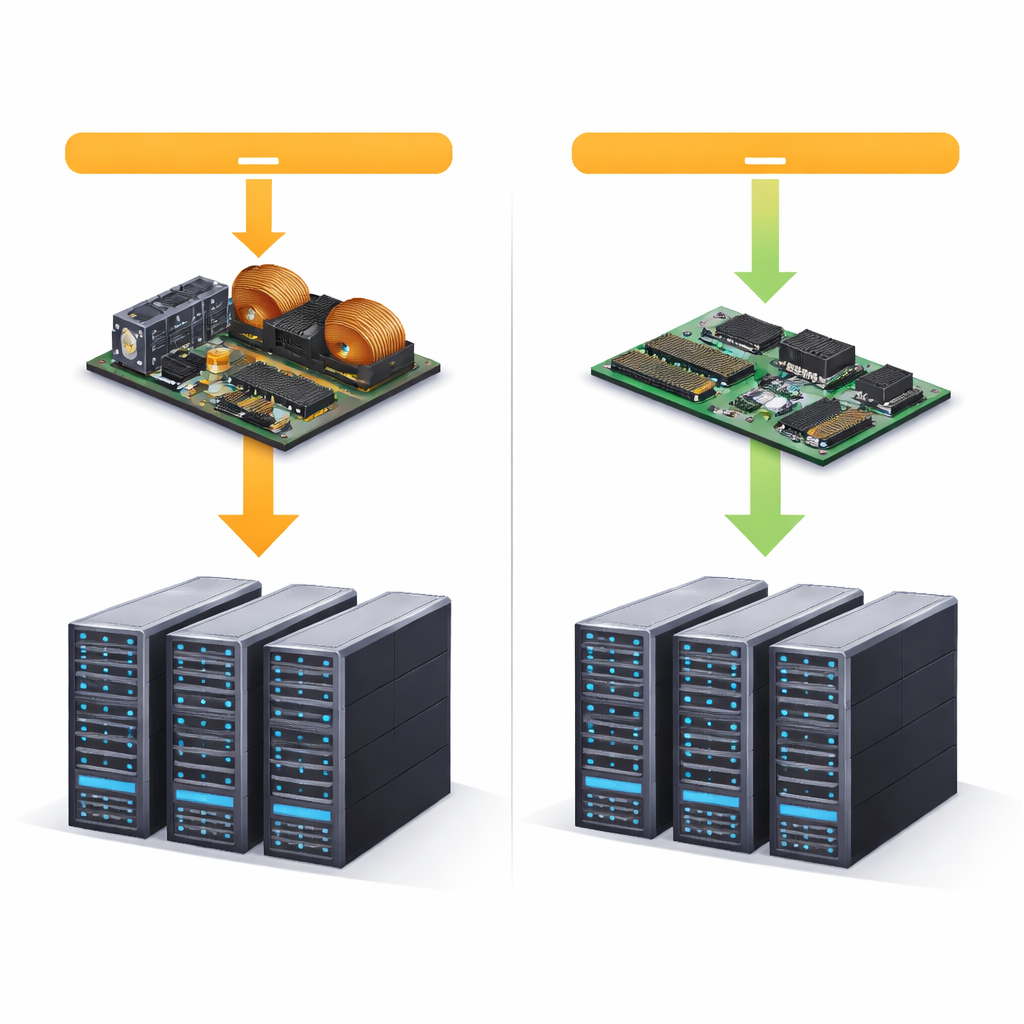
Why Today’s Power Bricks Are Hitting a Wall
Modern data centers increasingly distribute power at about 48 volts to reduce energy lost in long cables, but the chips inside servers typically need 5 volts or less. Converting 48 volts down to a few volts in a single step is tough: conventional converters rely on magnetic components (like inductors and transformers) whose size and performance stop scaling well at high power and high frequency. As engineers push for smaller, denser systems, these magnets become a bottleneck—they occupy volume, limit current handling, and bump up losses, especially when the voltage change, or conversion ratio, is large.
From Magnetic Loops to Vibrating Crystals
The authors focus on piezoelectric resonators—thin discs of special material that store and move energy by physically vibrating instead of building up magnetic fields. These parts can be made very flat, fabricated in batches, and potentially integrated directly onto chips. Prior research showed that such resonators can replace magnetics in some converters, but there were two major roadblocks. First, efficiency dropped sharply when trying to step voltages down by large factors, because too much charge sloshed back and forth inside the resonator without reaching the load. Second, the resonator itself had to carry almost all of the current, limiting how much power the converter could safely deliver before the device hit its mechanical limits.
New Tricks: Helper Capacitors and Multiple Paths
To tackle these limits, the team introduces two key ideas and merges them into a single circuit. The first is an “embedded flying capacitor” scheme, in which carefully sized helper capacitors sit alongside the resonator and adjust the voltage levels it sees during its switching cycle. This reshapes the operating point so that, instead of working best at a modest 2:1 step-down, the resonator stage naturally prefers a 3:1 ratio. At that sweet spot, nearly all of the moving charge is delivered to the output instead of just circulating internally, cutting wasted energy and reducing how hard the resonator has to work. 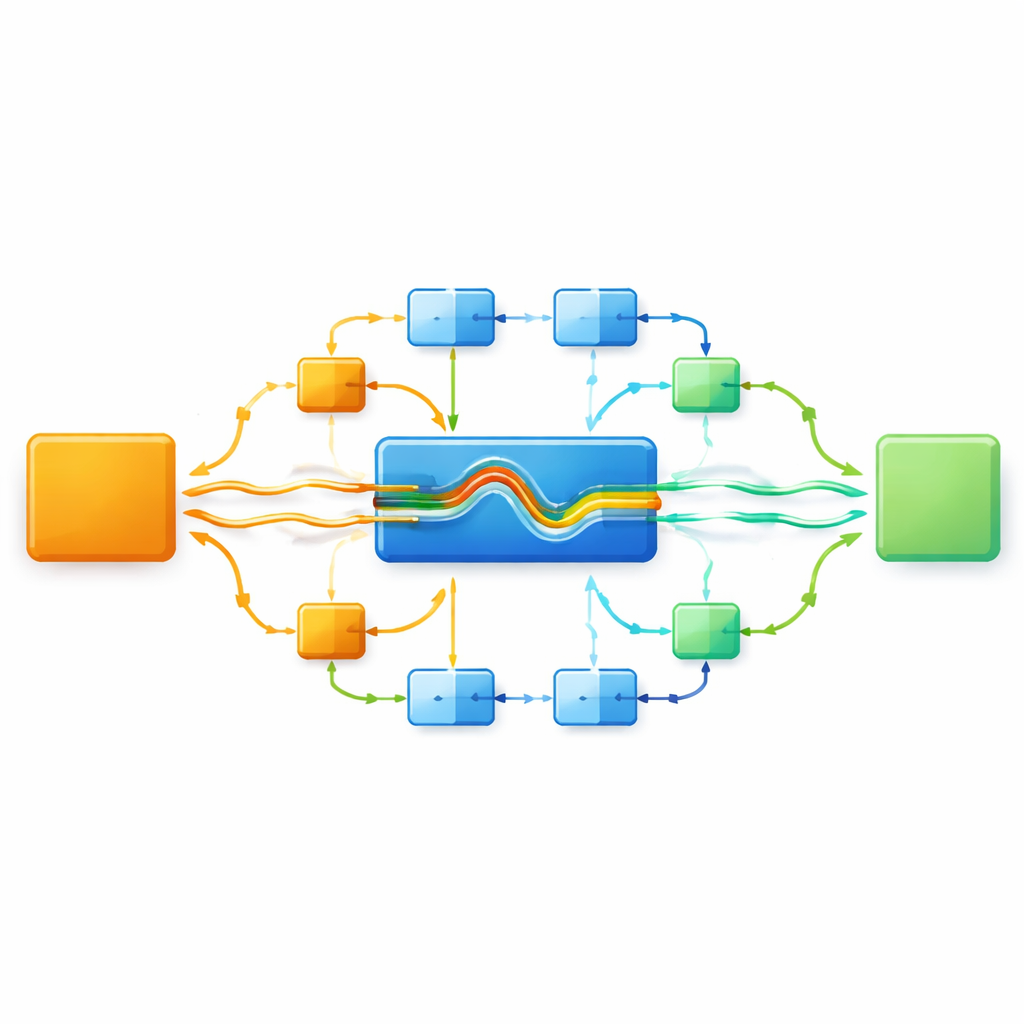
Sharing the Load So Nothing Works Alone
The second idea is an “always-multi-path” structure that splits the output power among several parallel routes through additional capacitors. Rather than forcing every bit of current through the vibrating crystal, the circuit arranges its capacitors so that there are always multiple active paths to the load during the energy-transfer phases. This lowers the peak resonator current by more than 80% compared with earlier designs, easing stress on the device, smoothing the output voltage, and trimming conduction losses in the switches and wiring. Together, the embedded capacitors and multi-path layout let the resonator operate where it is strongest—handling high voltage but modest current—while the capacitors shoulder more of the heavy lifting.
From Concept to Working Chip
The researchers built their design as an integrated circuit in a standard manufacturing process and paired it with a commercially available piezoelectric disc. In tests, the converter took 48 volts down to 4.8 volts—a 10:1 overall step-down—while reaching a peak efficiency of 96.2%. Thanks to the combination of a 3:1 resonator stage and a 3:1 capacitor stage, the optimal overall conversion ratio is 9:1, and the circuit can still operate efficiently at even higher ratios. The multi-path architecture allows up to 1 ampere of output current and delivers a current density several times higher than previous piezo-based converters that used the same type of resonator material.
What This Means for Future Data Centers
In simple terms, this work shows that thin vibrating crystals, when teamed with cleverly arranged capacitors, can rival or surpass traditional magnetic components for stepping high voltages down to chip-friendly levels. By boosting both efficiency and current handling in a compact form, the proposed hybrid piezoelectric converter moves the field closer to power systems that waste less energy and occupy less space in crowded server racks. While further advances in resonator materials and closed-loop control are still needed, this study offers a concrete path toward slimmer, cooler, and more efficient power delivery for tomorrow’s data-hungry cloud and AI infrastructure.
Citation: Ko, JY., Liu, WC.B. & Mercier, P.P. A hybrid piezoelectric resonator-based DC-DC converter. Nat Commun 17, 4054 (2026). https://doi.org/10.1038/s41467-026-70494-0
Keywords: data center power conversion, piezoelectric resonator, high voltage step-down, DC-DC converter efficiency, power electronics