Clear Sky Science · en
3D-printable phosphorescent woody materials
Glowing Wood You Can Print
Imagine ordinary sawdust that not only comes from trees but also glows in the dark and can be fed straight into a 3D printer. This study shows how scientists turned everyday wood into a sustainable "afterglow" material that can be shaped into custom objects, potentially changing how we make smart lighting, safety markers, and decorative pieces while keeping environmental impact low.
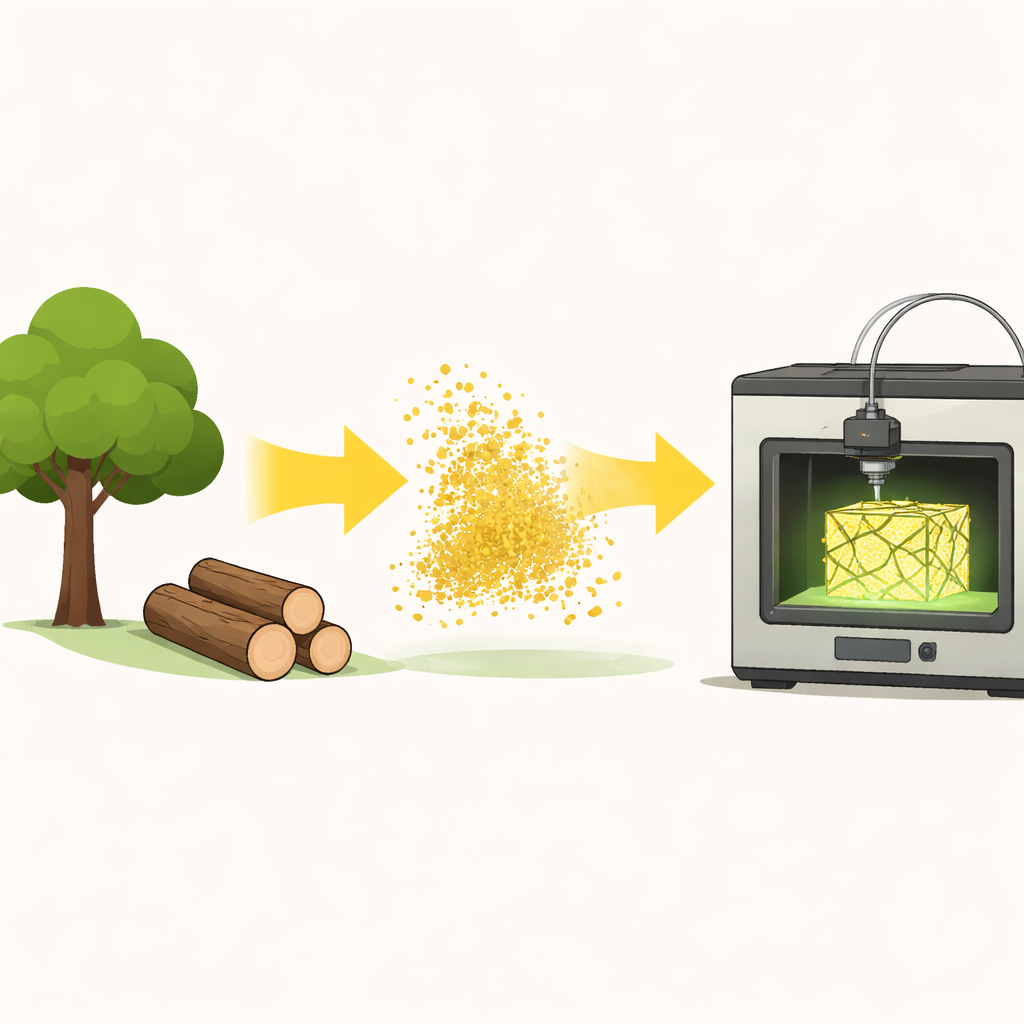
Turning Trees into Light-Storing Powder
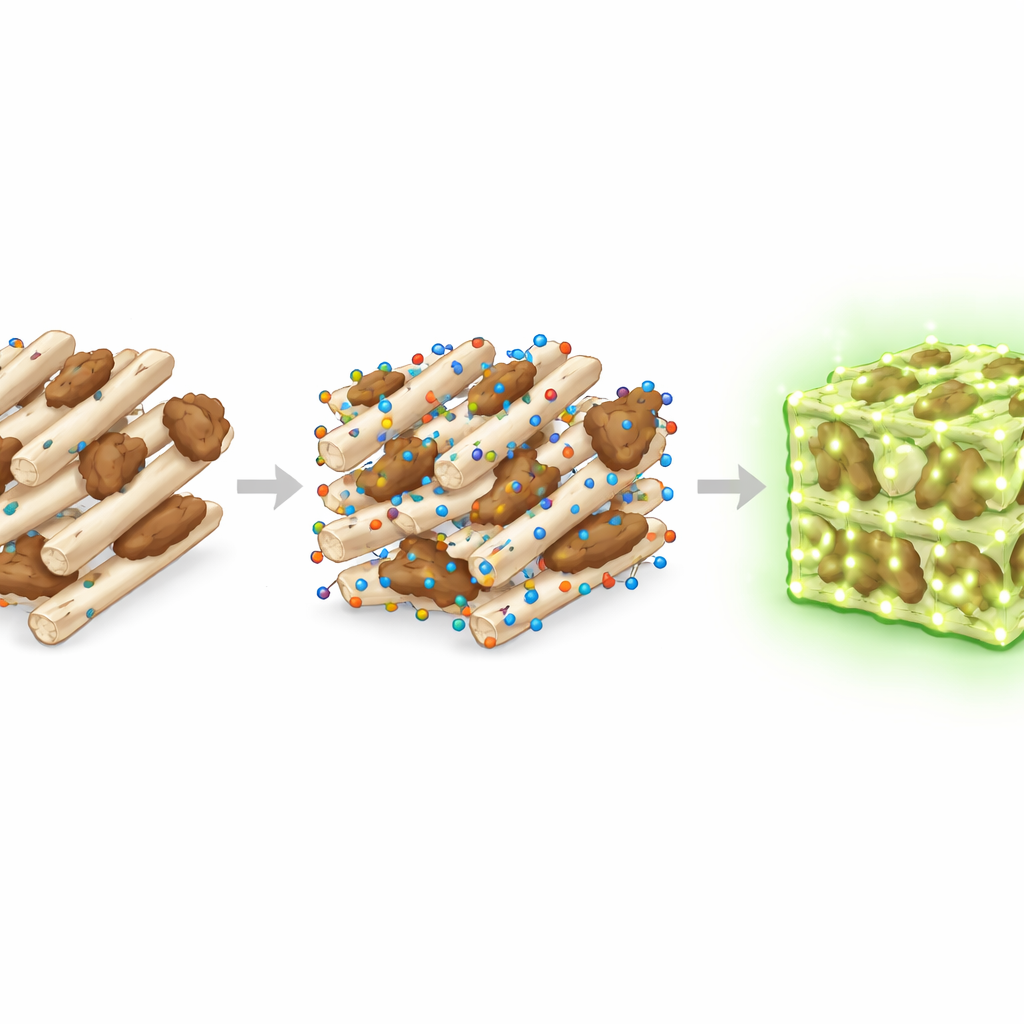
The researchers started with natural wood, a familiar mix of cellulose, hemicellulose, and lignin. By treating wood powder with a simple chemical process that adds carboxyl groups (a type of small, oxygen-rich chemical handle), they created a new material they call CX-Wood. This treatment subtly distorts the orderly structure of cellulose fibers and increases the density of hydrogen bonds—weak attractions between molecules that can lock them into a rigid framework. That rigidity is crucial because it helps trap energy in a special long-lived state, allowing the material to give off a visible glow long after a light source, such as ultraviolet (UV) illumination, is switched off.
Why This Wood Glows Longer and Brighter
To understand why CX-Wood glows so effectively, the team compared its behavior with that of untreated wood and with modified versions of its main components, cellulose and lignin. Both cellulose and lignin already emit faint afterglow light, but when they were decorated with the same carboxyl groups, their glow became stronger and lasted much longer. Detailed measurements showed that CX-Wood could emit a green afterglow for hundreds of milliseconds, far outlasting natural wood. The modified structure reduces pathways for energy to leak away as heat and makes it easier for excited molecules to shift into long-lived energy states. Computer simulations and X-ray measurements supported this picture, revealing tighter interactions and a more interconnected molecular network that stabilizes the stored energy.
From Powder to Printable Glowing Ink
Beyond making wood glow, the scientists needed it to behave like a good 3D-printing ink. By simply dispersing CX-Wood powder in water, they obtained a paste with just the right flow properties for a technique known as direct ink writing. Under pressure in a printer nozzle, this paste flows smoothly like a thick liquid, but once deposited it quickly recovers a solid-like character and holds its shape. The particle size of the wood powder turned out to be important: finer particles reacted more completely, improved the glow, and gave the ink better flow control. Remarkably, the ink formula contains only modified wood and water—no added plastics or petroleum-based binders—making it both simple and environmentally friendly.
Custom Shapes, Colors, and Reuse
Using CX-Wood inks, the team printed intricate three-dimensional structures in a variety of shapes and from multiple wood species. After exposure to UV light, the printed pieces showed a vivid green afterglow that persisted in the dark. The glow could be tuned in subtle ways: changing temperature, humidity, or adding small amounts of other dyes allowed the color and duration of the afterglow to be adjusted, including red-tinted versions. The printed objects retained most of their shape after drying and also showed useful mechanical strength and flame resistance. Because the structures are not permanently cross-linked, they can be broken down in water back into an ink and reprinted into new forms, all while largely preserving their glowing behavior.
A Greener Path to Smart, Glowing Objects
Overall, the study demonstrates that ordinary wood can be converted into a recyclable, water-based ink that both shines with a long-lasting glow and can be 3D-printed into complex designs. By carefully altering the wood’s microscopic structure, the researchers created a rigid, interconnected network that stores and slowly releases light while also flowing just enough to be printed. For non-specialists, the key takeaway is that common, renewable biomass can be transformed into advanced, light-storing building blocks for future products—from safety signage to decorative panels and smart furnishings—without relying on complex plastics or energy-intensive manufacturing.
Citation: Chen, Z., Wang, K., Zhai, Y. et al. 3D-printable phosphorescent woody materials. Nat Commun 17, 3796 (2026). https://doi.org/10.1038/s41467-026-70488-y
Keywords: phosphorescent wood, 3D printing, sustainable materials, afterglow inks, biobased composites