Clear Sky Science · en
Frequency-division routing via spin–refractive-index locking
Steering Signals with Tiny Spins
Modern communication networks need hardware that can guide signals cleanly in one direction, separate information by frequency, and block unwanted echoes—all on a tiny chip. This research shows how to do that by harnessing a subtle property of light-like waves called “spin,” and tying it to how waves travel through specially designed materials. The result is a compact microwave device that can route signals based on their frequency, potentially simplifying components in wireless, radar, and future quantum technologies.
Waves that Carry a Built-In Twist
When electromagnetic waves, such as microwaves or light, skim along a surface or through a waveguide, their electric and magnetic fields can swirl as they move forward. This swirling gives the wave an internal “spin,” pointing sideways relative to the direction of travel. In many photonic structures, this spin is tightly linked to the direction of motion, a phenomenon known as spin–momentum locking: waves going one way carry one spin, while waves going the opposite way carry the opposite spin. Engineers have used this effect to launch waves in only one direction and to sense tiny changes in materials placed near a waveguide.
Turning the Spin with Negative Index Materials
Most media used so far behave in a “right-handed” way: the direction of energy flow matches the direction of the wave’s phase. However, specially engineered metamaterials can act in a “left-handed” or negative-index regime, where the phase runs opposite to the energy flow. In this work, the authors build a composite right-/left-handed transmission line that supports both regimes in a single microwave device. They find that for waves with the same energy-flow direction, the internal spin flips when the material switches from positive to negative effective index. They call this new relationship spin–refractive-index locking (SRIL): the spin is not only tied to direction, but also to the sign of the effective index. 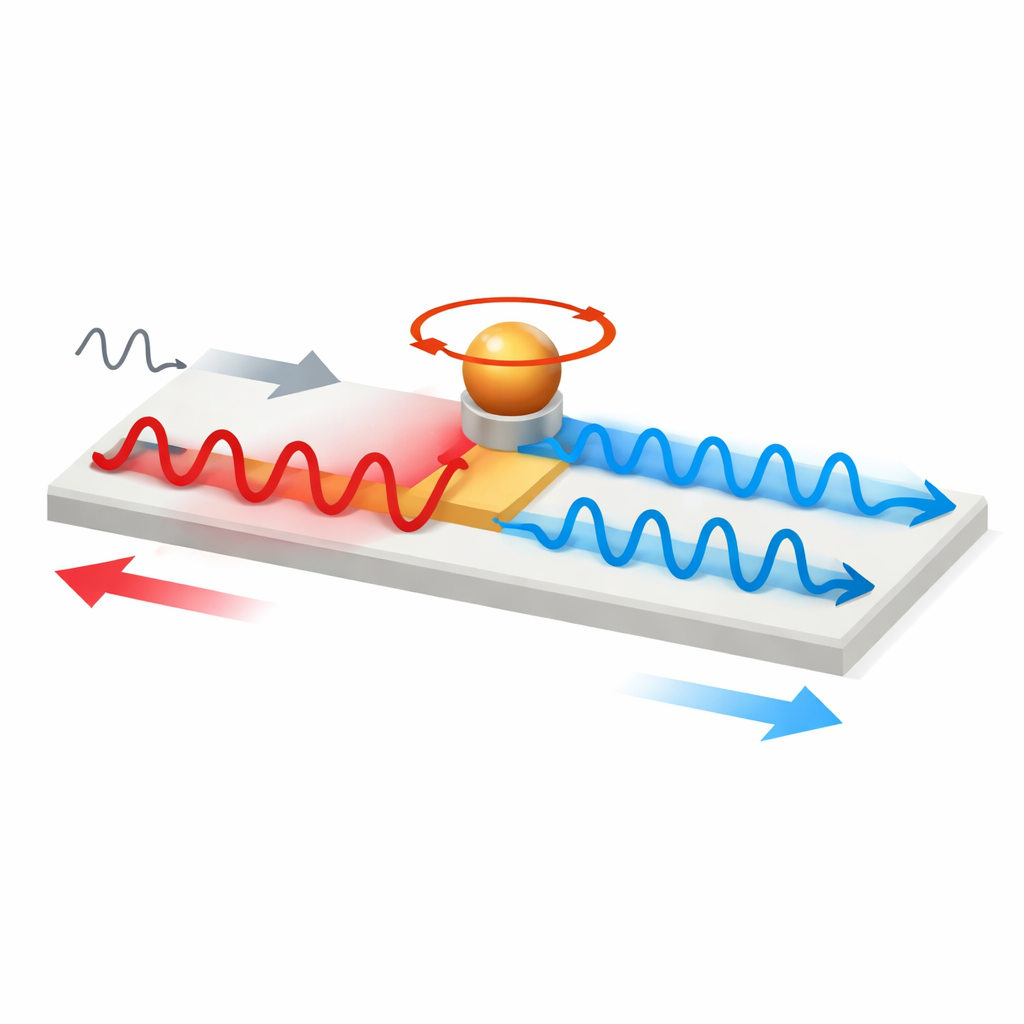
Letting Only Matching Spins Talk
To turn this spin control into a practical function, the team couples their special waveguide to a tiny magnetic sphere made of yttrium iron garnet (YIG). Inside this sphere, collective wiggles of electron spins—called magnons—behave like a spinning antenna that prefers to talk to waves with a specific spin. When the spin of the guided microwaves matches the magnon spin, energy is strongly exchanged; when it does not, the two are nearly invisible to each other. Because SRIL flips the spin when the index changes sign, simply changing the microwave frequency moves the system between a negative-index band and a positive-index band, and with it, switches which direction of propagation couples to the sphere.
One Chip, Two Directions, and Tunable Flow
Experimentally, the researchers place the YIG sphere at a carefully chosen spot near the edge of the transmission line and apply a static magnetic field to set the magnon frequency. They measure how microwaves pass through the device from left to right and from right to left. In the negative-index band, waves traveling in one direction are absorbed strongly by the sphere, while waves from the opposite direction pass almost undisturbed, showing highly one-way behavior. In the positive-index band, the situation reverses: the preferred direction of coupling flips, exactly as SRIL predicts. By sweeping the magnetic field, they scan the magnon frequency across the entire passband and map out how this chiral, or direction-sensitive, interaction tracks the sign of the refractive index.
Routing Signals by Frequency
Building on this effect, the team constructs a three-port device where the magnetic sphere sits along a waveguide that connects two microwave ports, while a third port is used to excite the magnons. At low frequencies, where the guide behaves with negative index, the magnon’s emission flows mainly toward one output port. At higher frequencies, in the positive-index regime, the emission is sent toward the opposite port. Viewed together with the nonreciprocal transmission between the two main ports, the device acts like a circulator whose circulation direction depends on frequency: the signal path cycles around the three ports in one order in the negative-index band and in the reverse order in the positive-index band. 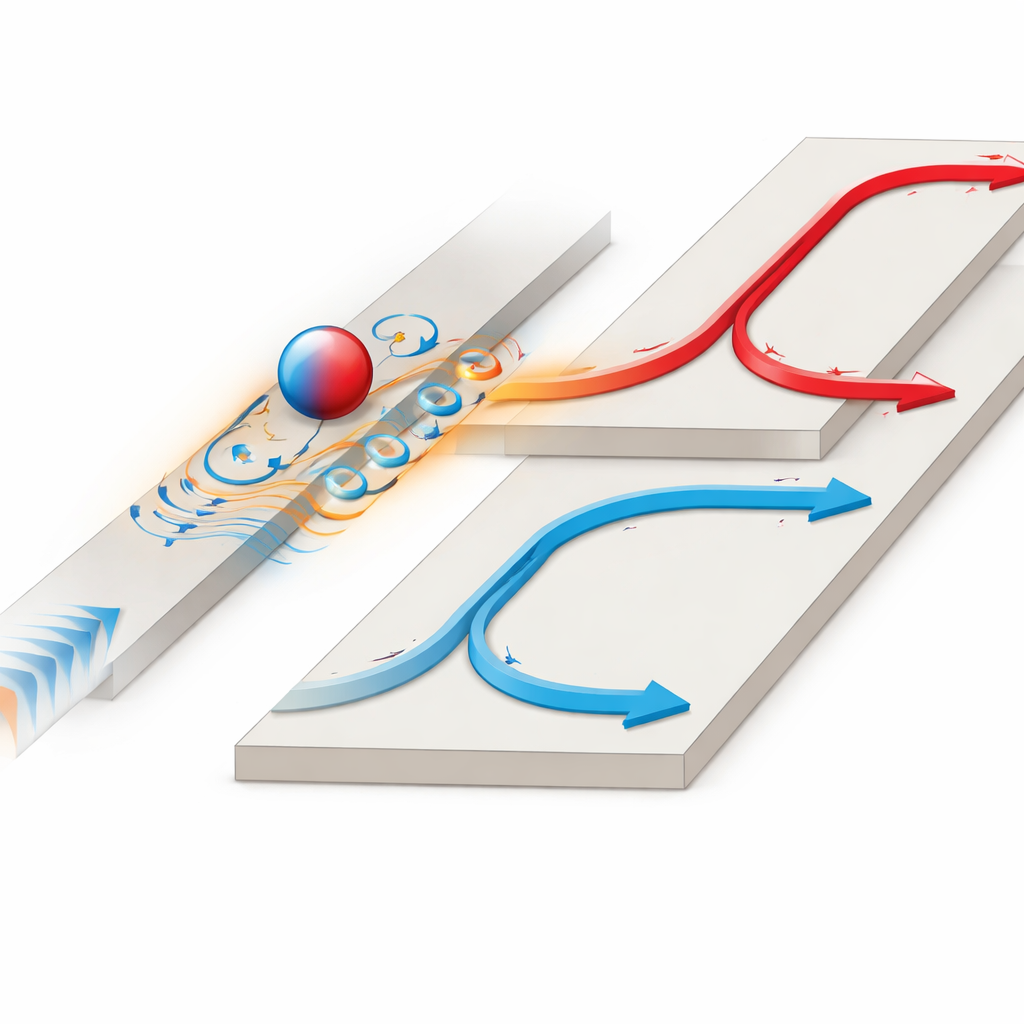
Making It Practical and Looking Ahead
To move toward applications, the authors explore simple ways to make the useful frequency range wider. Using a larger magnetic sphere strengthens the interaction and broadens the nonreciprocal band, while placing multiple spheres along the line and tuning them slightly apart creates a combined, wider isolation window. The demonstrated isolation is already comparable to commercial microwave circulators, but in a flat, chip-friendly geometry that does not rely on bulky magneto-optical effects. Looking ahead, similar designs could be adapted to terahertz and optical frequencies by swapping in suitable metamaterials and spin-bearing media, offering a general strategy for compact, reconfigurable devices that steer signals according to both their spin and their color (frequency).
Citation: Peng, YP., Zhu, SY., You, J.Q. et al. Frequency-division routing via spin–refractive-index locking. Nat Commun 17, 3637 (2026). https://doi.org/10.1038/s41467-026-70460-w
Keywords: spin–refractive-index locking, microwave nonreciprocity, magnon–photon coupling, metamaterial waveguides, frequency-division routing