Clear Sky Science · en
Abrasion-resistant wearable skins based on bilayered solid/liquid stretchable conductors
Electronic bandages that can survive real life
Imagine a tattoo-thin electronic bandage that can track your heartbeat, muscle activity, or touch, yet shrugs off rubbing from clothes, showers, workouts, and even harsh cleaners. Today’s “electronic skins” are flexible and sensitive, but they tend to crack, peel, or lose signal when life gets rough. This study introduces a new kind of wearable skin that stays electrically reliable even when stretched several times its length and scuffed thousands of times, bringing us closer to long‑term, truly forgettable body‑worn sensors.
Why today’s soft wearables wear out
Most existing electronic skins rely either on solid metal traces or on liquid conductors embedded in rubbery materials. Solid metals can be patterned into intricate sensors that feel pressure, strain, and temperature, but they eventually crack or separate from their soft supports under repeated bending, stretching, or rubbing. Liquid metals avoid cracking because they can flow, yet their very fluidity makes them prone to leaking and being scraped away. Simple protective coatings can slow the damage, but often block good contact with the skin and still fail under intense abrasion, such as the constant friction between skin and clothing.
A two-layer conductor that acts like real skin
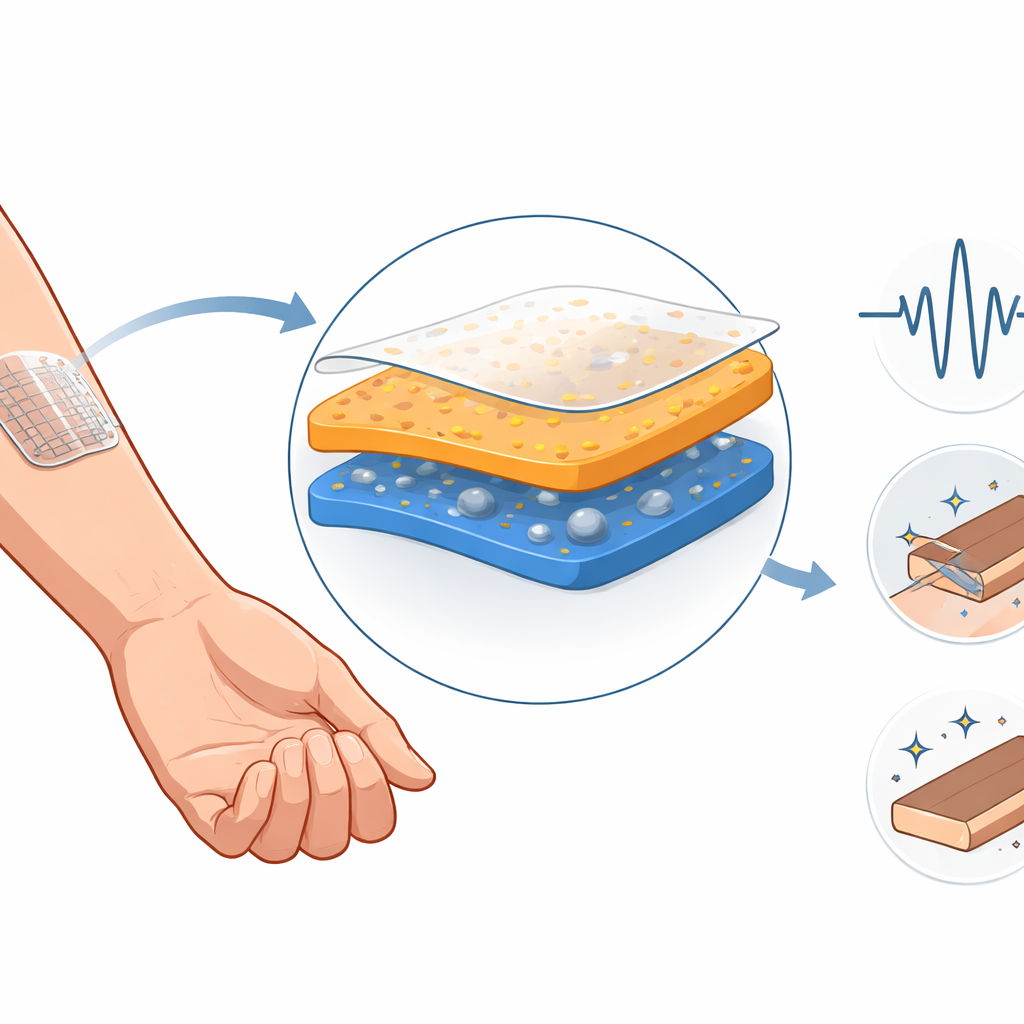
The researchers solve this trade-off with a cleverly engineered bilayer—two different conductive layers tightly bonded into a single ultrathin film. The top layer is a rubbery plastic (SEBS) loaded with tiny silver particles, forming a tough, abrasion‑resistant shield. Beneath it sits a second SEBS layer packed with microscopic droplets of a liquid metal alloy. Thermal processing fuses these layers into one seamless structure only about 13 micrometers thick—far thinner than a human hair—allowing the film to conform to fingerprints and move like a second skin. In this architecture, the silver layer takes the brunt of mechanical wear, while the liquid metal layer ensures that electrical pathways remain intact even when the film is stretched to more than nine times its original length.
How the film keeps conducting under stress
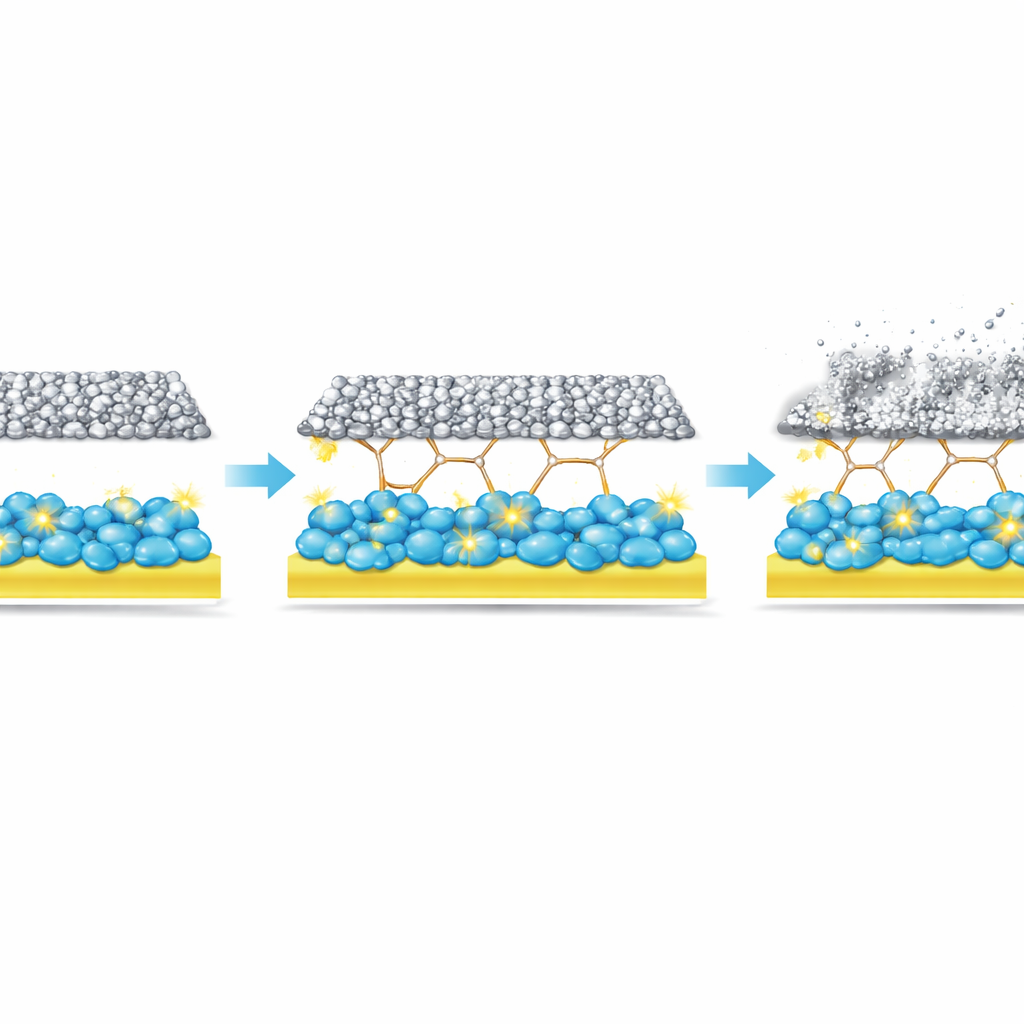
When the bilayer is stretched, the silver particles in the top layer tend to separate into isolated islands. Instead of losing conductivity, the underlying liquid metal droplets deform and connect these islands from below, creating vertical bridges for electrons to cross. During standardized abrasion tests, the film maintained nearly constant resistance for over 1500 seconds—far longer than comparable single‑layer conductors, which failed within seconds to minutes. High‑magnification images revealed that under prolonged rubbing, silver particles and liquid metal begin to fuse, forming a new, continuous conductive network that still works even after severe combined stretching and abrasion. Crucially, no liquid metal seeps out, and the film withstands strong acids, bases, repeated washing, and large cyclic strains without losing its electrical performance.
Comfortable and safe on the body
To transform the bilayer film into skin‑friendly electrodes, the team added a small amount of acrylic ester to increase adhesion to the outer skin layer. This creates strong yet reversible bonding through molecular interactions, allowing the film to stick securely during movement but be removed gently with an alcohol wipe. The resulting “tattoo‑like” electrodes show much lower contact impedance with the skin than commercial gel pads, meaning they can pick up tiny electrical signals more cleanly. Tests with cultured skin cells and human volunteers indicate good biocompatibility, while the silver-rich surface helps inhibit bacterial growth. Even after hours of laundering or thousands of simulated abrasion cycles, the electrodes keep their electrical properties and adhesion.
Real-world tests: hearts, muscles, braille, and faces
The authors put their electronic skin through realistic scenarios. As interconnects, the bilayer traces powered LED circuits that continued to glow steadily after repeated rubbing and extreme stretching. As heart and muscle sensors placed on the chest and forearm, they recorded electrocardiogram and electromyogram signals with high clarity before and after 500 abrasion cycles, outperforming both standard gel electrodes and simpler stretchable films. The team then built a multimodal system that combines strain and muscle signals to read braille patterns as a fingertip slides across raised dots, achieving perfect recognition of test phrases. In another demonstration, arrays on the face monitored muscle activity associated with smiling, laughing, surprise, and anger; a machine‑learning model decoded these expressions with 98.75% accuracy, even after vigorous facial cleansing.
What this means for future wearable tech
This work shows that by carefully engineering how different conductive materials meet inside a soft film, it is possible to build electronic skins that are not only thin and stretchable, but also tough enough to rival human skin under real‑world abrasion. The silver‑reinforced, liquid‑metal‑backed bilayer resists cracking, leaking, and chemical attack while preserving intimate contact with the body and clean electrical signals. Such robust, washable, and long‑lasting tattoo‑like sensors could help make continuous health monitoring, assistive technologies for people with disabilities, and expressive human–machine interfaces far more practical in everyday life.
Citation: Wang, Z., Shi, P., Li, Y. et al. Abrasion-resistant wearable skins based on bilayered solid/liquid stretchable conductors. Nat Commun 17, 3767 (2026). https://doi.org/10.1038/s41467-026-70438-8
Keywords: wearable electronics, electronic skin, liquid metal conductors, biomedical sensors, abrasion resistance