Clear Sky Science · en
A rubber-based sensor with over 100 million-level ultra-sensitivity (0–10% strain range) via 3D super-interface
Listening to Tiny Stretches
From monitoring your heartbeat to warning of a swelling battery, the world increasingly relies on soft, skin-like sensors that can feel motion and strain. But building a stretchy electronic "skin" that is both extremely sensitive and still works when pulled hard has been a stubborn engineering puzzle. This study reports a new rubber-based sensor that breaks that deadlock, achieving record-breaking sensitivity while remaining reliable over large stretches, opening doors for safer wearables and smarter batteries.
Why Stretchy Sensors Are So Hard to Build
Most flexible strain sensors are built from soft plastics mixed with conductive particles or stacked in thin layers. When you stretch them, their internal conductive networks change, and that change shows up as a change in electrical resistance. The catch is that high sensitivity, wide stretch range, and simple, predictable behavior usually fight each other. Highly sensitive designs often rely on tiny cracks in a stiff conductive coating: even a small pull separates the crack faces and produces a huge resistance jump. But once these cracks fully open, the sensor behaves like a broken wire—signals vanish, which is unacceptable in health monitors or robotic systems that must never “go blind.”
Building a 3D Grip Between Layers
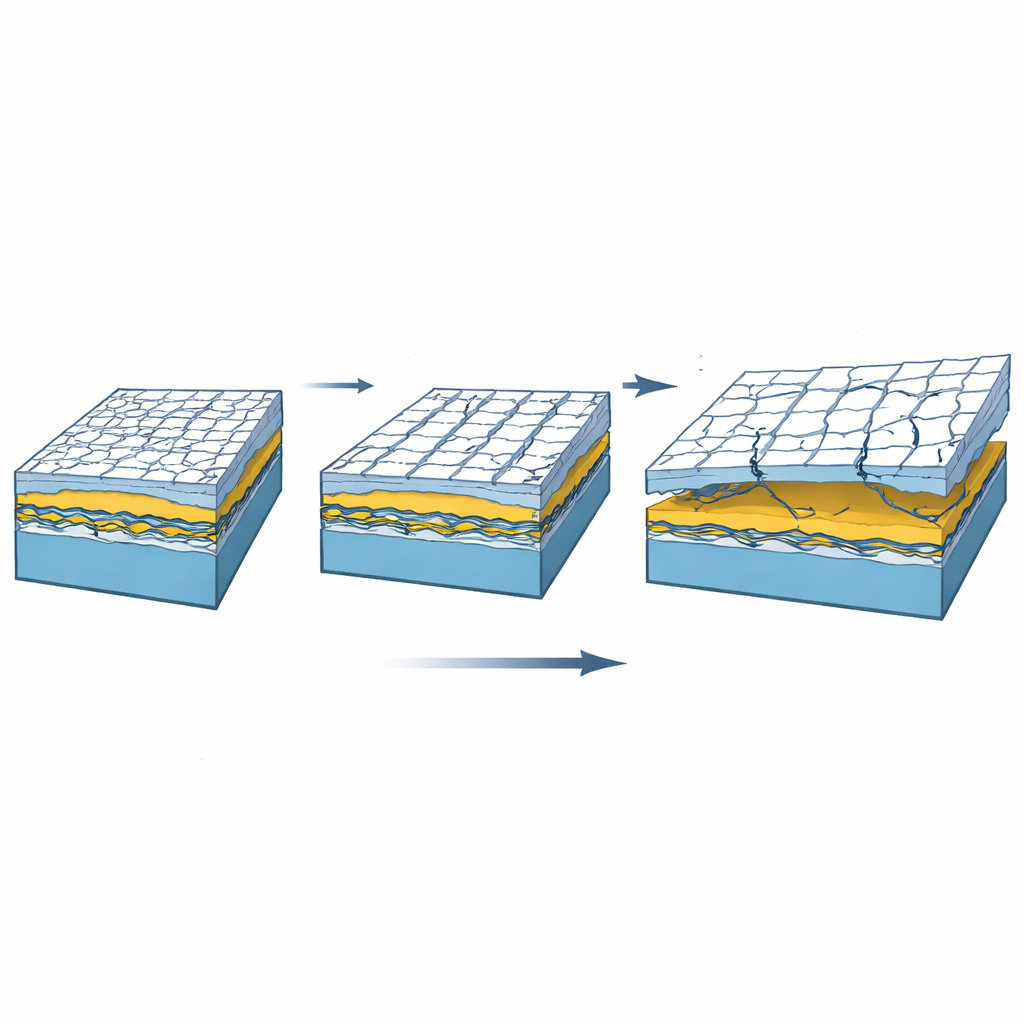
To escape this trade-off, the researchers designed what they call a three-dimensional super-interface between the rubber base and the conductive coating. Instead of a smooth, flat boundary, they sculpted the rubber surface with micro- and nano-scale bumps and valleys, then coated it with a water-based film containing two polymers and conductive fillers. This textured surface lets the coating physically anchor into the rubber, while chemical groups on both sides form many hydrogen bonds—weak individual links that collectively create a strong, flexible grip. The result is a thick, layered sensor in which a brittle, crack-forming top layer is tightly tied to a tougher, more elastic underlying layer and the soft rubber beneath.
Turning Cracks into a Useful Signal
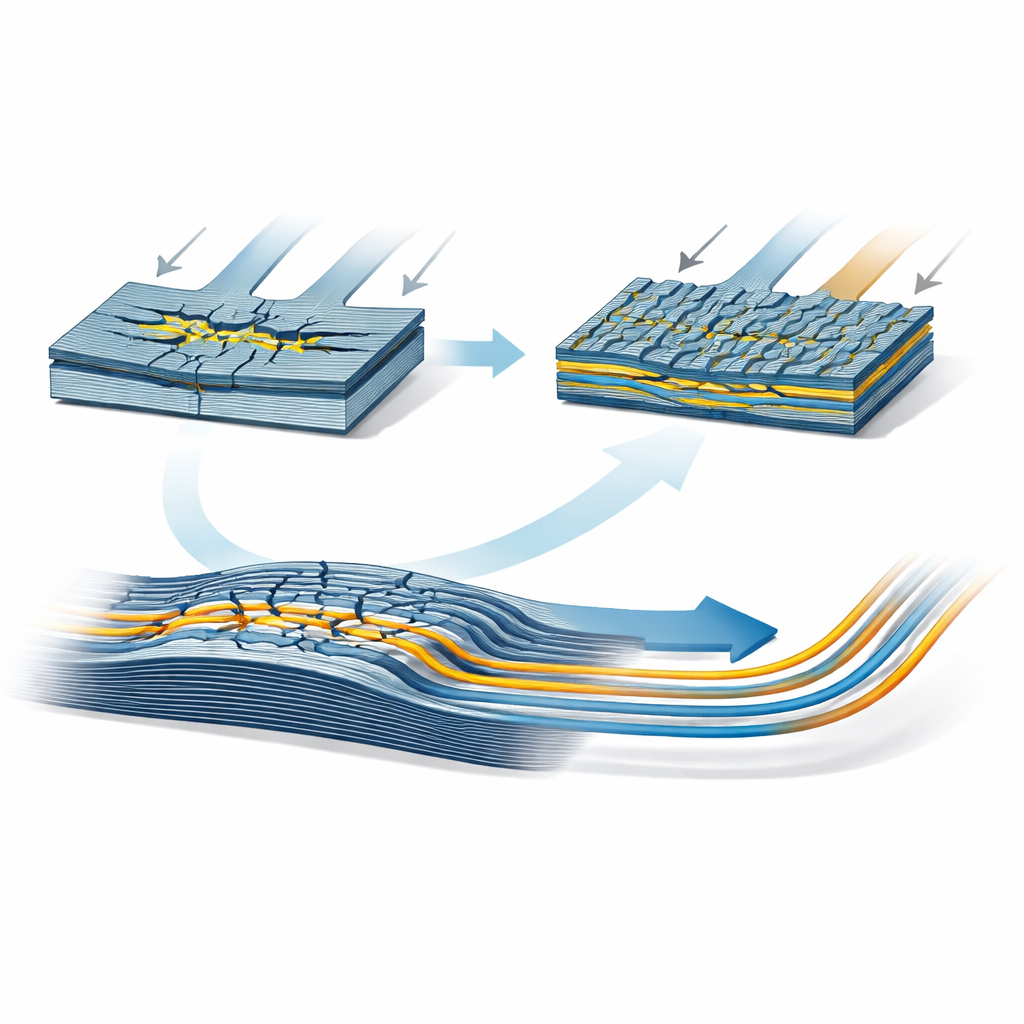
The key idea is to let the top conductive layer crack in a controlled way while the hidden layers quietly hold everything together. By tuning the mix of the two polymers in the coating, the team controlled how easily cracks form and how they line up. Stiff films formed a net-like crack pattern, while more balanced films produced neat, parallel cracks. Under small stretches—up to about 10 percent—these microcracks widen and deepen rapidly, causing enormous changes in resistance. In this range, the sensor reached a gauge factor (a standard measure of strain sensitivity) of about 1.1 × 10^8, hundreds to thousands of times higher than many advanced flexible sensors, yet with a nearly straight, predictable response. Beyond that, as the device is pulled further, the crack pattern has largely finished evolving, and the deeper, more flexible conductive layer takes over, keeping current flowing even past 100 percent stretch.
How the Inner Structure Keeps Working
Detailed imaging shows how the microcracks evolve from shallow lines to deeper gaps as strain increases, but they consistently stop at the super-interface instead of tearing through the whole thickness. Inside, silver nanowires in the brittle layer provide the huge response to tiny movements, while single-walled carbon nanotubes in the lower layer act as a safety net, forming stable conductive paths even when cracks above are wide open. Electrical tests under tiny strains (fractions of a percent) and repeated stretches over thousands of cycles show that the signals remain strong and stable. The sensor also shrugs off changes in temperature and humidity and continues to operate when bent, folded, or twisted, reflecting the resilience of the rubber base and the anchored interface.
From Human Motion to Safer Batteries
Because it can register both minute and large deformations, the new sensor performed well in demonstrations on the human body. When placed on the throat, it captured sharp signal spikes during swallowing; on the wrist, it tracked heartbeats that grew stronger and faster during exercise. Fixed to joints such as fingers, elbows, and knees, it reported vast, repeatable signal changes as the joints bent. The sensor’s ultra-sensitivity also pays off in less obvious settings: mounted on a silicon-anode battery pack, it detected tiny thickness increases of just a few percent during charging. A modest 2 percent expansion led to a 22-fold rise in resistance, clearly distinguishing normal operation from dangerous swelling long before a temperature rise would be apparent.
What This Means Going Forward
By reshaping and strengthening the interface between a stiff, crack-prone coating and a soft rubber base, the authors show that you do not have to choose between extreme sensitivity and wide, reliable stretch. Their three-dimensional super-interface turns cracks from a failure mode into a powerful sensing mechanism, while hidden conductive layers keep the signal alive even under severe deformation. For non-specialists, the bottom line is that this rubber-based sensor can feel incredibly small motions yet survive big stretches, making it a promising building block for future wearable health monitors, soft robots, and early-warning systems for batteries and other devices where subtle shape changes signal looming trouble.
Citation: Wang, X., Huang, Y., Wang, H. et al. A rubber-based sensor with over 100 million-level ultra-sensitivity (0–10% strain range) via 3D super-interface. Nat Commun 17, 3547 (2026). https://doi.org/10.1038/s41467-026-70434-y
Keywords: flexible strain sensor, wearable electronics, microcrack interface, battery safety, rubber-based sensor