Clear Sky Science · en
Geometry-programmed self-wrinkling in organo-hydrogels for anisotropic mechanics and adaptive sensing
Wrinkles That Make Soft Materials Smarter
From touchscreens you can wear to medical patches that listen to your heartbeat, tomorrow’s gadgets will need materials that are as soft and flexible as skin, yet tough and reliable. This paper shows how to make such soft materials stronger and more capable by letting them wrinkle themselves in a controlled way. Those tiny ridges and valleys, much like fingerprints or skin folds, give the material a built‑in sense of direction, turning simple gels into rugged, adaptable sensors that can feel stretch, sliding, and heat.
Why Soft Gels Need an Upgrade
Gel-based materials are already popular in flexible electronics and medical devices because they are soft, wet, and friendly to living tissue while conducting ions like salty water. But their very softness is a problem: traditional gels can tear easily, wear out under repeated bending, and do not always give rich, reliable signals when used as sensors. Researchers have tried to fix this by copying nature’s internal architectures, such as honeycomb bones or layered bamboo, which distribute stress and prevent cracks. Surface wrinkles inspired by skin and fingerprints have also been used to improve sensing, yet they usually require extra processing steps after the gel is made, and they only modify the top surface rather than the gel’s internal structure.
Letting Geometry Grow Its Own Wrinkles
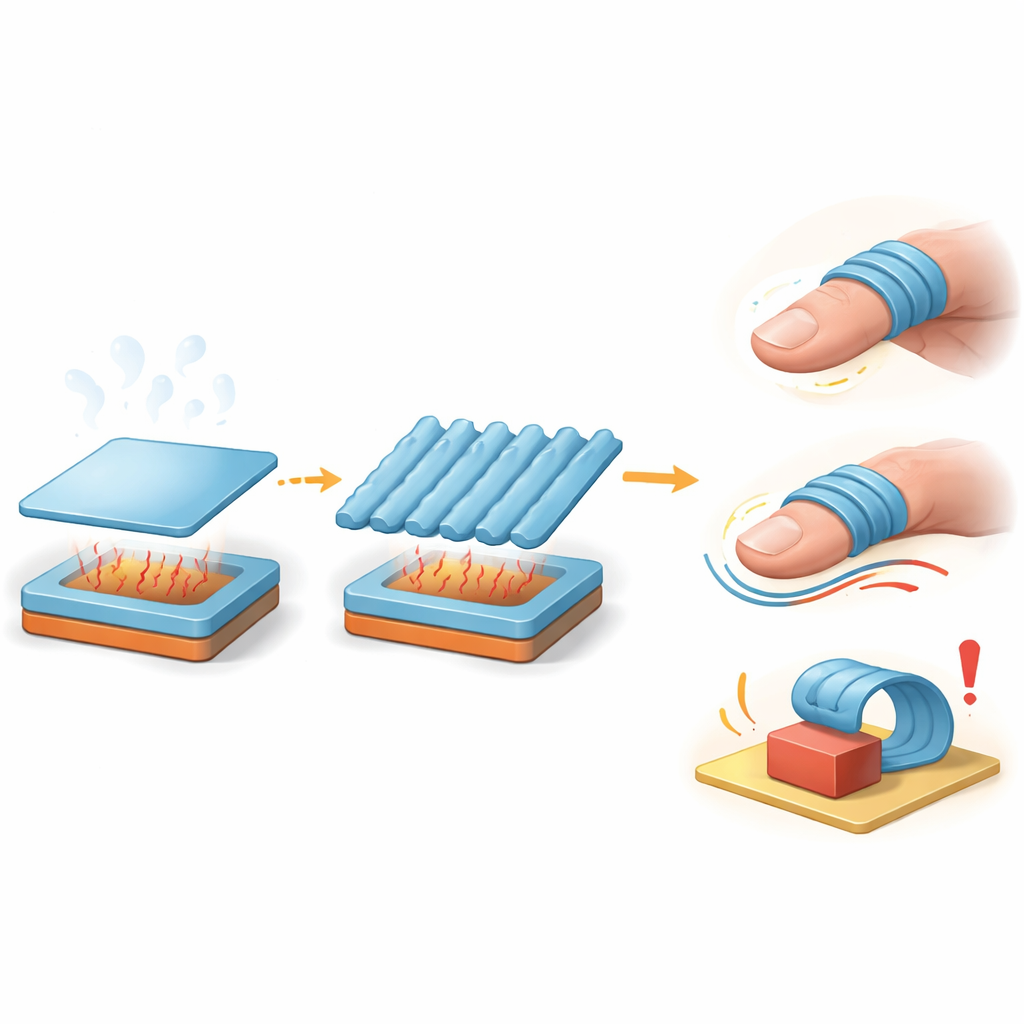
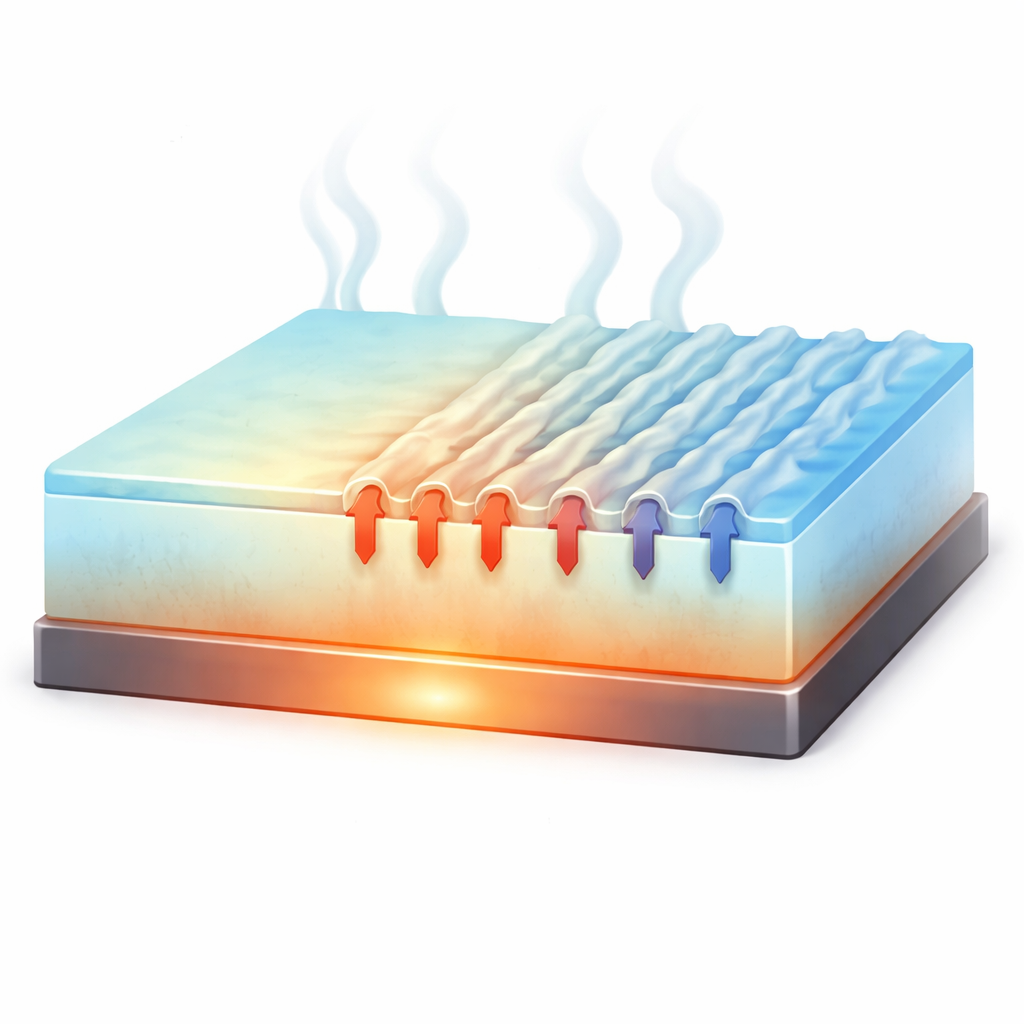
The authors introduce a “self-wrinkling” approach that happens while the material forms, instead of afterward. They start with a solution of a common polymer, poly(vinyl alcohol), mixed with water, glycerol, and tiny additives such as magnesium boride nanosheets. This liquid is poured into a shallow mold whose shape—rectangular, triangular, or circular—is carefully chosen. The bottom of the mold is heated while the top surface is exposed to air, so solvent slowly evaporates. As the top dries, it turns into a thin skin resting on a softer layer below. Because the bottom is warm and the top cools by evaporation, stresses build in the skin until it buckles into wrinkles. Remarkably, the overall mold shape guides how these wrinkles line up: in rectangles, for instance, they run along the short side, a behavior that agrees with recent theories for thin curved shells.
Tuning Size and Strength Through Ingredients
Once wrinkles appear, their size and height continue to evolve as drying and gelation proceed. By adjusting the amount of glycerol, the type of nano‑additives, the amount of starting solution, and even the mold shape, the team can tune both the wavelength (spacing) and amplitude (height) of the wrinkles. Measurements show that the wrinkled regions are not just reshaped—they are fundamentally re‑built at the microscopic level. Inside the ridges, the polymer chains are more tightly packed, more crystalline, and more strongly linked to the nanosheets than in flat regions or in gels made without wrinkles. When pulled along the wrinkle direction, these wrinkled organo‑hydrogels can stretch to over ten times their original length while withstanding very high stresses, placing them among the toughest gel materials reported. Pulling across the wrinkles, by contrast, leads to much lower strength, revealing a clear directional dependence in how the material deforms and breaks.
Wrinkles That Guide Electricity and Motion
The wrinkles also steer how ions move through the gel, which directly affects its electrical behavior. Conductivity is higher along the ridges than across them, and electrical measurements show that ions encounter less resistance when traveling in the wrinkle direction. X‑ray scattering confirms that the internal structure is more aligned along these ridges, creating straighter, better-connected pathways. This built‑in anisotropy—different behavior in different directions—turns the material into a versatile sensing platform. Flat pieces can track stretching or pressing; patterned pieces can tell which way a finger is sliding based on distinct resistance signals in different directions. The researchers even trained a simple neural network to read these patterns and turn thumb motions over a wrinkled pad into commands for a robotic arm.
From Rolling Strips to Heat Alarms
Because the wrinkled layer is stiffer than the underlying matrix, heating the material creates uneven internal stresses that make it bend and roll up like a scroll. By joining two wrinkled strips and activating this rolling, the team built a compact strain sensor where contact between inner ridges and the outer surface forms multiple conductive paths. Stretching gently separates these contacts in steps, producing stable, low‑hysteresis signals even after thousands of large stretching cycles. In another demonstration, a rolled strip carried a metal rod that closed an electrical circuit only when warmed to a certain temperature, acting as a simple heat alarm that needs no extra power source beyond the temperature change itself.
What This Means for Future Wearable Tech
In plain terms, the study shows how to “bake in” both reinforcement and directionality into soft, gel-like materials simply by choosing mold shapes and heating conditions, without complex machining or patterning. The resulting organo‑hydrogels are not only tougher but also know which way is which, responding differently to stretch, sliding, and heat depending on direction. This geometry-programmed self-wrinkling strategy could help engineers design the next generation of wearable sensors, soft robots, and biointerfaces that are more durable, more informative, and easier to manufacture at scale.
Citation: Qi, H., Yang, H., Li, T. et al. Geometry-programmed self-wrinkling in organo-hydrogels for anisotropic mechanics and adaptive sensing. Nat Commun 17, 3773 (2026). https://doi.org/10.1038/s41467-026-70433-z
Keywords: self-wrinkling hydrogels, flexible sensors, anisotropic mechanics, ionic conductive gels, soft robotics materials