Clear Sky Science · en
Reversible On/Off Switching of Ferroelectricity in a Molecular FeCo Prussian Blue Analogue with Multiple Control
Smart materials for future memory
Imagine a tiny crystal that can remember whether it is "on" or "off" without any power, and can be reset simply by shining light on it, changing its temperature, or adding and removing a simple solvent such as alcohol. This article reports such a molecular material. It shows how a specially designed iron–cobalt crystal can have its internal electric alignment, or polarization, turned on and off in several different ways, opening doors to contactless, low‑energy memory and sensor technologies.
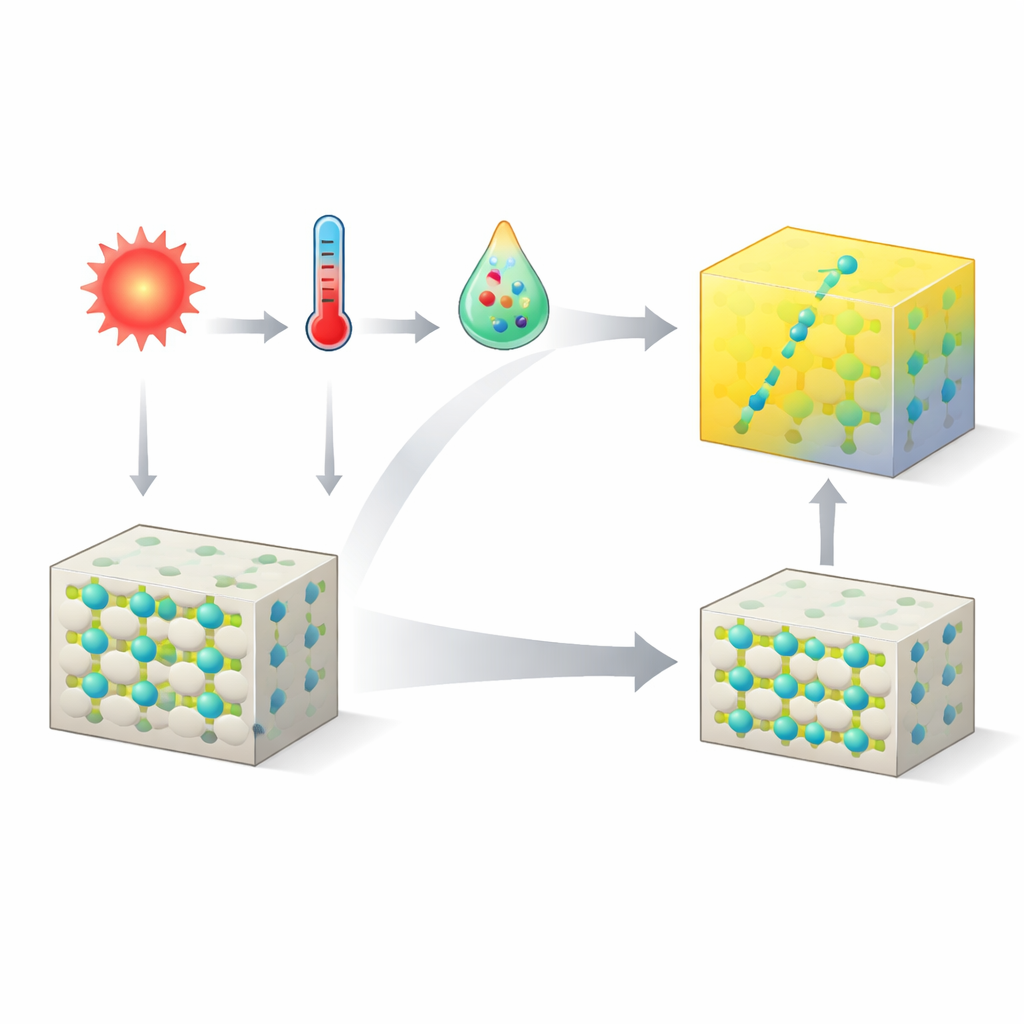
A crystal that acts like a tiny switch
The researchers study a molecular solid built from three metal centers—two iron atoms and one cobalt atom—linked by cyanide bridges and surrounded by organic ligands, water, and ethanol molecules. This family of compounds, known as Prussian blue analogues, is famous for being able to rearrange electrons between different metal sites. In the new compound, called 1, that internal electron shuffle is carefully directed so that it changes the overall electric polarity of the crystal. At low temperature the electrons sit in one pattern, making the crystal polar ("ferroelectric on"); at higher temperature they rearrange, the polarity cancels out, and the crystal becomes non‑polar ("off").
Light, cooling speed, and guest molecules as controls
Unlike traditional ferroelectrics, which are mainly switched by an applied electric field, this material offers several independent control knobs. Heating and cooling drive a reversible change between low‑temperature polar and high‑temperature non‑polar phases. If the crystal is rapidly cooled from high temperature, it can be trapped in a long‑lived non‑polar "metastable" state that normally only exists when it is hot. Red light irradiation at very low temperature also pushes electrons into the non‑polar arrangement, again turning the polarization off. By changing the cooling rate or using light, the team can choose whether the crystal ends up polar or non‑polar at the same low temperature.
How alcohol molecules help steer the change
A key surprise is the central role of ordinary ethanol molecules inside the lattice. In compound 1, ethanol forms hydrogen bonds to parts of the iron–cobalt framework and can reorient between more ordered and more disordered arrangements as temperature changes. Detailed X‑ray studies show that when electrons move between iron and cobalt, the ethanol molecules rotate in a preferred direction, helping to stabilize the polar structure. When the researchers gently heat the crystals to drive out ethanol, they obtain a new phase, 1', that keeps water but loses alcohol. This new crystal still shows an internal electron rearrangement with temperature, but now it remains non‑polar throughout: the electric alignment no longer switches on. Re‑exposing 1' to ethanol vapor restores the original compound and its ferroelectric behavior, giving a true on/off control of polarization through guest absorption and desorption.
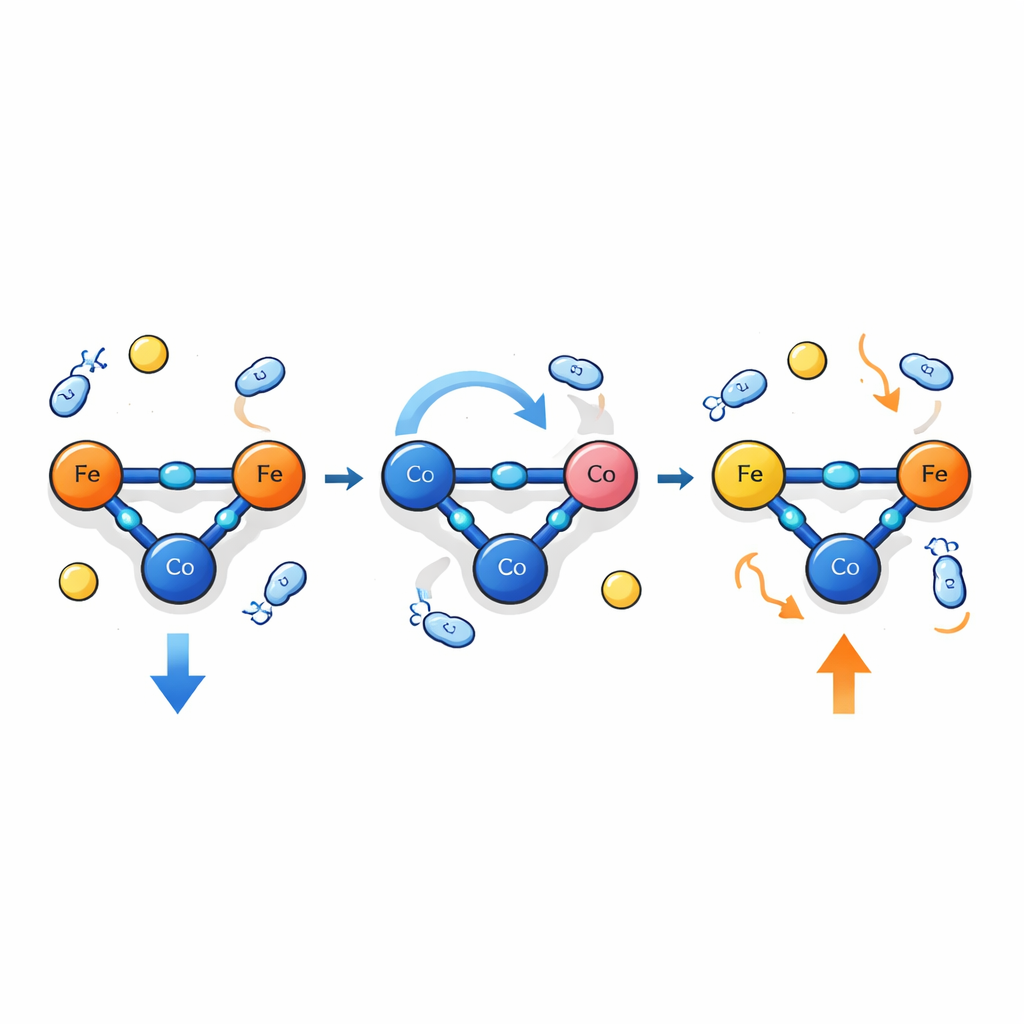
Watching electrons and spins move
To unravel these effects, the team combined multiple measurements. Magnetic susceptibility reveals how the unpaired electrons—and thus the magnetic "spins"—on iron and cobalt change with temperature, confirming the coupled electron and spin rearrangement. Infrared spectroscopy tracks shifts in cyanide bond vibrations that signal different charge states. Second‑harmonic generation, a nonlinear optical effect that only occurs in non‑centrosymmetric (polar) structures, switches on in the low‑temperature phase, proving that the crystal symmetry changes when polarization appears. Pyroelectric measurements on single crystals and pellets directly record current bursts when the material crosses between polar and non‑polar states, and show that the direction of polarization can be reversed by an electric field, satisfying the definition of a ferroelectric.
Many stable states in one tiny framework
Taken together, these experiments reveal an unusually rich energy landscape. The iron–cobalt framework with ethanol can occupy six distinct, long‑lived states: high‑ and low‑temperature phases with ethanol present, corresponding light‑ or cooling‑induced metastable non‑polar states at low temperature, and high‑ and low‑temperature phases after ethanol removal. Each state has its own pattern of electron distribution, spin configuration, and crystal symmetry. Theoretical calculations show that the main contribution to the polarization change comes from the directional motion of charge between metal centers, with smaller but important help from ethanol rotation.
What this means for everyday technology
For non‑specialists, the core message is that the authors have built a molecular crystal whose electric memory can be written and erased not only by electric fields but also by light, temperature, cooling rate, and vapor exposure. Because the ferroelectric behavior can be switched fully off by removing guest molecules and then restored, such materials could help tackle fatigue—the gradual loss of performance that plagues conventional ferroelectric memories. The work suggests a design strategy in which internal electron transfer and mobile guest molecules are combined to engineer crystals with many controllable, non‑volatile states, pointing toward future solid‑state devices that are reconfigurable, contactless, and extremely energy efficient.
Citation: Huang, YB., Su, SQ., Xu, WH. et al. Reversible On/Off Switching of Ferroelectricity in a Molecular FeCo Prussian Blue Analogue with Multiple Control. Nat Commun 17, 3609 (2026). https://doi.org/10.1038/s41467-026-70427-x
Keywords: ferroelectric memory, Prussian blue analogue, electron transfer, photoresponsive materials, guest molecule switching