Clear Sky Science · en
Superior resilience to poisoning and amenability to unlearning in quantum machine learning
Why cleaning up bad data matters for AI
Modern artificial intelligence systems learn from massive collections of examples, but those examples are often imperfect. Some are mislabeled by accident, others may be tampered with on purpose. Once such “poisoned” data slips into training, it can quietly bend a model’s behavior in harmful ways. This article asks a surprising question: if we build learning systems out of quantum computers instead of classical ones, do they react differently to bad data—and can they more easily forget it when needed?
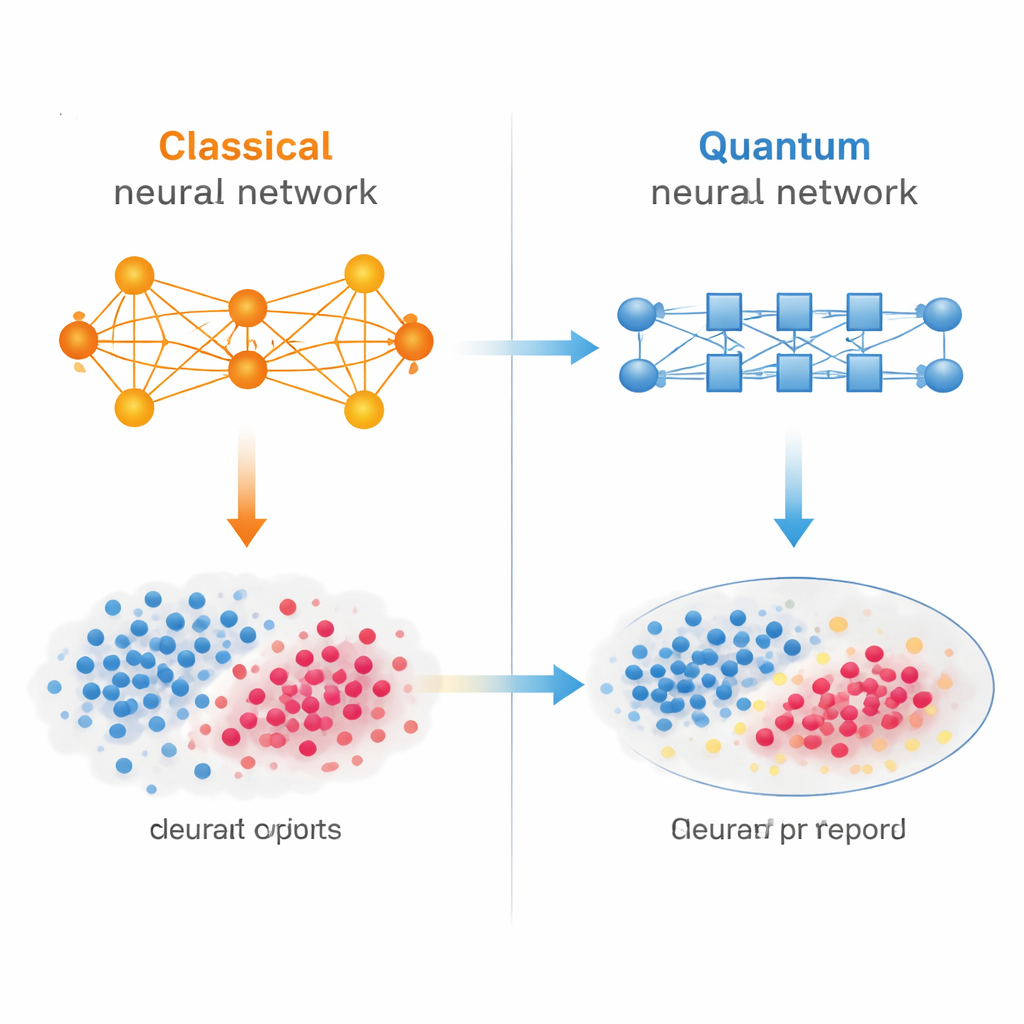
Two ways of learning from messy information
The authors compare two kinds of neural networks trained on the same tasks. One is a familiar classical network, a stack of weighted connections running on an ordinary computer. The other is a quantum neural network that uses qubits and quantum gates to process information in superposition. Both are asked to solve two kinds of classification problems: telling apart handwritten digits in the MNIST dataset and distinguishing between two phases of matter in a quantum physics model. In each case, the researchers deliberately contaminate part of the training data, either by flipping the labels on some examples or by replacing the input features with random noise, then observe how each model copes.
When labels lie, quantum models hold their ground
The starkest difference appears when labels are flipped. The classical network tries to satisfy every training example, including the contradictory ones, and gradually twists its internal decision boundary to fit them. Its performance on new, unseen data steadily decays as more labels are corrupted. By contrast, the quantum network shows a robust plateau: over a wide range of noise levels, it continues to classify clean validation data well, effectively ignoring mislabeled outliers. Only when the corrupted labels become dominant—around the point where half the labels are wrong—does its performance suddenly collapse, in a sharp, phase transition–like change. This behavior suggests that the quantum learner favors the simplest, most coherent pattern in the data and treats scattered contradictions as irrelevant disturbances until they overwhelm the true signal.
Forgetting bad training is easier for quantum models
Beyond withstanding corruption, the authors study “machine unlearning”: how efficiently a trained model can be forced to forget the influence of bad data without starting from scratch. They explore several strategies, such as retraining on only the clean portion of the data, fine-tuning from the poisoned model, explicitly pushing the model’s predictions away from what it learned on the bad subset, and using gradient steps that undo the effect of those examples. For the classical network, all efficient approximate methods lag behind full retraining, indicating that its internal representation has hardened around the poisoned samples. The quantum network behaves differently. Starting even from a poisoned state, it can be steered by approximate unlearning methods to match or surpass the performance of an expensive retrain within the same time window. This shows that its learned representation is more plastic—structured enough to be useful, yet flexible enough to be corrected.
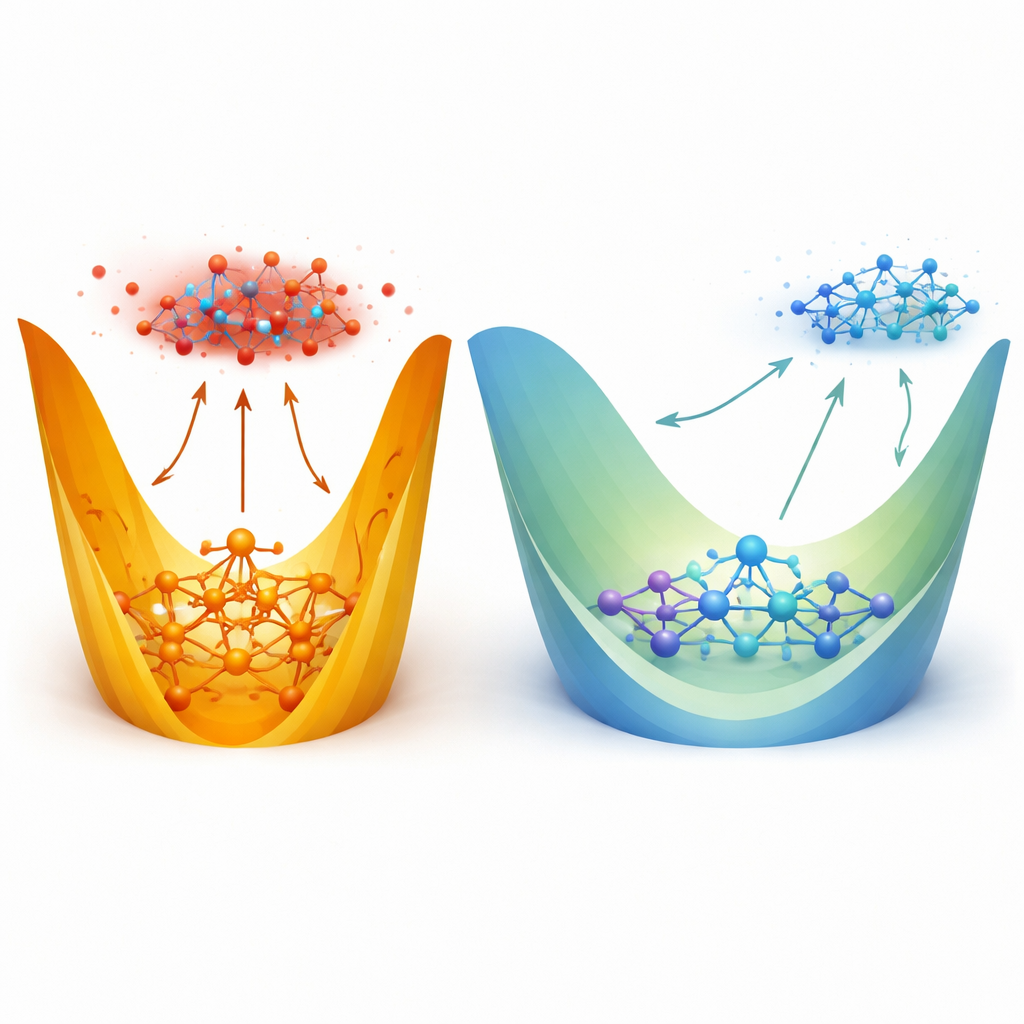
The hidden landscape behind resilience and plasticity
To explain these contrasting behaviors, the authors look at the “loss landscape,” a high-dimensional surface that measures how well the model fits the data at each setting of its parameters. Good generalization is known to be linked to broad, flat valleys in this landscape, while brittle overfitting often corresponds to sharp, narrow minima. By analyzing how the curvature of this landscape changes when data are poisoned, they find that classical networks undergo a dramatic roughening: a once-flat region around the solution becomes extremely sharp as the model memorizes mislabeled points. Escaping this steep valley during unlearning is difficult, which explains the stubbornness of classical memories. Quantum networks, on the other hand, maintain nearly the same gentle curvature even after poisoning. Their landscapes are structurally stable, bounded by the mathematics of quantum operations, which prevents the formation of extremely sharp minima and naturally steers learning toward smooth, generalizable solutions.
What this means for future trustworthy AI
To a non-specialist, the takeaway is that quantum machine learning is not just about speed or exotic hardware. In these experiments, quantum models act more like careful editors than obsessive scribes: they pick out the main storyline in messy data, resist being swayed by a few bad examples, and can be coaxed into forgetting harmful influences without being rebuilt from scratch. This combination of resilience to poisoning and readiness to unlearn suggests a new kind of quantum advantage—one rooted in reliability and safety rather than raw computation alone—hinting that future quantum-enhanced AI systems could be better partners in a noisy, ever-changing information landscape.
Citation: Chen, YQ., Zhang, SX. Superior resilience to poisoning and amenability to unlearning in quantum machine learning. Nat Commun 17, 3716 (2026). https://doi.org/10.1038/s41467-026-70420-4
Keywords: quantum machine learning, data poisoning, machine unlearning, robust AI, loss landscape