Clear Sky Science · en
Unveiling the thermodynamic-kinetic trade-off effect on acid sites in zeolite-catalyzed alcohol dehydration
Turning Plant Alcohol into Useful Gases
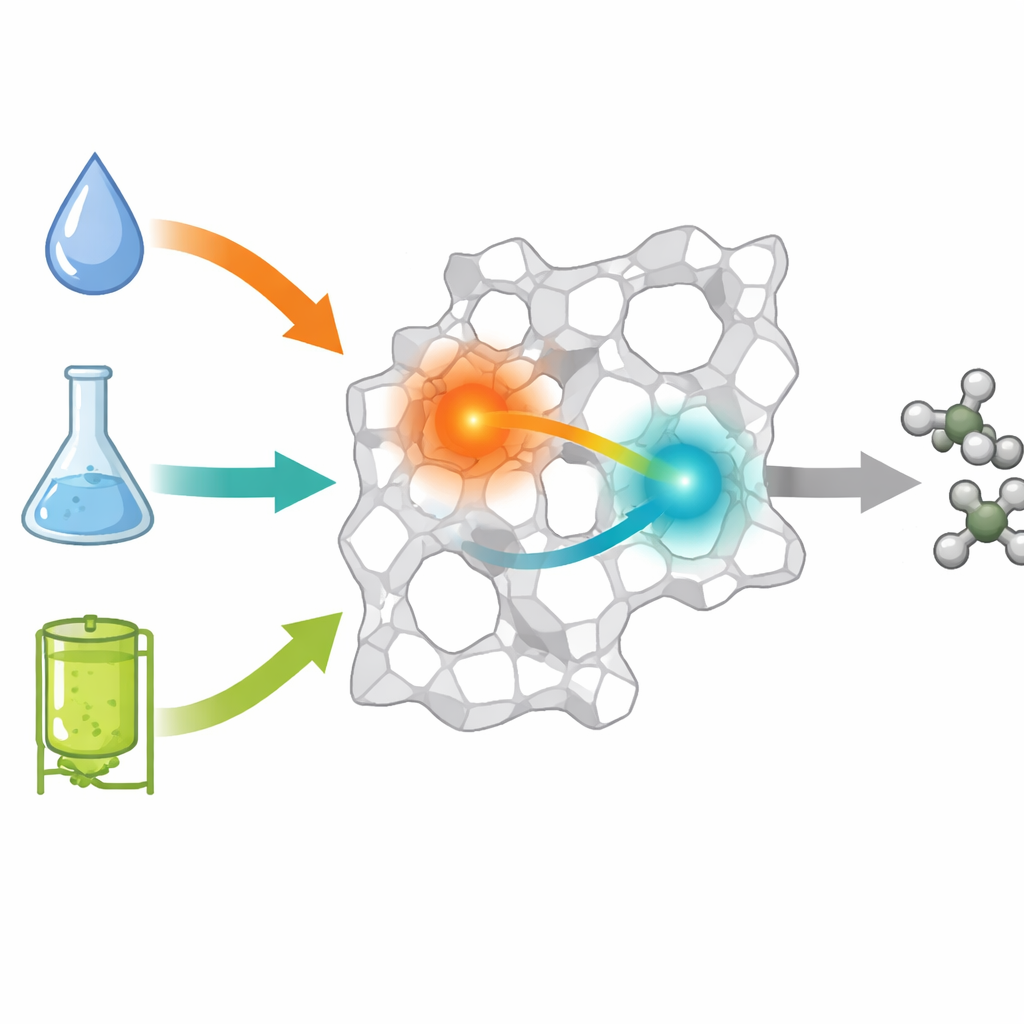
Many plans for a cleaner chemical industry rely on making everyday products from renewable alcohols like ethanol, instead of from crude oil. One promising route is to turn ethanol into ethylene, a basic building block for plastics and other materials. Zeolite minerals are already powerful catalysts for this change, but scientists still struggle to control exactly how they work. This study peeks inside zeolites at the atomic level and shows why two different types of internal “hot spots” each help and hinder the reaction in different ways.
Why Tiny Mineral Cages Matter
Alcohols such as ethanol can be made from coal, natural gas, or biomass, and converting them into ethylene could cut dependence on petroleum. Zeolites are porous crystals whose internal channels act as tiny chemical factories. Inside these channels sit special acidic sites that do the heavy lifting during reactions. One type, called Brønsted sites, behaves somewhat like classic acids that donate a proton. The other type, Lewis sites, behaves more like electron-hungry metal centers. In real industrial catalysts these two kinds of sites usually coexist, making it hard to disentangle which one is doing what and how to tune them for cleaner, more selective chemistry.
Two Kinds of Hot Spots, Two Kinds of Help
The researchers prepared a family of ZSM-5 zeolites where they could dial the balance between Brønsted-rich, Lewis-rich, and mixed materials. Using advanced solid-state NMR and other spectroscopies, they directly observed short-lived surface species formed when ethanol meets these acid sites. On Brønsted sites, ethanol forms “surface ethoxy species,” which then shed hydrogen to make ethylene. On Lewis sites, ethanol binds in a slightly different manner as “chemisorbed ethanol” species. Both pathways involve two main stages: first, breaking the alcohol’s OH bond to form an activated surface species, and second, removing a hydrogen from the carbon backbone to release ethylene.
A Built-In Trade-Off Between Ease and Speed
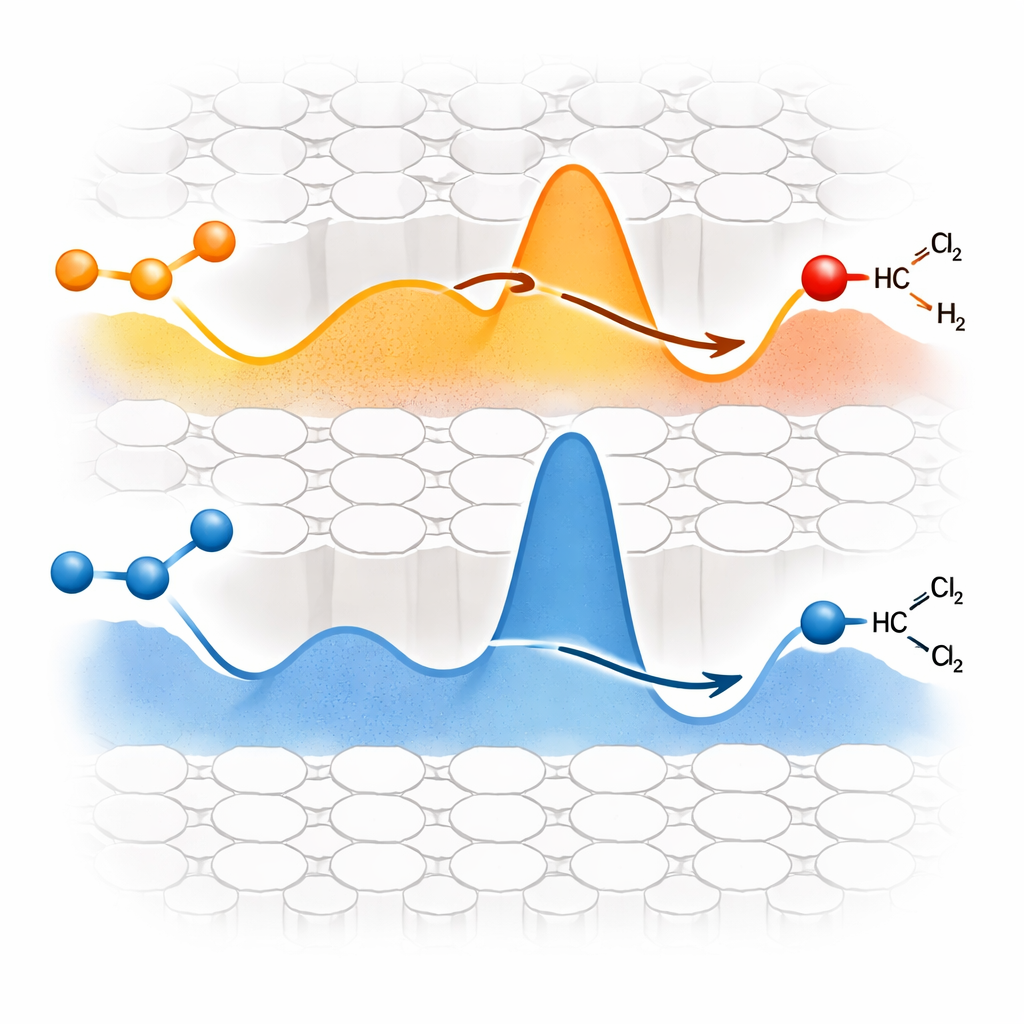
By following these species as temperature increased, the team uncovered a thermodynamic–kinetic trade-off between the two site types. Lewis sites grab ethanol easily even at room temperature, stabilizing chemisorbed ethanol very strongly. That makes the first step—activating the OH group—energetically favorable. However, because the bound intermediate is so stable, the second step, in which it must give up hydrogen to release ethylene, requires a large energy push and happens only at higher temperatures and more slowly. Brønsted sites behave in the opposite way. They need more heat to form ethoxy species in the first place, but once formed these intermediates transform into ethylene relatively easily, with a lower energy barrier for the second step. This “easy first step, hard second step” versus “hard first step, easy second step” contrast is the heart of the trade-off.
Matching Theory with Real-World Performance
Computer simulations using density functional theory mapped the full energy landscape of both pathways and closely matched the experimental observations. They showed that stronger bonding of ethanol to Lewis sites goes hand in hand with higher barriers for the final hydrogen-removal step. Brønsted sites, though less welcoming at first, offer smoother passage to ethylene once the intermediate forms. Kinetic measurements on Brønsted-heavy and Lewis-heavy zeolites confirmed the predicted activation energies. Interestingly, the same pattern shows up when isopropanol is dehydrated to propene, suggesting that this trade-off is a general feature of alcohol dehydration on zeolites, not a peculiarity of ethanol alone.
Designing Smarter Catalysts from This Balance
For a layperson, the core message is that not all “acid spots” inside a zeolite help a reaction in the same way. One type makes it very easy for alcohol molecules to stick and start reacting but slows down the final release of useful product. The other type is harder to get started but lets the reaction finish more quickly once underway. By recognizing this built-in give-and-take, catalyst designers can aim for a carefully balanced mix of Brønsted and Lewis sites that optimizes both stages of the reaction. This insight offers a roadmap for creating more efficient, selective, and longer-lived catalysts for turning renewable alcohols into key chemical building blocks.
Citation: Hu, M., Chu, Y., Wang, C. et al. Unveiling the thermodynamic-kinetic trade-off effect on acid sites in zeolite-catalyzed alcohol dehydration. Nat Commun 17, 3675 (2026). https://doi.org/10.1038/s41467-026-70418-y
Keywords: zeolite catalysis, ethanol dehydration, acid sites, ethylene production, solid-state NMR